
Inventory cycle counting is a perpetual, focused audit that keeps your on-hand records accurate without shutting the warehouse down. Start this week by publishing an ABC schedule for your A-items and assigning a daily counter to work through the list.
TL;DR:
- Cycle counting replaces disruptive wall-to-wall physical inventories with continuous, subset-based audits that protect Inventory Record Accuracy (IRA) every day.
- A well-run program reduces shrinkage, cuts carrying costs, and eliminates the surprise adjustments that derail year-end reconciliations.
- The Pareto Principle (ABC analysis) is the fastest way to prioritize which SKUs to count first and how often.
- Availzyemachinistpro's Tool Crib and Job Tracker features map directly to cycle count workflows, giving shop teams a ready-made audit trail without building one from scratch.
Immediate next step: Rank your SKUs by annual dollar usage, assign the highest-value SKUs to Class A, and schedule a daily counter to work through that list starting Monday.
Table of Contents
- What is inventory cycle counting and how does it differ from a full physical count?
- Why cycle counting pays for itself: the business case
- Which cycle counting methods should you use?
- How to run a cycle count: a step-by-step SOP
- How often should you count each SKU class?
- KPIs that tell you whether your program is working
- Tools and automation that cut reconciliation time
- Common cycle counting problems and how to fix the root causes
- Sample cycle count policy and on-floor checklist
- Key Takeaways
- Cycle counting as a continuous improvement engine
- Availzyemachinistpro makes cycle counting practical for machining shops
- Useful sources for further reading
What is inventory cycle counting and how does it differ from a full physical count?
Cycle counting is a perpetual auditing procedure that verifies inventory records by counting small, specific subsets of stock on a regular basis instead of performing an annual wall-to-wall physical count. The warehouse keeps running. Transactions keep flowing. A counter works through a daily list, reconciles what they find, and logs any variance before the shift ends.
A full physical inventory freezes operations. Every SKU, every location, every bin gets counted in a single event, usually overnight or over a weekend. That approach made sense when inventory systems were paper-based. Today, it introduces its own errors: rushed counters, tired staff, and a snapshot that is already stale by the time the books close.
Cycle counting is not just a lighter version of a physical count — it is a fundamentally different philosophy. A physical count tells you what you had on one night. Cycle counting tells you whether your processes are working every single day. The goal, done right, is to make a full physical count unnecessary.
That said, there are situations where a full physical count still belongs in the calendar. An initial baseline before launching a cycle program, a tax-year audit requiring a certified count, or a post-acquisition reconciliation all justify stopping the floor. Once your IRA consistently exceeds 95%, those events become rare.
For multi-location warehouses, multi-bin SKUs, and serialized stock, cycle counting requires tighter location discipline. The count list must specify not just the part number but the exact bin address. A counter directed to location A3-07 who finds the bin empty needs to know whether the stock moved to A3-09 or was consumed. Without that specificity, adjustments write off inventory that is simply misplaced.
Why cycle counting pays for itself: the business case
Cycle counting reduces operational downtime compared with full physical inventories and helps detect discrepancies earlier, improving fill rates and reducing carrying costs. Those are the headline benefits. The table below maps each benefit to the KPI it moves, so you can build a quick business case with your own numbers.
| Benefit | Measurable KPI | Who Cares |
|---|---|---|
| Continuous IRA improvement | Inventory Record Accuracy % | Operations, Finance |
| Earlier shrinkage detection | Shrinkage rate ($ and %) | Finance, Loss Prevention |
| Fewer stockouts | Order fill rate % | Sales, Customer Service |
| Lower safety stock requirements | Carrying cost ($) | Procurement, Finance |
| Smaller year-end adjustments | Reconciliation variance ($) | Finance, Auditors |
| Faster root-cause identification | Count variance rate by SKU | Operations, Quality |
The procurement angle is underappreciated. When IRA is unreliable, buyers pad safety stock to compensate. Fix the accuracy, and that buffer shrinks. For a warehouse carrying $2 million in inventory at a 25% annual carrying cost, a 10-point IRA improvement can translate to a meaningful reduction in excess stock, even before you account for fewer emergency buys and expedited freight charges.
Finance benefits too. Year-end adjustments that used to run into six figures compress when variances are caught and corrected monthly rather than discovered in December.
Which cycle counting methods should you use?
Five primary methods cover most warehouse environments: ABC Analysis (Pareto), Random Sample, Control Group, Geographic/Location-Based, and Opportunity-Based counting. No single method fits every operation, and most mature programs use a hybrid.

| Method | Best-Fit Environment | Pros | Cons | Typical Cadence |
|---|---|---|---|---|
| ABC (Pareto) | Most warehouses with varied SKU value/velocity | Focuses effort on highest-risk items | Low-value items may be neglected | A: weekly/monthly; B: monthly/quarterly; C: quarterly/annually |
| Random Sample | Stable, homogeneous SKU sets | Statistically unbiased | Misses high-risk items without weighting | Weekly or monthly |
| Control Group | Any program needing process validation | Isolates counting errors from process errors | Small sample; not a full accuracy measure | Weekly (same SKUs each time) |
| Geographic/Location-Based | Simple warehouses, zone-based layouts | Easy to plan; no system required | Ignores value and velocity | Rotating zone sweep |
| Opportunity-Based | High-throughput receiving/putaway operations | Catches errors at the source | Reactive; coverage depends on activity | Event-triggered |
ABC analysis is the right starting point for most operations. It concentrates counting effort where inventory value and velocity are highest, which is exactly where a variance costs the most. The hybrid [cost × usage] approach, where you weight both dollar value and movement frequency, handles the ABC method's main weakness: a $0.03 fastener that stops an assembly line if it runs out deserves more attention than its unit cost suggests.
Opportunity-based counts trigger during inventory events like receiving, putaway, and replenishment. They work well as an exceptions-based layer on top of a scheduled ABC program, catching errors at the moment they are most likely to occur.
Control group counting repeatedly measures a small, stable set of SKUs to test counting technique and reveal process errors quickly. If the same SKUs keep showing variances, the problem is upstream, not the counter.
Pro Tip: Start with ABC for your primary schedule, layer in opportunity-based counts at receiving, and run a small control group of 20–30 stable SKUs weekly. The control group will tell you within two weeks whether your variances come from counting technique or from process failures like receiving lag and mislabeling.
How to run a cycle count: a step-by-step SOP
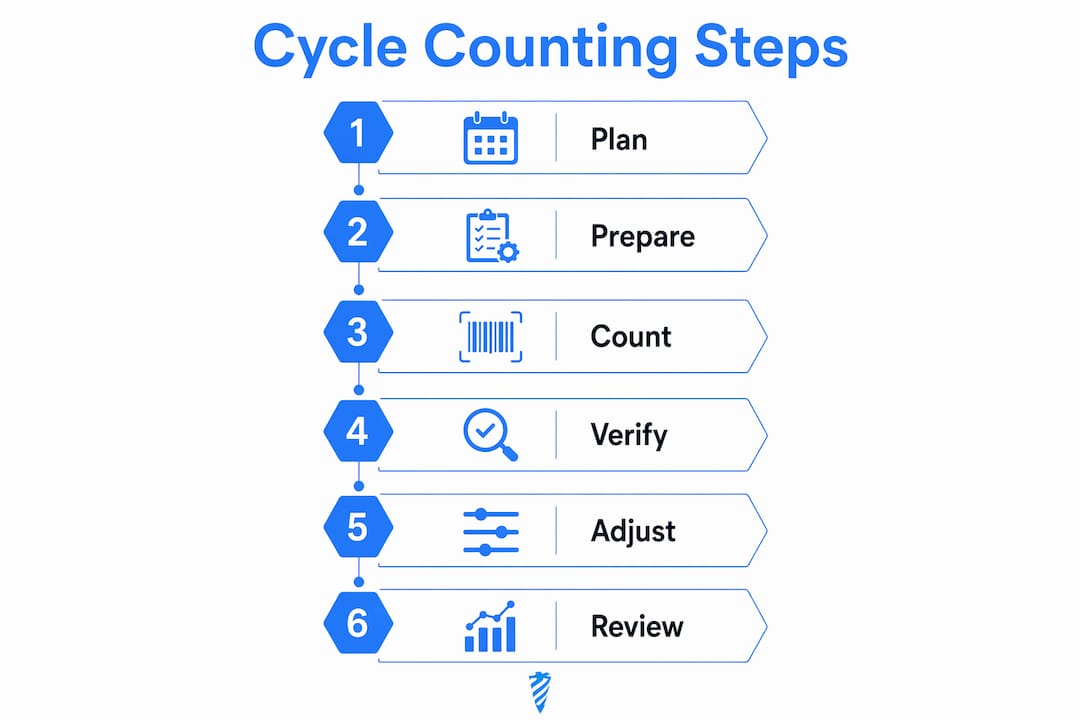
A reliable cycle count follows five phases. The detail below is written to be dropped into an operations manual with minimal editing.
Roles
- Counter: Physically counts and records quantities; must be trained and tested before working independently.
- Verifier/Supervisor: Spot-checks counts, approves recounts, and signs off on the daily count sheet.
- Reconciling Analyst: Compares count results to system records, posts adjustments with reason codes, and flags variances above threshold for investigation.
The five-phase sequence
-
Prepare. Generate the count list from your WMS or spreadsheet the evening before. Print or push to mobile devices. For manual environments, place a "Product Being Cycle Counted" label on each bin and attach a transaction card to log any movements during the count. This prevents count contamination when stock moves while the counter is working.
-
Issue the count list (blind count preferred). Give counters a list of locations, not expected quantities. A blind count removes the temptation to confirm rather than count. If your system cannot suppress quantities, use a paper list with quantities covered.
-
Count and record. Counters record what they physically find at each location. They note the bin address, part number, unit of measure, and quantity. Any discrepancy between the bin label and the physical stock gets flagged immediately, not adjusted on the spot.
-
Verify. The supervisor spot-checks a percentage of completed counts before the counter leaves the floor. Any location with a variance above your threshold (typically ±2% or ±$500, whichever is lower) gets a recount by a second counter before the shift ends.
-
Reconcile and post adjustments. Use delta-only reporting: record the difference between expected and actual, not the absolute count. This keeps adjustments valid even if transactions post after the count was taken. Attach a reason code to every adjustment (receiving error, mispick, labeling error, theft, UOM error, unknown). Post to the system within 24 hours.
Pro Tip: In non-RF environments, the biggest source of count contamination is a transaction that posts while the count is in progress. The transaction card on the bin solves this: any movement during the count gets logged on the card, and the reconciling analyst adds or subtracts it before posting the adjustment.
How often should you count each SKU class?
Practical ABC frequency guidance: A-items more frequently, B-items at moderate intervals, and C-items less frequently, depending on risk and value. Those ranges are starting points. Your actual cadence depends on SKU count, staffing, and throughput.
To calculate your daily workload, divide total annual counts required by 250 working days:
- A-items counted frequently enough to require several counts per day
- B-items counted at moderate intervals
- C-items counted less frequently requiring fewer daily counts
That totals 48 counts per day for a mid-size warehouse. One trained counter can typically complete 40–60 location counts per shift, depending on bin density and travel time. If the math exceeds your staffing, reduce C-item frequency before cutting A-items.
Consistency matters more than ambition. A modest, steady schedule that staff follow reliably beats an aggressive one that gets skipped when the dock gets busy. Build the count into the daily shift routine, not as an add-on task.
Re-rank your ABC classifications quarterly, or immediately after a major product launch, seasonal shift, or supplier change. A SKU that was a C-item in January can become an A-item by March if a new contract drives volume.
KPIs that tell you whether your program is working
Track these six metrics. Report them at three cadences: daily on the floor, weekly in ops review, and monthly in a root-cause session with procurement and finance.
- Inventory Record Accuracy (IRA %):
(Locations counted accurately ÷ Total locations counted) × 100. Target: 95% minimum; world-class programs run at 98–99%. Calculate per SKU class and by location zone, not just as a single warehouse number. - Count variance rate:
(Locations with variance ÷ Total locations counted) × 100. Tracks how often counts disagree with the system, regardless of dollar value. - Count hit rate:
(Counts completed on schedule ÷ Counts scheduled) × 100. A hit rate below 90% signals a staffing or scheduling problem, not an accuracy problem. - Time per count: Average minutes from list generation to posted adjustment. Useful for capacity planning and spotting process bottlenecks.
- Shrinkage rate:
(Unexplained inventory loss ÷ Total inventory value) × 100. Cycle counting should drive this down over time; a flat or rising shrinkage rate after six months of counting points to a process or security gap. - Reconciliation lag time: Hours between physical count and posted adjustment. Keep this under 24 hours. Lag beyond that introduces transaction noise that makes root-cause analysis harder.
Escalation thresholds: Any single variance exceeding ±2% of location value, or any SKU showing a variance in three consecutive counts, triggers a mandatory root-cause investigation before the next scheduled count.
Suggested KPI report columns: Date | SKU | Location | Class | Expected Qty | Counted Qty | Variance Qty | Variance % | Reason Code | Investigator | Resolution Date.
Tools and automation that cut reconciliation time
Technology matters here. Tech-supported cycle counting programs can improve accuracy from roughly 72% to 99.4% and reduce shrinkage from 17% to 1.7%, according to data cited by Shopify from IJSRA research. These figures highlight the substantial benefit that technology brings: programs see inventory accuracy approach 99.4% and shrinkage drops to about 1.7% when tech is implemented, versus roughly 72% accuracy and 17% shrinkage for manual approaches. That gap between manual and technology-assisted programs is large enough to justify almost any reasonable investment in scanning hardware.

The technology stack does not need to be expensive to be effective and may include handheld scanners, mobile apps, software integrations, and CSV import workflows to improve inventory accuracy.
Availzyemachinistpro's Tool Crib maps directly to these workflows. It handles check-in/check-out logging, low-stock alerts, tool life tracking, and CSV imports, giving machining shops a structured inventory record that supports cycle count reconciliation without a separate WMS. The Job Tracker ties work orders to tool consumption, so variances between expected and actual tool usage surface automatically rather than waiting for a scheduled count.
For shops starting with limited tech, a low-tech hybrid works well: paper count sheets, a barcode scanner for bin confirmation, and a CSV import into Availzyemachinistpro for reconciliation. That setup can be running in a day.
Predictive alert systems, like those used in industrial monitoring workflows, complement opportunity-based counts by triggering a count when stock levels drop to a reorder threshold, catching discrepancies before they become stockouts.
Pro Tip: Configure automated reason codes in your WMS or software for the five most common variance types at your facility. When a counter flags a variance, the system prompts them to select from the short list rather than typing a free-text note. Reason-code consistency is what makes monthly root-cause analysis fast instead of painful.
Common cycle counting problems and how to fix the root causes
A successful program focuses on eliminating root causes, not just recording adjustments. If you are posting the same variance for the same SKU every month, the count is not the problem.
Receiving lag: Stock arrives and gets put away before the receipt posts in the system. The count finds more than the system expects. Fix: enforce a receiving SOP that requires system posting before putaway, not after. Use opportunity-based counts at the dock to catch discrepancies at the source.
Mispicks: A picker pulls the wrong SKU or quantity. The count finds a shortage in one location and a surplus in another. Fix: add a pick-confirmation step (scan-to-confirm) and track mispick rate as a separate KPI. High mispick rates usually point to labeling problems or similar-looking SKUs stored adjacently.
Labeling errors: Bin labels that do not match the system, or SKUs stored in unlabeled overflow locations. Fix: run a labeling audit before launching the cycle program. Any bin without a scannable label is a variance waiting to happen.
Incorrect unit of measure (UOM): The system records in each; the counter counts in boxes of 12. Fix: standardize UOM at item setup and print the UOM on every bin label. A UOM error looks like a 12× variance and wastes investigation time.
Unrecorded transfers: Stock moved between locations or warehouses without a system transaction. Fix: enforce a transfer-order requirement for any inter-location movement. No physical move without a system transaction.
Process drift: Counters who were trained six months ago and have developed shortcuts. Fix: run a control group count monthly and compare results across counters. Diverging accuracy between counters is a training signal, not a staffing problem.
Pro Tip: Use your control group counts to run a quarterly "counter calibration." Have two counters independently count the same 20 locations, then compare results. Consistent disagreement between counters tells you the training needs a refresh. Consistent agreement with the system tells you your processes are solid.
Sample cycle count policy and on-floor checklist
Policy template
Objective: Maintain Inventory Record Accuracy at or above 95% through a continuous cycle counting program that identifies and eliminates root causes of inventory variance.
Scope: All SKUs in active storage locations. Serialized stock, work-in-process, and consignment inventory are included unless excluded by a separate procedure.
ABC ranking rules: Rank SKUs by annual dollar usage (unit cost × annual units consumed). Top 20% by value = Class A. Next 30% = Class B. Remaining 50% = Class C. Re-rank quarterly.
Scheduling cadence: A-items: weekly to monthly. B-items: monthly to quarterly. C-items: quarterly to annually. Daily count lists generated by [system/software] the prior evening.
Roles and responsibilities: Counter (count and record), Verifier (spot-check and approve recounts), Reconciling Analyst (post adjustments with reason codes within 24 hours).
Reconciliation rules: Delta-only adjustments. Reason code required for every adjustment. Variances exceeding ±2% of location value or ±$500 require supervisor sign-off before posting.
Escalation thresholds: Three consecutive variances on the same SKU trigger a mandatory root-cause investigation. Variances exceeding ±5% of location value trigger an immediate recount and supervisor review.
On-floor checklist
- Receive count list from supervisor or system before shift start.
- Confirm each bin label matches the part number on the count list before counting.
- Place "Being Cycle Counted" label on bin; attach transaction card for any movements during count.
- Count quantity physically present. Do not reference system quantity.
- Record bin address, part number, UOM, and counted quantity on count sheet or mobile device.
- Flag any bin with missing or damaged labels before recording a quantity.
- Report any variance to the verifier immediately. Do not adjust the bin or move stock.
- Submit completed count sheet to verifier before leaving the count zone.
- Verifier spot-checks a minimum of 10% of completed counts.
- Reconciling analyst compares results to system, calculates delta, assigns reason code, and posts adjustment within 24 hours.
- Log any floating paperwork (transactions that occurred during the count) on the transaction card and hand to the reconciling analyst.
Key Takeaways
A cycle counting program built on ABC prioritization, consistent scheduling, and root-cause discipline will deliver measurable IRA improvement within 90 days of launch.
| Point | Details |
|---|---|
| Start with ABC scheduling | Rank SKUs by annual dollar usage and assign A-items to weekly or monthly counts first. |
| Protect count integrity | Use blind counts and bin transaction cards to prevent contamination in manual environments. |
| Measure IRA and variance rate | Track Inventory Record Accuracy % and count variance rate by SKU class; target 95% IRA minimum. |
| Fix root causes, not just records | Three consecutive variances on one SKU signal a process failure, not a counting error. |
| Availzyemachinistpro Tool Crib | The Tool Crib's check-in/check-out logs, low-stock alerts, and CSV imports support cycle count reconciliation for machining shops. |
Cycle counting as a continuous improvement engine
The conventional view of cycle counting treats it as a compliance task: count the items, post the adjustments, move on. That framing misses the real value. Every variance is a data point about a process failure somewhere upstream, whether in receiving, putaway, picking, or labeling. A program that only records adjustments is doing half the job.
The more useful frame is to treat cycle count data as a diagnostic feed. Monthly root-cause reviews that include procurement and finance convert variance patterns into process changes. A recurring receiving-lag variance leads to a tighter dock SOP. A persistent mispick pattern in one zone leads to a relabeling project or a slotting change. Over time, the count program shrinks its own workload because the processes it monitors get cleaner.
Cycle counting also feeds maintenance and training decisions in ways most operations teams do not fully use. A machining shop tracking tool consumption through a cycle program will spot tools that are disappearing faster than job records justify, which points to either theft, breakage that is not being logged, or a feeds-and-speeds problem that is burning through tooling. That connection between inventory accuracy and process quality is where the real return on a cycle program lives.
Availzyemachinistpro makes cycle counting practical for machining shops
Machining shops carry a different kind of inventory than a distribution warehouse: cutting tools, inserts, fixtures, and raw stock that directly affect job quality and machine uptime. When a tool goes missing or a low-stock alert fires too late, the cost shows up on the floor immediately.
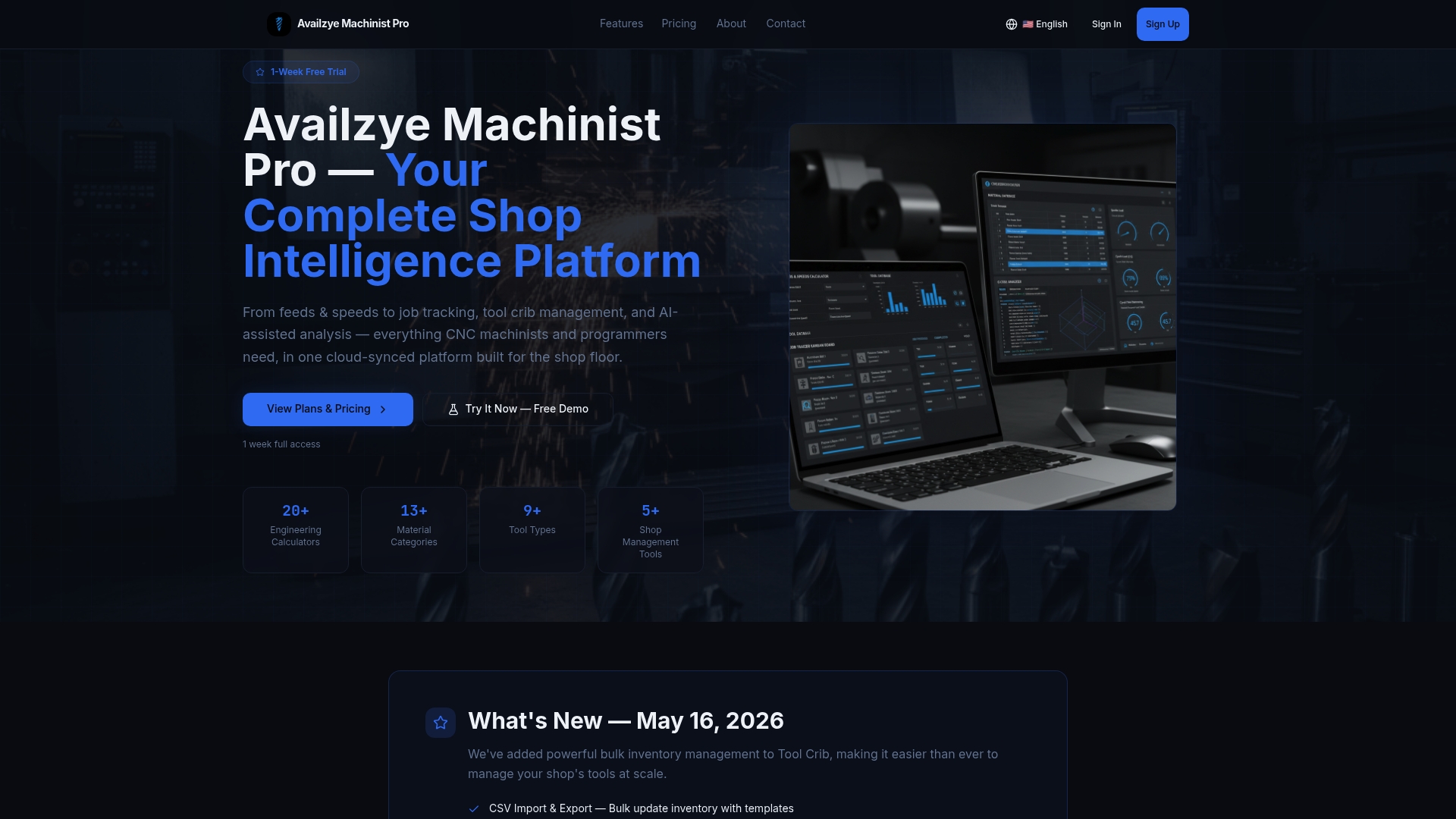
Availzyemachinistpro's Tool Crib gives you the infrastructure a cycle program needs: check-in/check-out logging, low-stock alerts, tool life tracking, and CSV import for bulk reconciliation. The Job Tracker ties tool consumption to work orders, so you can see exactly which jobs are driving variance before the next scheduled count. Audit logs and role-based access mean every adjustment has an owner and a timestamp, which is exactly what a reconciliation review requires.
Start with a 7-day free trial and run your first ABC count list through the Tool Crib this week. Plans start at $9.99/month, with no long-term contract required.
Useful sources for further reading
- Achieving cycle counting success — Effective Inventory Management: Covers perpetual counting philosophy, delta-only reconciliation, control group technique, and count contamination prevention. The most practically detailed free resource available.
- Inventory Cycle Counting 101: Best Practices & Benefits — NetSuite: Strong on ROI framing, root-cause focus, and WMS integration. Good for building a business case with leadership.
- What Is an Inventory Cycle Count? — FieldStack: Clear ABC frequency examples and scheduling guidance for retail and distribution environments.
- Cycle Counting: Types, Best Practices & Benefits — Shopify: Accessible overview of all five methods with technology accuracy data. Useful for teams new to the topic.
- Cycle counting — AccountingTools: Concise method descriptions with an accounting perspective. Good reference for finance stakeholders.
- What is a cycle count? — SalesTaxCel: Covers opportunity-based counting and event-triggered audits in plain language.
- Cycle count — Wikipedia: Comprehensive reference covering all method types, process steps, software requirements, and the distinction between cycle counts and physical inventories. Useful as a citation anchor when adapting your SOP.
- Tool Crib — Availzyemachinistpro: Product page for the Tool Crib feature, including check-in/check-out, low-stock alerts, and CSV import capabilities relevant to machining shop cycle programs.
- Job Tracker — Availzyemachinistpro: Feature page for work-order and job tracking, showing how tool consumption ties to scheduled counts and reconciliation workflows.