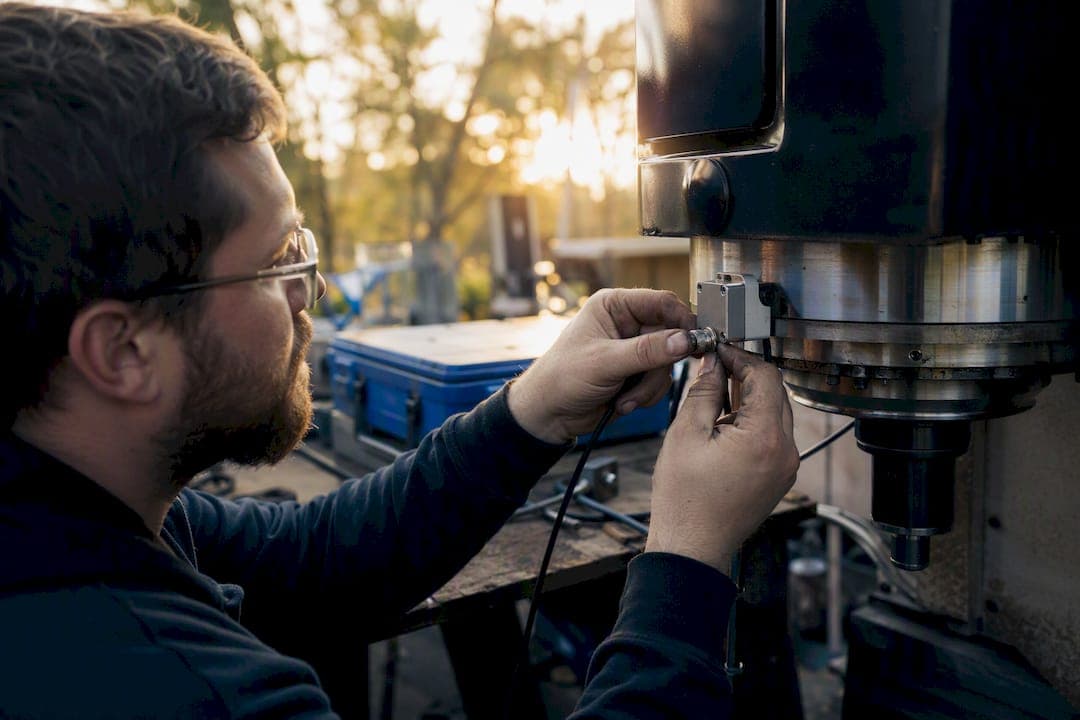
Predictive maintenance cuts unplanned CNC downtime significantly and pushes tool-failure forecasts out to weeks or months instead of leaving you guessing. It runs on three building blocks: sensors that capture vibration, current, and temperature; analytics that turn those signals into a remaining useful life estimate; and operators who actually act on the alert instead of ignoring another dashboard. Shops that treat all three as one system see the downtime and cost gains published in the research below.
TL;DR:
- Predictive maintenance reduces unplanned downtime by enabling failure forecasts weeks or months in advance, rather than relying on calendar-based or threshold alerts.
- Core sensors such as vibration, current, acoustic emission, and temperature effectively detect early signs of tool wear and mechanical faults without requiring exotic hardware.
- Combining multiple sensor signals through digital twins and advanced models like LSTM and GANs improves fault detection accuracy and reduces RUL prediction errors by nearly 30%.
- Implementing a pilot on a single machine type with well-understood failure modes, verifying data readiness, and setting clear success metrics accelerates adoption and minimizes costly mistakes.
- Deploying sensors and analytics with security best practices, such as network segmentation and encryption, is essential to prevent cyber threats that could compromise industrial equipment.
Table of Contents
- Why Predictive Maintenance Matters for CNC Shops
- Core Telemetry and Sensors for Machining PdM
- Analytic Techniques and Models Used in Machining PdM
- How to Implement Predictive Maintenance: A Pilot Checklist
- Deployment Considerations: Edge vs Cloud, Latency, and Standards
- Choosing Metrics, Alarm Logic, and Managing False Positives
- Operator Workflows: Closing the Loop on the Shop Floor
- Evidence and Short Case Summaries From the Field
- Cybersecurity Considerations for Connected PdM Systems
- Where to Start and What to Expect Realistically
- How Availzye Machinist Pro Fits Into Your PdM Workflow
- Sources
Why Predictive Maintenance Matters for CNC Shops
An unplanned spindle failure doesn't just cost a bearing. It costs the job in the machine, the missed delivery window, and the overtime hours to catch back up. Most shops still run on preventive schedules, replacing tools and components on a calendar regardless of actual wear, or condition-based maintenance, which reacts to a threshold being crossed after the fact. Predictive maintenance (PdM) does something different: it forecasts when a failure will happen, before the part degrades enough to trip a simple threshold.
The distinction matters more than it sounds. Preventive maintenance wastes good tool life by swapping parts early. Condition-based maintenance catches problems only once they're already visible in the data, often too late to schedule around. AI-based predictive maintenance research applied to machine condition data frames this as a shift from calendar-driven replacement to condition-driven intervention, one that extends component life while cutting the maintenance labor spent on parts that didn't need attention yet.
The published numbers back up why shops are making the switch:
- Digital twin-enabled PdM pilots in smart manufacturing settings reported a 35% reduction in unplanned downtime alongside a 28% improvement in maintenance scheduling accuracy.
- The same study measured remaining useful life prediction accuracy near 92.4% across twelve months of sensor data.
- A separate CNC tool-health digital twin improved fault detection F1 score from 0.811 to 0.892, while cutting RUL prediction error (RMSE) from 10.4 cycles down to 8.1.
Pro Tip: Don't sell PdM internally on downtime reduction alone. The scheduling accuracy gain is often the easier win to prove in month one, since you can measure it against your existing work order calendar before RUL forecasts have enough history to validate.
Those figures came from instrumented pilots with real sensor infrastructure, not simulations. The gap between a shop running blind and one running on predictive analytics in machining isn't marginal. It's the difference between finding out a spindle bearing failed at 2 a.m. on a Saturday and getting a maintenance ticket three weeks earlier that lets you schedule the swap during a planned changeover.
Core Telemetry and Sensors for Machining PdM
Four signal types cover most machining failure modes, and none of them require exotic hardware to start collecting.
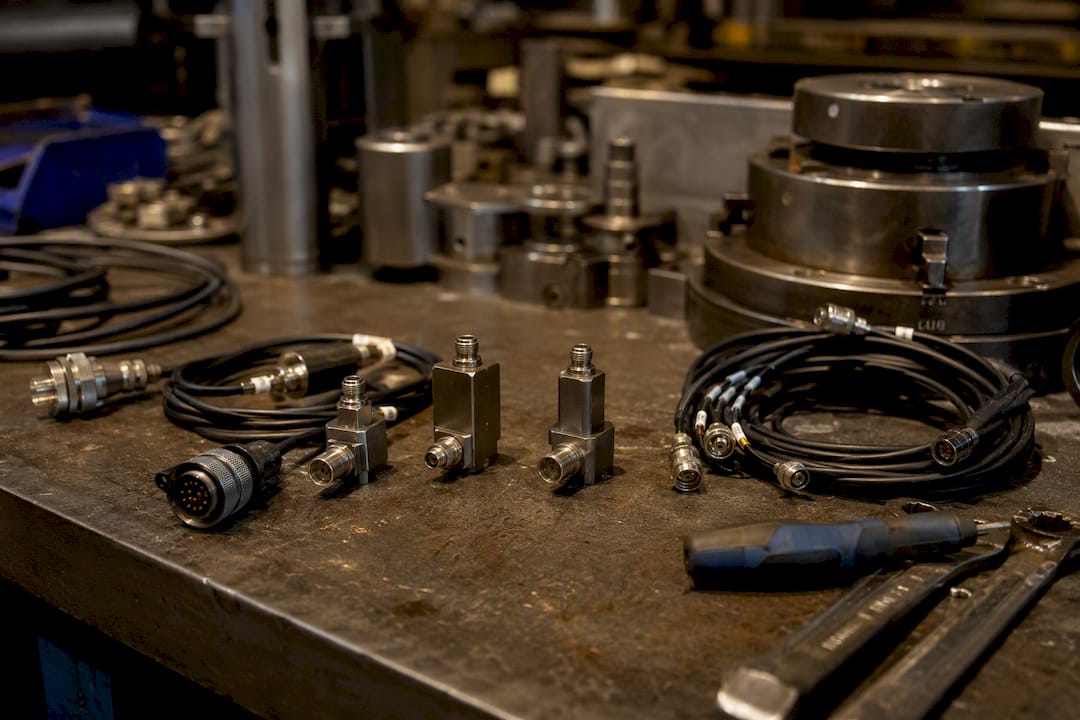
Tri-axial vibration is the workhorse. Bearing wear, tool chatter, and spindle imbalance all show up first as changes in vibration signature, usually well before they're audible or visible. Spindle current (or motor current more broadly) is the cheapest signal to add, since it often just taps existing drive telemetry, and it's sensitive to load changes from a dulling tool or a developing mechanical fault. Acoustic emission sensors pick up high-frequency stress waves from crack initiation and tool wear that vibration sensors miss entirely, particularly useful for detecting micro-fractures before they become catastrophic tool failures. Temperature at the spindle bearing and in coolant lines rounds out the core set, flagging lubrication breakdown and thermal drift that skew every other measurement if left uncorrected.
Machine-state tags matter as much as the raw signals themselves. Feed rate, spindle speed, tool ID, and material tie every reading to the operating context it happened in. Without those tags, a vibration spike from a legitimate high-speed roughing pass looks identical to a spike from a failing bearing, and your model can't tell the difference.
On the connectivity side, you have a choice between pulling telemetry straight from the machine controller or bolting on external sensors:
- Controller telemetry (spindle load, feed override, alarm codes) is free if your machine already exposes it, but sampling rates are often too coarse, sometimes just a few hertz, to catch fast-developing faults.
- External accelerometers and current clamps give you control over sampling rate (typically 10 to 25 kHz for vibration) but add hardware cost and mounting complexity.
- Most working pilots blend both: controller data for context, external sensors for the fast dynamics that actually predict failure.
Mounting matters more than shops expect. A vibration sensor bolted to the spindle housing near the front bearing captures a fundamentally different signal than one mounted on the machine base, and inconsistent mounting across machines of the same model is one of the fastest ways to poison a training dataset. Documented deployment studies flag missing machine-state tags, inconsistent sampling frequency, and unsynchronized clocks across sensors as the most common gaps that undermine model training and cross-machine generalization.
Analytic Techniques and Models Used in Machining PdM
Raw sensor data doesn't predict anything on its own. It has to pass through a feature engineering step, or increasingly, an end-to-end model that learns features directly from raw sequences.
Traditional signal processing extracts hand-crafted features: RMS vibration amplitude, spectral kurtosis, FFT peak frequencies tied to bearing defect frequencies, and current harmonics. These features feed classical machine learning models (random forests, SVMs) that work well when you have clean domain knowledge about what failure signatures look like. The alternative, gaining ground fast in machining applications, is feeding raw or lightly processed time-series data into sequence models that learn the relevant patterns themselves.
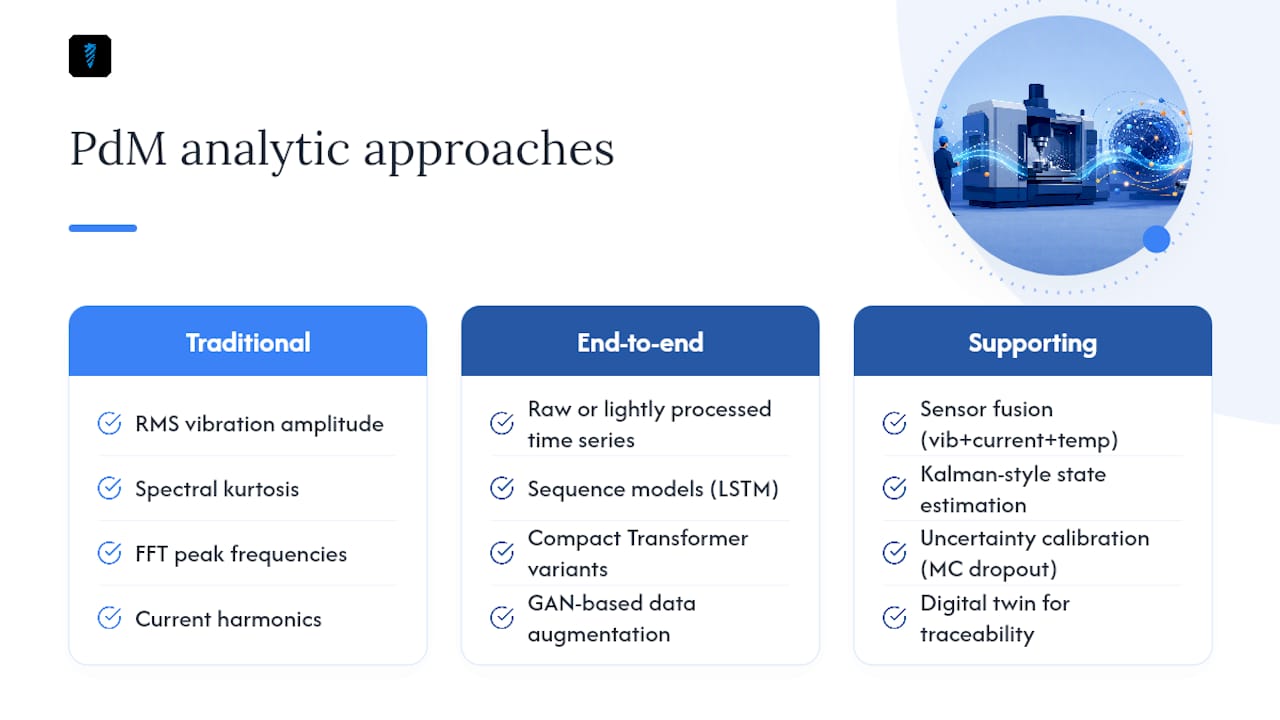
LSTM networks (long short-term memory, a recurrent neural network architecture built to learn from sequences) have become the default choice for RUL estimation in machining because tool and bearing wear are inherently sequential processes. One study on CNC machining center failure prediction found that pairing an LSTM predictor with GAN-based data augmentation cut average RUL prediction error by roughly 29% compared to a plain LSTM. That's a meaningful gap, and it points to a broader insight: when training data is sparse, which it almost always is early in a pilot, transfer learning and synthetic data augmentation do more for accuracy than a bigger model architecture. Compact Transformer variants are starting to show up in anomaly detection work too, particularly where you need to weigh distant historical context against recent readings without the vanishing-gradient issues that plague deep LSTMs.
Sensor fusion is where the real engineering work happens. Combining vibration, current, and temperature into a single wear estimate requires more than concatenating features. A tool-health digital twin approach used innovation-adaptive fusion with Kalman-style state estimation to stabilize latent wear trajectories across changing feed rates and materials, which is a fancier way of saying it kept the wear signal from getting noisy every time the machine switched jobs. That work improved fault detection F1 from 0.811 to 0.892 and dropped RUL RMSE from 10.4 cycles to 8.1.
Uncertainty calibration is the piece most pilots skip and later regret. A model that predicts "14 days remaining" with no confidence band is nearly useless for scheduling decisions. Techniques like Monte Carlo dropout produce calibrated confidence bands that let you build alarm, defer, or schedule logic instead of a single binary threshold.
Digital twin frameworks tie all of this together. A digital twin, in this context, is a live virtual model of the machine or tool that updates continuously from sensor data, giving you a traceable record of predicted versus actual wear that simplifies both deployment and audits. Digital twin-enabled pilots reported the strongest combined results in published research: a 35% downtime reduction and 92.4% RUL accuracy across a full year of sensor data, which is currently the closest thing the field has to a proof point that the full analytics stack pays for itself.
How to Implement Predictive Maintenance: A Pilot Checklist
Running before you can walk is the single most common way PdM pilots stall. Here's the sequence that actually works.
- Pick a pilot asset with a clear, costly failure mode. A spindle with a known bearing wear pattern, or a tool family with high scrap cost from unpredicted breakage, gives you a measurable target. Don't pilot on a machine where failures are rare and mysterious. You need enough failure events, even a handful, to validate anything.
- Audit data readiness before buying sensors. Check what your controller already exposes through the machine's native interface, confirm sampling rates, and verify clocks are synchronized across every data source. Missing machine-state tags (feed, speed, tool ID) are the most common reason pilots fail to generalize.
- Establish connectivity through open standards. Standardize on OPC UA or MTConnect rather than a proprietary interface, since both give you a machine-agnostic path to pull controller data without a custom integration for every make and model on your floor.
- Decide on an edge gateway early. Even a small pilot benefits from local pre-processing, filtering noise and computing basic features before anything hits a cloud pipeline, both for latency and for reducing the bandwidth bill.
- Set pilot evaluation metrics before you start collecting data. Decide up front what "success" means: a target mean absolute error on RUL, a false-positive rate ceiling, or a downtime reduction percentage, so you're not retroactively grading yourself.
- Use transfer learning and synthetic augmentation if you're short on failure data. GAN-based augmentation reduced RUL error by close to 29% in published research precisely because most shops don't have hundreds of documented failures to train on.
Pro Tip: Run your pilot on one asset family for a full production cycle before expanding. Every shop we've studied that instrumented ten machines on day one ended up with ten inconsistent datasets instead of one solid model they could trust.
Availzye Machinist Pro's maintenance tracker is a practical place to log the baseline failure history you’ll need before a model can tell you anything useful about what "normal" looks like.
Deployment Considerations: Edge vs Cloud, Latency, and Standards
Where you run inference changes what you can promise operators. Edge inference, meaning the model runs on hardware physically near the machine, keeps latency low and doesn't depend on network uptime, but it constrains model size and complicates updates. Cloud inference gives you room for heavier models and centralized retraining across a fleet, at the cost of round-trip latency and a dependency on connectivity you don't always control on a shop floor.
Deployment research on tool-health digital twins found the full sensor fusion and inference pipeline stayed feasible under a 100 millisecond latency budget running on embedded edge hardware, with heavier model retraining pushed to local servers or the cloud as compressed artifacts. That split, light inference at the edge, heavy training elsewhere, is becoming the standard pattern rather than the exception.
A few architectural decisions matter more than they get credit for:
- Edge inference protects you against network outages killing your alarm system exactly when you need it most.
- Cloud-side retraining lets you improve the model across your whole fleet without manually redeploying to every machine.
- OPC UA and MTConnect remain the two dominant connectivity standards for pulling controller telemetry without a custom integration per machine brand.
- MES (manufacturing execution system) hooks let a predictive alert automatically generate a work order instead of sitting in a separate dashboard nobody checks.
Skipping the standards layer is the mistake that shows up two years into a PdM program, when a shop tries to add a second machine brand and discovers their entire pipeline was built around one controller's proprietary protocol.
Choosing Metrics, Alarm Logic, and Managing False Positives
A model that's technically accurate but constantly wrong in the ways that matter to operators will get ignored within a month. Track these metrics from day one:
- MAE and RMSE for RUL regression tasks, giving you the average and worst-case error in your remaining-life estimates.
- F1 score for fault classification, balancing false alarms against missed detections.
- PR-AUC (precision-recall area under the curve), which matters more than plain accuracy when failures are rare events buried in mostly-normal data, which they always are.
Raw accuracy numbers mean little without alarm logic that translates a probability into an operator action. The stronger approach uses calibrated confidence to drive a three-tier decision: alarm now if confidence and severity both cross a high threshold, defer to next scheduled maintenance if confidence is moderate, or simply log and monitor if the signal is weak. Building that logic on calibrated uncertainty bands rather than a single hard cutoff is what separates a system operators trust from one they learn to override.
Nuisance alarms kill adoption faster than any accuracy shortfall. A digital twin pilot that fused vibration, current, and temperature signals with regime-aware noise adaptation improved fault F1 from 0.811 to 0.892, a jump that translates directly into fewer false alarms interrupting production for no reason. Practical threshold tuning usually means starting conservative, tracking every alarm against actual outcomes for several weeks, and adjusting thresholds based on real false-positive rates rather than guessing at a number that looks reasonable on paper.
Operator Workflows: Closing the Loop on the Shop Floor
A predictive model that only outputs a probability score to an engineer's dashboard has failed at the one job that matters: getting the right person to act before the machine goes down. Research on operator-facing PdM systems is consistent on this point. Deployments that push actionable, plain-language alerts directly to shop-floor staff see meaningfully better adoption than systems built only for engineering review, because the feedback loop from alert to action shortens dramatically.
In practice, that means every predictive alert needs a landing spot: a maintenance ticket, a checklist item, or an inventory pull, not a raw number in a spreadsheet.
- Route high-confidence alerts straight into a maintenance ticket with the predicted failure mode and estimated remaining life attached.
- Tie tool-wear predictions to your tool crib inventory so a predicted replacement automatically checks stock and flags a reorder if you're running low.
- Keep alert messages in plain operator language ("spindle bearing, replace within 2 weeks") rather than raw sensor readings or model confidence scores.
- Log every alert outcome, whether the operator confirmed the fault or dismissed it as a false alarm, since that feedback is what improves calibration over time.
Pro Tip: Explainability builds trust faster than accuracy does. An operator who just sees a red flag with no reasoning will start ignoring red flags.
Availzye Machinist Pro's maintenance tracker and tool crib features exist specifically to give predictive alerts somewhere concrete to land, turning a model output into a work order and an inventory action instead of a notification that dies in an inbox.
Evidence and Short Case Summaries From the Field
The lab-to-shop-floor gap in predictive maintenance has actually closed faster than most manufacturing technology trends, and the published numbers are specific enough to check your own pilot against.
The strongest combined result comes from a digital twin framework tested across twelve months and roughly 2.5 terabytes of sensor data in a smart manufacturing environment: 35% reduction in unplanned downtime, 28% improvement in maintenance scheduling accuracy, and RUL prediction accuracy of 92.4%. That's not a proof-of-concept number. That's a full production year.
On the model side, an LSTM predictor combined with GAN-based synthetic data augmentation reduced average RUL prediction error by 29% against a baseline LSTM, a result that matters most to shops without years of failure history to train on.
Industry deployments outside pure machining show a similar pattern with simpler entry points. A motor current monitoring rollout at ArcelorMittal detected faults up to four months in advance in some cases and prevented 31 hours of downtime by catching 27 failures ahead of schedule. That case is a useful reminder that you don't need a full digital twin to get real value. Plug-and-play electrical monitoring can be the pragmatic starting point when mechanical instrumentation is expensive or hard to retrofit.
- Digital twin pilots: 35% downtime reduction, 92.4% RUL accuracy, 28% better scheduling.
- Tool-health fusion models: F1 up from 0.811 to 0.892, RUL RMSE down to 8.1 cycles.
- LSTM plus GAN augmentation: 29% lower RUL prediction error versus a baseline model.
- Motor current monitoring case study: faults caught 4 months ahead, 31 hours of downtime prevented.
What ties these results together is not the specific model architecture. It's that every successful case paired a real sensor pipeline with a feedback loop back to maintenance action, not just a more accurate number sitting in a research paper.
Cybersecurity Considerations for Connected PdM Systems
Every sensor you add to a CNC machine is also a new network endpoint, and machining shops have historically treated their equipment networks as isolated, which they increasingly are not once PdM connects them to cloud analytics.
The exposure runs in both directions. An attacker who compromises a vibration sensor or edge gateway can potentially pivot toward the machine controller itself, a genuinely dangerous scenario on equipment capable of physical damage. Just as concerning: manipulated sensor data can quietly poison a predictive model, either masking a real developing fault or triggering false alarms that erode operator trust in the entire system.
A few practical steps reduce that exposure without requiring an enterprise security team:
- Segment PdM sensor networks from the machine control network using a firewall or VLAN, so a compromised sensor can't reach the controller directly.
- Encrypt telemetry in transit, particularly for any data leaving the shop floor toward a cloud analytics platform.
- Apply the same patch discipline to edge gateways and IoT sensors that you'd apply to any networked computer, since these devices are frequently the weakest link.
- Restrict write access to machine controllers strictly to authorized maintenance systems, never to the same channel carrying read-only sensor telemetry.
OPC UA has built-in security features (authentication, encryption) that older proprietary protocols generally lack, which is one more practical argument for standardizing your connectivity layer around it rather than a legacy interface built with no security model in mind at all.
Where to Start and What to Expect Realistically
If you're weighing where to begin, start smaller than feels comfortable. A three to six month pilot on a single asset family, one machine model with a well-understood failure mode, teaches you more than a scattered rollout across your whole floor ever will. You'll hit real data problems (missing tags, inconsistent sampling, a controller that doesn't expose what you assumed it would) faster on one asset than on ten.
Set your accuracy targets before you start, and set them modestly. A first-pass model with an MAE of a few days on RUL and a manageable false-positive rate is a legitimate win, not a disappointment.
The mistake I'd flag hardest: don't over-instrument before you've validated your baseline signals. Buying accelerometers for twenty machines before confirming vibration data actually predicts your dominant failure mode wastes both budget and the goodwill you need from the team running the pilot.
— Availzye
How Availzye Machinist Pro Fits Into Your PdM Workflow
Availzye Machinist Pro isn't a sensor platform or a machine-learning pipeline. It's the layer that keeps your predictive maintenance findings from evaporating into a spreadsheet nobody opens twice. Once a predictive alert flags a spindle bearing or a tool approaching end of life, the maintenance tracker logs the service history that your next model iteration needs, and the tool crib inventory ties predicted tool wear directly to stock levels and low-stock alerts so a forecasted replacement doesn't stall out waiting on a part.
The platform's chatter prediction calculator complements vibration-based PdM by catching a different failure mode, unstable cutting dynamics, before it damages a tool or a part surface. The AI Assistant surfaces machining guidance and cost estimates in the same place your team already tracks jobs and shift notes, so predictive insights sit next to the work orders they're meant to inform instead of in a separate system nobody checks during a shift change.
If you're running a pilot and need a practical place to track baseline failure history, tool life, and maintenance outcomes without building custom software first, start with the GCode Generator and explore the maintenance and tool crib features during the 7-day free trial.
Sources
For deeper technical detail, the digital twin PdM framework study, the tool-health sensor fusion research, and the LSTM/GAN failure prediction model cover the analytics in full. For provider-side context on managed PdM deployments, see Aros Platforms' predictive maintenance use cases.
- Digital Twin-Enabled Predictive Maintenance Framework for Smart Manufacturing Systems
- Tool-Health digital twin for CNC predictive maintenance via innovation-adaptive sensor fusion and uncertainty-aware prognostics
- Long Short-Term Memory-Based Computerized Numerical Control Machining Center Failure Prediction Model
- Predictive Maintenance of Machine Tool Systems Using Artificial Intelligence Techniques Applied to Machine Condition Data
- Predictive Maintenance for CNC Machines: Empowering Operators with Real-Time Insights