
That single rule covers the vast majority of shop tapping jobs. Newman Tools' tap drill tables and the Wikipedia drill and tap chart both use 75% as the standard recommendation.
Here are six immediately useful examples to get you started:
For automated lookups and batch jobs, use the Availzyemachinistpro Thread Drill Calculator — it handles UNC, UNF, ISO metric, and NPT without manual rounding.
Key Takeaways
| Point | Details |
|---|---|
| 75% engagement is the standard | Use it for mild steel, aluminum, and most alloys; it delivers near-maximum pull-out strength. |
| Hard alloys need less engagement | Drop to 60–65% for stainless, titanium, or hardened steel to reduce torque and protect taps. |
| Clearance drills are not tapping drills | Close-fit clearance runs a few thousandths over bolt major diameter; free fit adds 0.010"–0.030" more. |
| NPT pilot size drives the seal | Tap oversize and the taper will not seal regardless of sealant; use the chart size exactly. |
| Availzyemachinistpro automates the lookup | The Thread Drill Calculator returns drill size, nearest stock drill, and actual engagement for any thread standard. |
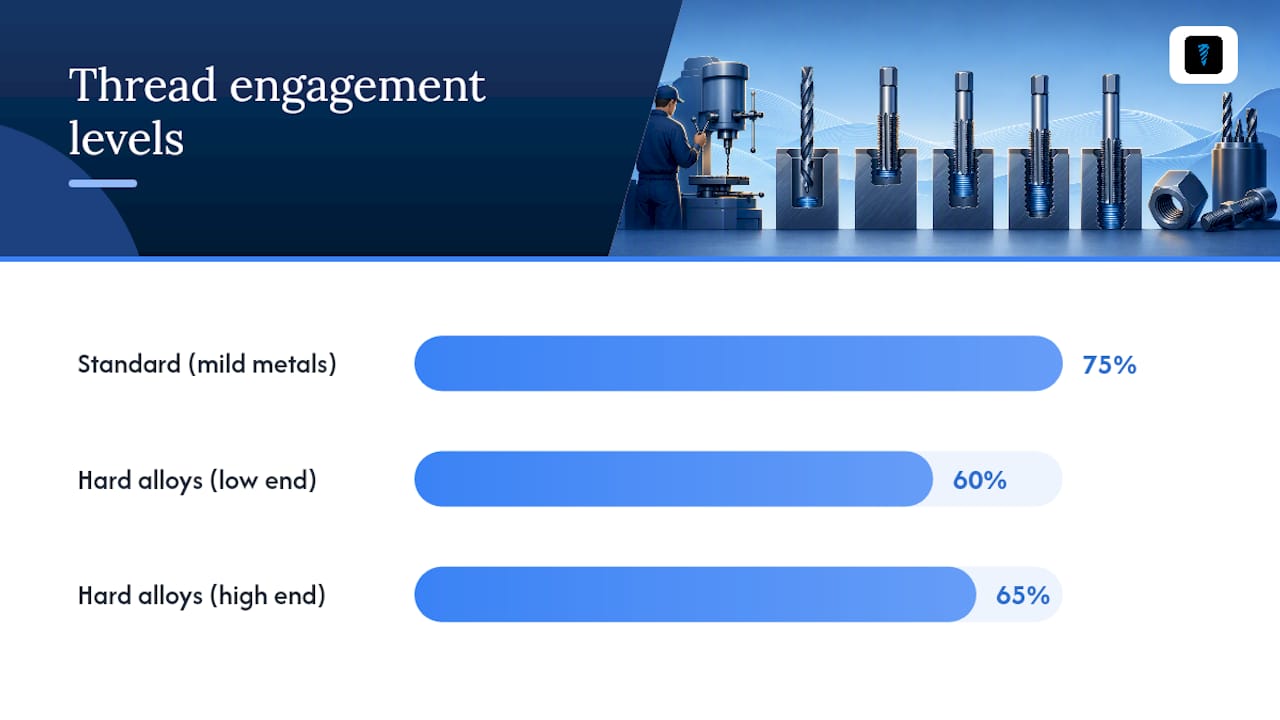
Table of Contents
- What does a tap drill size chart actually cover?
- How do you read and use a tap drill chart?
- How does the tap drill formula work?
- What is the difference between a clearance drill and a tapping drill?
- What pilot drill do you need for NPT pipe threads?
- How do you convert between decimal, fraction, and drill number sizes?
- [A machinist's salary and career outlook often reflect the importance of understanding thread engagement and proper tapping techniques.](#a-machinists-salary-and-career-outlookhttpssalary-atlascommachinist-salary-often-reflect-the-importance-of-understanding-thread-engagement-and-proper-tapping-techniques)
- Skip the manual chart lookup with Availzyemachinistpro
- Sources
What does a tap drill size chart actually cover?
A tap drill size chart maps every standard thread size to the drill bit that produces the correct minor diameter before tapping. The chart is your primary reference for inch (UNC/UNF), metric coarse and fine, and pipe threads. The tables below are organized by thread standard so you can find the right row fast.
UNC and UNF inch tap drill sizes
The table below covers the most common unified inch threads. Drill numbers come from the standard wire-gauge series; fractional sizes are listed where they are the closest available stock drill. All recommended drills target approximately 75% thread engagement for general-purpose work in mild steel and aluminum, consistent with Newman Tools' UNC/UNF recommendations and the ICS Cutting Tools tap drill cross-reference.
Metric coarse and metric fine tap drill sizes
Metric drill sizes are stated in millimeters to two decimal places. The formula behind these numbers is covered in the calculation section below. For a downloadable PDF of the full ISO metric series, Allied Machine's ISO metric tap drill chart is a reliable shop printout.
Engineers Edge ISO metric tap sizes explicitly notes that the 75% engagement target should be reduced to approximately 60–65% for harder materials to prevent tap breakage.
How do you read and use a tap drill chart?
Pick the right drill in five steps: identify your thread standard, find the major diameter and pitch or TPI, locate the matching row, confirm the drill-number or fractional equivalent you have in stock, and verify your target percent engagement before you drill.
Here is how each step plays out in practice:
- Identify the thread standard. Is it UNC, UNF, ISO metric coarse, metric fine, or NPT? The standard determines which table to use. A bolt stamped "M8-1.25" is metric coarse; "3/8-24" is UNF.
- Note the major diameter and pitch or TPI. For metric, pitch is stated in millimeters (M6×1.0 means 6 mm major diameter, 1.0 mm pitch). For inch, TPI is threads per inch (1/4-20 means 0.250" major diameter, 20 TPI).
- Find the matching row in the chart. Locate the tap size in the left column. Read across to the recommended drill column.
- Confirm your available drill. Cross-reference the decimal size against your drill index. The Montana State drill chart PDF maps decimal diameters to fractional and wire-gauge equivalents — keep a copy at the machine for fast cross-referencing.
- Set your target percent thread. For general steel and aluminum, 75% is the standard. For stainless, titanium, or hardened alloys, drop to 60–65%.
Worked example — 1/4-20 UNC in mild steel: Look up 1/4-20 UNC in the inch table. The recommended drill is #7 (0.2010"). You have a #7 in the index. Drill, deburr, and tap.
Because 304 stainless work-hardens, reduce engagement to approximately 65% — use an 8.80 mm drill instead, or confirm the adjusted size with the thread drill calculator. Use a spiral-flute tap with cutting oil and back off a quarter turn every half turn to break chips.
Pro Tip: In blind holes, plan for at least 1.5× the tap diameter of full-thread depth below your target depth to account for the tap's chamfer lead. A spiral-point (gun) tap pushes chips forward and works well in through holes; a spiral-flute tap pulls chips back out of blind holes.
How does the tap drill formula work?
The quick approximation for metric threads is: Drill diameter (mm) = Major diameter − Pitch. For M6×1.0, that gives 6.0 − 1.0 = 5.0 mm. For M10×1.5, it gives 10.0 − 1.5 = 8.5 mm.
For inch threads, the equivalent approach uses TPI directly:
Drill diameter (in) = Major diameter − (1 / TPI)
For 1/4-20 UNC: 0.250 − (1/20) = 0.250 − 0.050 = 0.200". The nearest standard drill is #7 at 0.2010" — close enough for shop use.
Worked metric example: M6×1.0
- Major diameter = 6.0 mm
- Pitch = 1.0 mm
- Drill = 6.0 − 1.0 = 5.0 mm
- Confirm: 5.0 mm is a standard stock size. Use it.
Worked inch example: 1/4-20 UNC
- Major diameter = 0.250"
- TPI = 20, so 1/TPI = 0.050"
- Drill = 0.250 − 0.050 = 0.200"
- Nearest standard drill: #7 at 0.2010". Use #7.
These formulas are approximations. They do not account for the exact thread form geometry (60° V-thread), so the actual engagement percentage varies slightly by thread series. For precise engagement percentages, use the Availzyemachinistpro Thread Drill Calculator, which applies the full formula and lets you input target engagement directly.
Two accuracy warnings worth keeping in mind. First, rounding to the nearest available drill size shifts your actual engagement up or down by a few percent — usually acceptable, but worth checking for critical joints. For hard alloys, Engineers Edge recommends stepping up to the next larger drill size to land near 60–65% engagement instead.
What is the difference between a clearance drill and a tapping drill?
A tapping drill creates the minor diameter for thread cutting. A clearance drill creates a hole large enough for a bolt to pass through freely without threading. These are two completely different operations, and mixing them up is one of the most common setup errors in a shop.
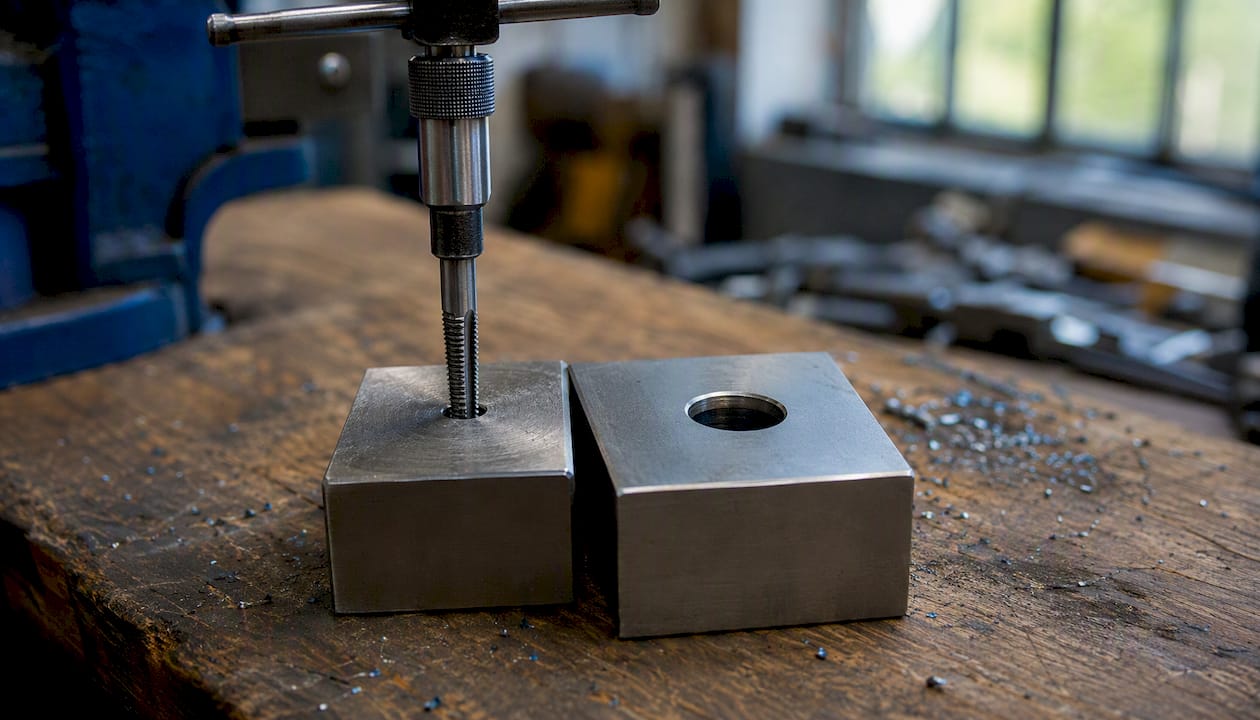
Close fit clearance is only a few thousandths of an inch larger than the bolt's major diameter. Use it when you need accurate bolt location or minimal play in the joint. Free fit leaves more room — typically 0.010"–0.030" over nominal — for assembly tolerances, washer clearance, and slight misalignment.
The University of Washington metric clearance drill reference lists both close-fit and free-fit clearance sizes for metric threads with decimal equivalents. For the counterbore dimensions that go with these clearance holes, the Availzyemachinistpro counterbore calculator handles the full geometry.
| Bolt Size | Tapping Drill | Close Fit Clearance | Free Fit Clearance |
|---|---|---|---|
| #8-32 | — (—") | #— (0.1695") | #16 (0.1770") |
| #10-24 | — (—") | #10 (0.1935") | #7 (0.2010") |
| 1/4-20 | #7 (0.2010") | 17/64 (0.2656") | 9/32 (0.2812") |
| —-— | F (0.2570") | 21/64 (0.3281") | — (0.3437") |
| 3/8-16 | — (—") | 25/64 (0.3906") | 13/32 (0.4062") |
| 1/2-13 | 27/64 (0.4219") | 33/64 (0.5156") | 17/32 (0.5312") |
| M6×1.0 | 5.00 mm | 6.— mm | 6.60 mm |
| M8×1.25 | 6.80 mm | 8.— mm | 8.60 mm |
| M10×1.5 | 8.50 mm | 10.50 mm | 10.80 mm |
| M12×1.75 | 10.20 mm | 12.50 mm | 13.00 mm |
A few practical notes on clearance holes:
- Close-fit clearance is the right call for precision fixtures, jigs, and any joint where bolt location matters.
- Free-fit clearance works for general structural assemblies where a washer under the bolt head is standard practice.
- When a clearance hole needs to be truly accurate — for a dowel-located assembly, for example — drill slightly undersize and ream to final diameter. The reaming speed and feed guide covers the parameters for finishing clearance holes precisely.
- Never use a tapping drill as a clearance drill. The bolt will not pass through.
What pilot drill do you need for NPT pipe threads?
NPT (National Pipe Taper) threads require a pilot drill sized for the nominal pipe size, not the actual thread diameter. The taper does the sealing work — the thread form wedges into the mating part as it tightens, so the pilot hole size and depth both matter more than they do for straight threads.
The most common pilot sizes for 1/8" through 1" NPT:
For taper calculations on NPT fittings, the Availzyemachinistpro taper calculator handles the geometry when you need to verify taper angle or depth.
Key points for NPT tapping:
- NPT threads seal by taper interference, not by a gasket or O-ring. Do not tap oversize — a loose fit will not seal regardless of how much thread sealant you apply.
- Use PTFE tape or a pipe thread sealant compound on the threads before assembly. The thread form alone is not a pressure-tight seal without it.
- NPT is a tapered thread; BSPP (British Standard Parallel Pipe) is parallel. They are not interchangeable. If the fitting is from a European or British source, confirm the standard before tapping.
- Back out chips every 1–2 turns during tapping, especially in blind holes. Pipe taps have a long chamfer lead that packs chips aggressively.
- Thread depth for NPT is measured in turns of engagement, not a fixed depth. The standard calls for hand-tight plus 2–3 turns with a wrench for a pressure-tight joint.
How do you convert between decimal, fraction, and drill number sizes?
Keep a short conversion reference at the machine. When a chart gives you a decimal size and your drill index is organized by fraction or wire-gauge number, a quick lookup prevents the wrong drill from going in the spindle. For CNC programming, always use the decimal diameter — fractions introduce rounding errors in tool offset entries.
The Montana State drill chart is the most complete single-page reference for decimal-to-gauge conversions. The table below covers the range most relevant to tapping work:
A few practical lookup strategies:
- If your exact size is not in stock, step up one size (larger drill, lower engagement) rather than down. A slightly lower engagement percentage is safer than a broken tap.
- Wire-gauge drills (#1–#80) cover the small-diameter range where fractional drills jump too coarsely. Letter drills (A–Z) fill the gap between 0.234" and 0.413".
- For CNC work, enter the decimal diameter directly into the tool offset. Use the Availzyemachinistpro tool database to log your actual drill stock and flag gaps before a job runs.
- Metric drills in 0.1 mm increments are often the most precise option for small tap sizes — a 5.0 mm drill is more accurate than hunting for a #9 wire-gauge equivalent.
A machinist's salary and career outlook often reflect the importance of understanding thread engagement and proper tapping techniques.
Here is what the charts do not tell you directly. What higher engagement does add is tapping torque, tap wear, and breakage risk.
Blind holes deserve extra attention. The tap's chamfer lead means the last few threads at the bottom of the hole are incomplete. Plan your hole depth so the full-thread zone starts at least 1.5× the tap diameter above the bottom. Spiral-flute taps pull chips back out; spiral-point (gun) taps push them forward into the hole. In a blind hole, a spiral-point tap packs chips at the bottom and can break the tap or prevent full depth. Use the right tap geometry for the hole type.
For long, thin taps (anything below M4 or #6-32), conservative engagement is worth more than the theoretical strength gain. A broken tap in a workpiece costs far more than a slightly lower thread engagement.
When a thread needs to carry high cyclic loads or the parent material is soft (aluminum, magnesium, plastics), consider a thread insert rather than increasing engagement. A Helicoil or Keensert insert in aluminum gives you a steel thread form at standard engagement — stronger than any percentage of aluminum thread you could cut.
Skip the manual chart lookup with Availzyemachinistpro
Manual chart lookups work fine for one-off jobs. For a shop running multiple thread standards across a shift, the math adds up fast — and a single wrong drill size means a scrapped part or a broken tap.

Availzyemachinistpro's Thread Drill Calculator handles UNC, UNF, ISO metric coarse, metric fine, and NPT in one input screen. Enter the thread size and target engagement percentage, and it returns the exact drill diameter, the nearest standard drill, and the actual engagement you will get with that drill. The Tool Crib ties directly to your in-shop drill inventory so you can confirm stock before the job starts, not after. For shops moving from drill selection into CNC programming, the G-Code Generator takes the drill diameter straight into a canned cycle. Start a 7-day free trial at Availzye-machinist-pro and run your next tapping job without touching a paper chart.
Sources
The tables and formulas in this article draw from the following primary references. Each covers a specific area of tap drill selection:
- Tap Drill Sizes and Tap Drill Size Calculator - Newman Tools
- inch/metric tap drill sizes & decimal equivalents
- Tap Drill Chart - ICS Cutting Tools
- Metric Tap & Tap Drill Clearance Drill
- Drill and tap size chart - Wikipedia