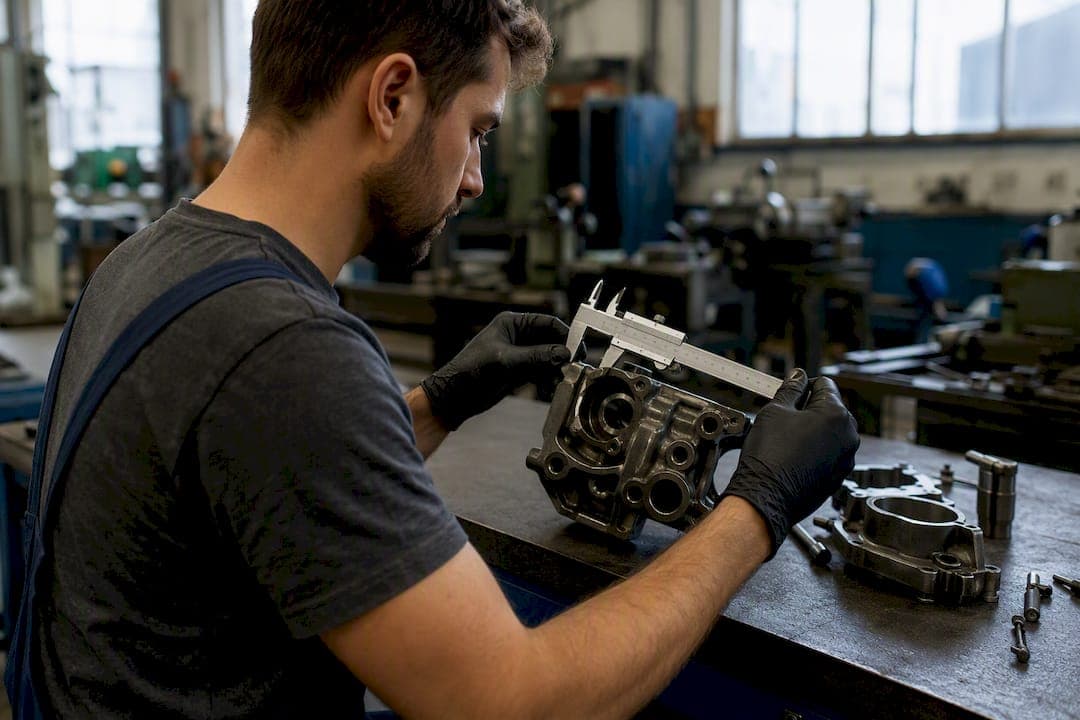
A defensible CNC quote rests on two things: a complete technical package and a line-item cost breakdown. Send a STEP file, a controlled 2D drawing with GD&T, a real material spec, quantity tiers, finish requirements, and inspection expectations, and a shop can quote your part on facts instead of assumptions. Skip any of those and you're paying for someone else's guesswork.
That gap is not trivial. Shops that receive incomplete RFQs typically add a 15 to 25 percent contingency just to cover the unknowns in the file. That's not padding out of greed. It's risk pricing, and you're the one funding it.
If you take one action from this article, take this: before you send an RFQ, confirm it includes:
- A STEP (.stp) 3D model, not just a rendering or a PDF
- A controlled 2D drawing calling out GD&T per ASME Y14.5-2018
- Material alloy, temper, and governing spec, not a generic name
- Quantity tiers so the shop can show you the cost curve
- Surface finish and inspection requirements (FAI, CMM, MTR) stated up front
Get that package in front of an estimator, and you've done more to control your CNC quoting process than any negotiation tactic ever will.
Key Takeaways
A defensible CNC quote combines a complete technical package with a transparent, line-item cost formula that separates material, run time, setup, tooling, overhead, and margin.
| Point | Details |
|---|---|
| Send a complete RFQ | Include STEP file, controlled 2D drawing with GD&T, exact material spec, quantity tiers, finish, and inspection needs. |
| Build cost in layers | Stack material, run cost, amortized setup, tooling, scrap, overhead, and margin rather than quoting a flat number. |
| Pad cycle time realistically | Add 10 to 20 percent to cut-time estimates to cover rapids, tool changes, and part handling. |
| Compare line items, not totals | A low total often hides missing tooling costs, skipped inspections, or vague finish notes. |
| Use software to remove repetition | Availzye Machinist Pro's cost estimator, CAD viewer, and G-Code analysis speed consistent quotes while estimators keep final judgment. |
Guides and calculators worth bookmarking
- The RFQ guide for CNC machined parts covers checklist items and typical inspection costs in detail.
- The job shop quoting calculator walks through setup payoff math with adjustable inputs.
- For CAD submission standards outside machining, this CAD drawing commissioning guide covers similar file-clarity principles.
Table of Contents
- What Belongs in the RFQ or Quote Package
- The Cost Formula Behind Every Accurate Quote
- Building an RFQ Package That Speeds Up the Quote
- What Quoting Software Actually Saves You
- Reading Quotes and Negotiating Without Losing Margin
- Sources
What Belongs in the RFQ or Quote Package
Most quoting delays trace back to one root cause: the shop is guessing at something the buyer already knows. Fix the file, fix the quote.
- Send STEP, not STL. STEP preserves exact geometry and units; STL is a triangulated mesh that loses precision on curved surfaces and can't carry PMI. Native CAD files (SolidWorks, Fusion 360) help further when the shop uses the same platform, but STEP is the universal baseline every shop can open.
- Attach a controlled 2D drawing. This is the contractual document, the one that governs disputes later. It needs a title block, revision number, datums, and every GD&T callout that actually matters, not a blanket "hold ±.005 on everything," which just inflates your quote for tolerances nobody will inspect.
- Specify the exact material. "Aluminum" tells a shop nothing useful. "6061-T6 per QQ-A-250/11" tells them what to buy, what it costs, and how it machines. The same logic applies to steel grades, stainless designations, and any spec-controlled alloy.
- Define finish and coating. Bead blast, anodize Type II vs Type III, black oxide, passivation. Note any masking requirements before plating.
- State inspection requirements plainly. A first article inspection (FAI) commonly runs $200 to $500 per part number, and a CMM report adds another $50 to $150 per part. If you need a material test report (MTR), say so in the RFQ, not after the quote lands.
- Give quantity tiers, not a single number.
Request pricing at 1, 5, 10, 25, 50, and 100 pieces. Setup amortization often drops per-part cost 40 to 60 percent between a single prototype and a 100-piece run, and you can't see that curve if you only ask for one quantity.
The Cost Formula Behind Every Accurate Quote
Every legitimate CNC quote is built from the same buckets, stacked in order:
Cost per part = material + amortized setup + run cost + tooling + scrap + overhead + margin.
Run cost is cycle time multiplied by a loaded shop rate, and this is where most quotes fall apart. Machine time and setup are the biggest cost drivers, and shops that skip rapids, tool changes, and part handling when estimating cycle time consistently underquote.
| Cost bucket | What it includes | Common estimating error |
|---|---|---|
| Material | Raw stock cost plus waste factor | Ignoring kerf and drop losses |
| Run cost | Cycle time × loaded shop rate | Timing only cutting moves, not rapids or tool changes |
| Setup | Programming, fixturing, first-piece approval, divided by quantity | Not amortizing across the run |
| Tooling | Inserts, end mills, drills consumed per job | Using new-tool life instead of realistic wear |
| Overhead | Facility, utilities, admin, maintenance | Underestimating machine depreciation |
| Margin | Profit layered on top of direct cost plus overhead | Applying margin before overhead is added |
A loaded shop rate has to account for machine depreciation, realistic billable utilization (not 100 percent), maintenance, and utilities. A shop running $85/hour without depreciation baked in is quietly eating margin on every job.
Pro Tip: When you can't nail cycle time from geometry alone, add 10 to 20 percent to your cut-time estimate to cover rapids, tool changes, and handling. An optimistic cycle time is the fastest way to quote a job you'll regret running.
Here's the payoff-quantity logic in practice: if setup costs $150 and takes 45 minutes, that's $150 spread across your quantity tier. At 5 pieces, that's $30 of setup cost per part. At 50 pieces, it's $3. The job-quote calculator approach formalizes this exact math, showing the quantity where setup stops dominating the price.
Building an RFQ Package That Speeds Up the Quote
A clean submission process removes most of the friction from the CNC quoting process before a shop ever opens your file.
Start with naming and revision control. Label files clearly, "PartName_Rev-A_Prototype" beats "final2_updated," and tag whether the run is a prototype or headed to production. That distinction changes how a shop sources material and amortizes setup, and including an annual forecast can lower your quoted price for future runs by letting the shop lock in material sourcing early.
Your submission checklist should include:
- STEP file with a controlled 2D drawing and GD&T
- Full material spec (alloy, temper, governing standard)
- Quantity tiers, not a single number
- Finish, coating, and masking requirements
- Inspection requirements: FAI, CMM report, MTR
- Packaging and lead-time expectations
For turnaround, expect quotes on simple parts within one business day when the package is complete. Complex geometry or tight tolerances can push DFM review to 24 to 48 hours. Ask directly for design-for-manufacturability feedback and a line-item breakdown, not a lump-sum number.
The most common drawing mistakes that stall quotes: tolerancing every dimension instead of the ones that matter, missing datum structure, and vague notes like "smooth finish" with no Ra value attached. A surface finish reference attached to your drawing removes that ambiguity before it costs you a clarification email.
What Quoting Software Actually Saves You
Automation doesn't replace an estimator's judgment. It removes the repetitive work that eats an estimator's day before judgment even gets applied.
- Automated STEP analysis detects setup count, hole and pocket features, and flags manufacturability issues, thin walls, deep pockets, unreachable features, before a human ever opens the model.
- Cost estimation and G-Code analysis check cycle-time assumptions and surface operations, catching a mismatch between quoted time and actual toolpath before the quote ships.
- Shop management tools (job tracking, tool crib inventory, maintenance logs) preserve the assumptions behind a quote so the job that actually runs matches the one that was priced.
- An AI assistant can flag missing RFQ items or surface a DFM suggestion before an estimator spends time on a file that's going to bounce back for revisions anyway.
This kind of automation pays off fastest for shops quoting many similar parts, where repetitive feature recognition is the actual bottleneck, not the pricing logic itself.
Pro Tip: A practical workflow: upload the STEP file, let automated analysis flag setups and manufacturability warnings, generate a draft estimate from your cost estimator, then have a human estimator review and adjust before it goes out. You get consistent line items and still keep a person accountable for the number.
Reading Quotes and Negotiating Without Losing Margin
Never compare quotes by their bottom-line total. Compare the line items, inspections, subcontracted operations, and lead times behind them, because that's where the real differences live.
A suspiciously low quote is usually missing something, not beating the market. Ask pointed questions: Is tooling wear accounted for, or is this priced off a fresh insert? Is inspection included, or bolted on later as a change order? Is the finish note vague enough to mean anything?
Setup amortization and minimum order quantities aren't padding, they're the honest cost of short runs. Present them plainly to customers instead of burying them in a flat per-part number. Use payoff quantity, the point where setup cost per part drops below a threshold you're comfortable with, to decide when a run is worth running as quoted versus when it needs a minimum order fee attached.
When a quote comes in well below your own numbers on a part with tight tolerances or exotic material, that's a signal to ask more questions, not to celebrate. And when a drawing keeps generating clarification requests instead of quotes, the fix is usually a redesign for manufacturability, not another round of shopping it to more suppliers.
An estimating manager's note on getting this right
Every clarification email is a quote cycle you didn't need to lose. I've seen the same pattern play out repeatedly: a shop switches to requiring the full package, STEP, controlled drawing, real material spec, and the back-and-forth practically disappears. Quotes move faster, margins hold because assumptions are explicit instead of padded. A platform like Availzye Machinist Pro that keeps cost estimation and job data in one place makes that discipline easier to sustain past the first good week.
— Availzye
Where Availzye Machinist Pro fits into your quoting process
Everything above, the cost formula, the RFQ checklist, the cycle-time math, is only as good as your ability to apply it consistently, job after job, without redoing the same calculations by hand every time. That's the gap Availzye Machinist Pro closes. The platform's cost estimator builds line-item quotes from material, run time, setup, and tooling instead of a gut-feel lump sum, and the CAD viewer reads STEP files directly so you're not guessing at geometry before you price it.
!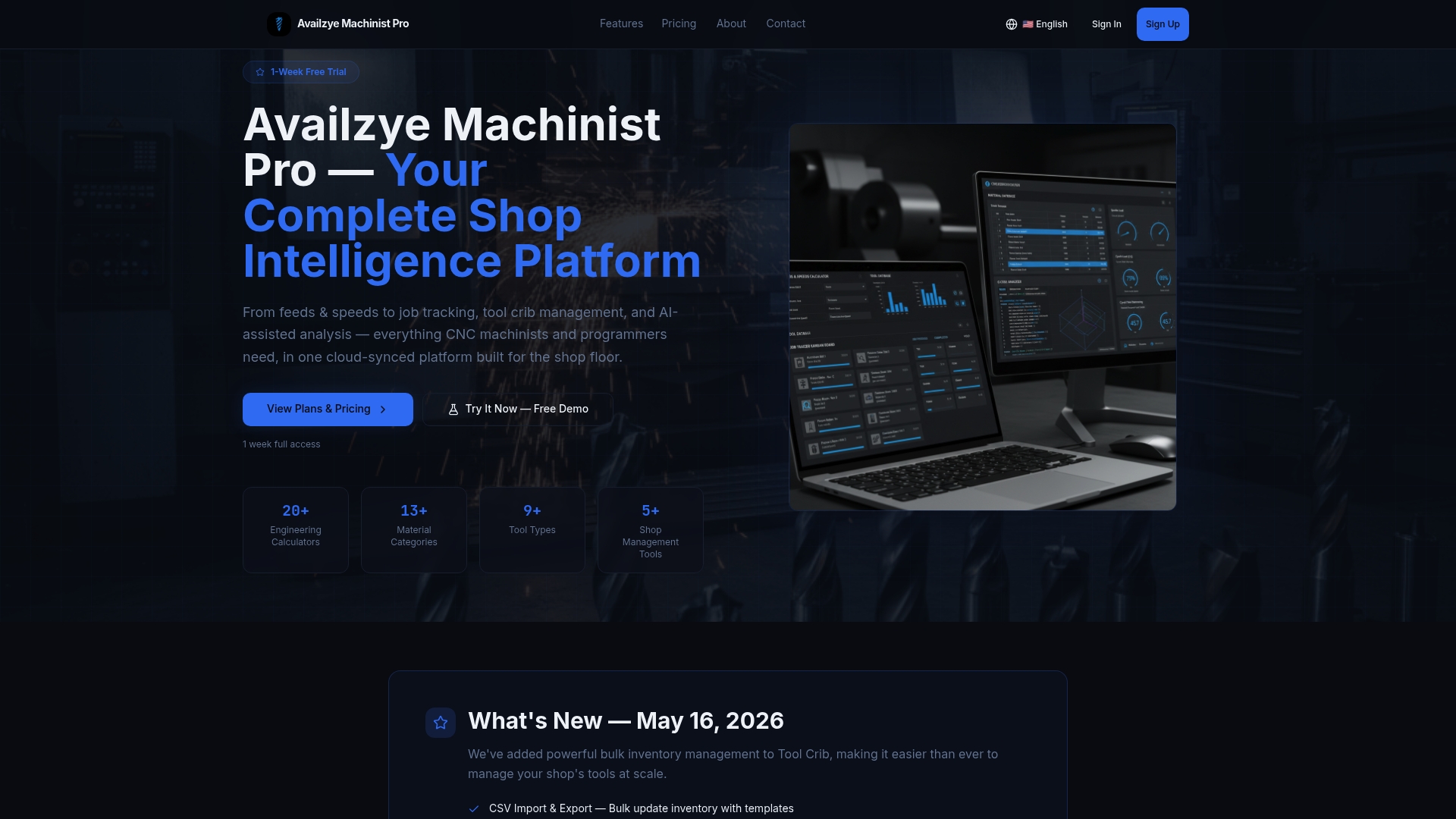
Pair that with G-Code analysis to check cycle-time assumptions before the part hits the machine, an AI assistant that flags missing RFQ items before you waste an estimator's afternoon, and a job tracker plus tool crib that keep your quote assumptions tied to what actually happened on the floor. The result is fewer clarification emails, faster turnaround, and quotes you can defend when a customer pushes back on price. Start a free trial and run your next RFQ through the cost estimator before you quote it by hand.
Sources
- RFQ guide for CNC machined parts (MakerStage) — RFQ checklist and typical inspection costs
- CNC machining cost estimation and how to quote a part (MFG Calcs)
- How to prepare a CNC machining quote package suppliers can price accurately (CNCMAVEN)