
The overhead rate equals your total indirect costs divided by a chosen allocation base. That single formula drives job costing, pricing, and margin analysis across every type of business. A quick example: if your annual overhead is large compared to revenue, the overhead rate tells you how much indirect cost is carried per dollar of revenue.
The four most common formula variants are:
- Percent of revenue: Overhead rate = Total overhead ÷ Total revenue × 100
- Per direct labor dollar: Overhead rate = Total overhead ÷ Total direct labor cost
- Per direct labor hour: Overhead rate = Total overhead ÷ Total direct labor hours
- Per machine hour: Overhead rate = Total overhead ÷ Total machine hours
Wall Street Prep notes that indirect costs often represent a significant share of total costs depending on the industry, which means many businesses are underpricing jobs when they skip a formal overhead rate calculation. Investopedia covers all four formula variants with worked examples if you want a reference alongside this guide. Availzyemachinistpro's Cost Estimator automates this math directly inside your shop workflow.
Pro Tip: Pick one allocation base before you run any numbers. Switching bases mid-year makes period-over-period comparisons meaningless.
Key Takeaways
A reliable overhead rate calculation requires the right cost pool, a driver that matches your actual cost behavior, consistent application across periods, and a year-end reconciliation that closes the loop between applied and actual overhead.
| Point | Details |
|---|---|
| Core formula | Overhead rate = Total indirect costs ÷ Allocation base; express as % or per-hour cost. |
| Benchmark range | Indirect costs typically represent 20–40% of total costs; use this as a sanity check, not a target. |
| Driver selection | CNC and automated shops should use machine hours, not labor hours, to avoid mis-costing jobs. |
| Year-end reconciliation | Compare applied overhead to actual overhead and adjust COGS for any material variance each period. |
| Availzyemachinistpro | The Cost Estimator integrates machine-utilization inputs with overhead allocation for auditable job costing. |
Table of Contents
- What counts as overhead and what doesn't?
- What are the core overhead rate formulas?
- How to calculate an overhead rate, step by step
- Two worked examples: percent-of-revenue and per-machine-hour
- How do you choose the right allocation base?
- How to apply the overhead rate to pricing and reconcile variances
- The overhead rate mistake most shops make
- Availzyemachinistpro's Cost Estimator puts this math to work
- Useful sources and further reading
What counts as overhead and what doesn't?
Overhead is any indirect cost you cannot trace directly to a single product, job, or unit. Rent, utilities, equipment depreciation, indirect wages (supervisors, janitors, office staff), insurance, and administrative software subscriptions all qualify. Raw materials and the wages of machinists running a specific job do not — those are direct costs.

The distinction matters more than most owners realize. Misclassifying a direct cost as overhead inflates your rate and makes every job look more expensive than it is. Misclassifying an overhead cost as direct does the opposite: it understates your rate and quietly erodes margin on every job you quote.
Manufacturing overhead is a subset: it covers only the indirect costs tied to the production floor (machine depreciation, factory utilities, maintenance labor). Total business overhead adds selling, general, and administrative costs on top. For job costing and pricing, most shops use manufacturing overhead. For full-absorption pricing or profitability analysis, total overhead is the right pool.
Pro Tip: When a cost sits on the borderline — say, a shop supervisor who also runs a machine 20% of the time — split it. Allocate 20% as a direct cost to the jobs they touch and 80% to overhead. That precision pays off at pricing time.
What are the core overhead rate formulas?
The base formula and its two expressions
The universal formula is:
Overhead Rate = Total Overhead Costs ÷ Allocation Base
Expressed as a percentage of revenue, it tells you how many cents of overhead ride along with every dollar of sales. Expressed as a cost per driver unit (dollars per labor hour, dollars per machine hour), it gives you a number you can multiply directly against job time estimates.
The predetermined overhead rate
Because you rarely know actual annual overhead until the year ends, most businesses use a predetermined overhead rate:
Predetermined Overhead Rate = Estimated Annual Overhead ÷ Estimated Annual Activity Base
You apply this rate to jobs throughout the year. At year-end, you compare total applied overhead against actual overhead. The gap is called over-applied overhead (applied too much) or under-applied overhead (applied too little), and you adjust cost of goods sold accordingly.
Wikipedia's entry on the pre-determined overhead rate explains that direct labor hours, direct labor cost, and machine hours are the most common activity bases, with the right choice depending on what actually drives overhead consumption in your operation.
Burden rate vs. overhead rate
The burden rate is a narrower concept: it typically refers to the fully loaded cost of a single employee or machine, including wages, benefits, and allocated overhead. The overhead rate is a pool-level figure applied across all jobs. Both matter, but they answer different questions.
Benchmark range: Wall Street Prep puts indirect costs at roughly 20–40% of total costs for most businesses. Treat that as a sanity check, not a target — a CNC shop running high-value aerospace parts will often sit above 40%, while a simple job shop with low fixed costs may come in below 20%.
- Start with the base formula before layering in predetermined rates.
- Choose your allocation base based on what actually drives overhead in your shop.
- Apply the predetermined rate to jobs throughout the period.
- Reconcile applied versus actual at period end.
Pro Tip: If your overhead rate swings noticeably between quarters, your allocation base probably doesn't match your cost behavior. That's the signal to revisit driver selection.
How to calculate an overhead rate, step by step
Workday's guide recommends a structured sequence for computing and applying overhead rates. Here is that process adapted for shop owners and accountants:
- Compute the rate — Divide total overhead by total base units.
Pro Tip: Handle mixed costs before you compute the rate, not after. Lumping a semi-variable cost into fixed overhead inflates your rate in low-volume months and understates it when production spikes.
Two worked examples: percent-of-revenue and per-machine-hour
Example A: Overhead as a percent of revenue
A small machine shop has the following annual indirect costs:
| Overhead Line Item | Annual Amount |
|---|---|
| Facility rent | significant amount |
| Utilities | moderate amount |
| Equipment depreciation | considerable amount |
| Indirect labor (supervisor) | substantial amount |
| Insurance | moderate amount |
| Admin software subscriptions | moderate amount |
| Total overhead | a substantial total |
Annual revenue is several times larger than overhead.
Overhead rate results in a meaningful percentage
Every job quoted at $10,000 in revenue carries $2,000 in overhead. If direct costs on that job are $6,500, gross profit is $1,500 before tax, not $3,500. Skipping the overhead allocation is how shops end up "profitable on paper" but cash-poor.
Seasonality matters here. If revenue drops to $25,000 in January but overhead stays at $6,000 per month, the effective rate for that month jumps to 24%. Predetermined annual rates smooth this out; monthly recalculations expose it.
Example B: Overhead per machine hour
Using the same substantial overhead pool, the shop logs a large number of machine hours annually.
Overhead rate can be calculated by dividing the overhead pool by machine hours to get cost per machine hour
Coefficient's overhead rate calculator uses exactly this approach: divide the total overhead pool by measured machine hours to get a per-hour figure you can apply directly to job estimates.
A job requiring a dozen machine hours carries overhead proportional to time multiplied by the per-machine-hour rate.
Apply that to your quote alongside direct material and direct labor costs and you have a fully loaded job cost. Rounding $16.67 to $17.00 per hour is fine for quoting; just use the precise figure for financial reporting.
Pro Tip: Run both calculations — percent of revenue and per machine hour — on the same overhead pool. If the two methods produce wildly different job costs, your revenue and machine hours are not moving together, which usually signals a pricing or utilization problem worth investigating.
How do you choose the right allocation base?
AccountingTools is direct on this: there is no perfect allocation base. The goal is to pick the driver that best reflects how overhead is actually consumed, then use it consistently.
Common bases and when they fit:
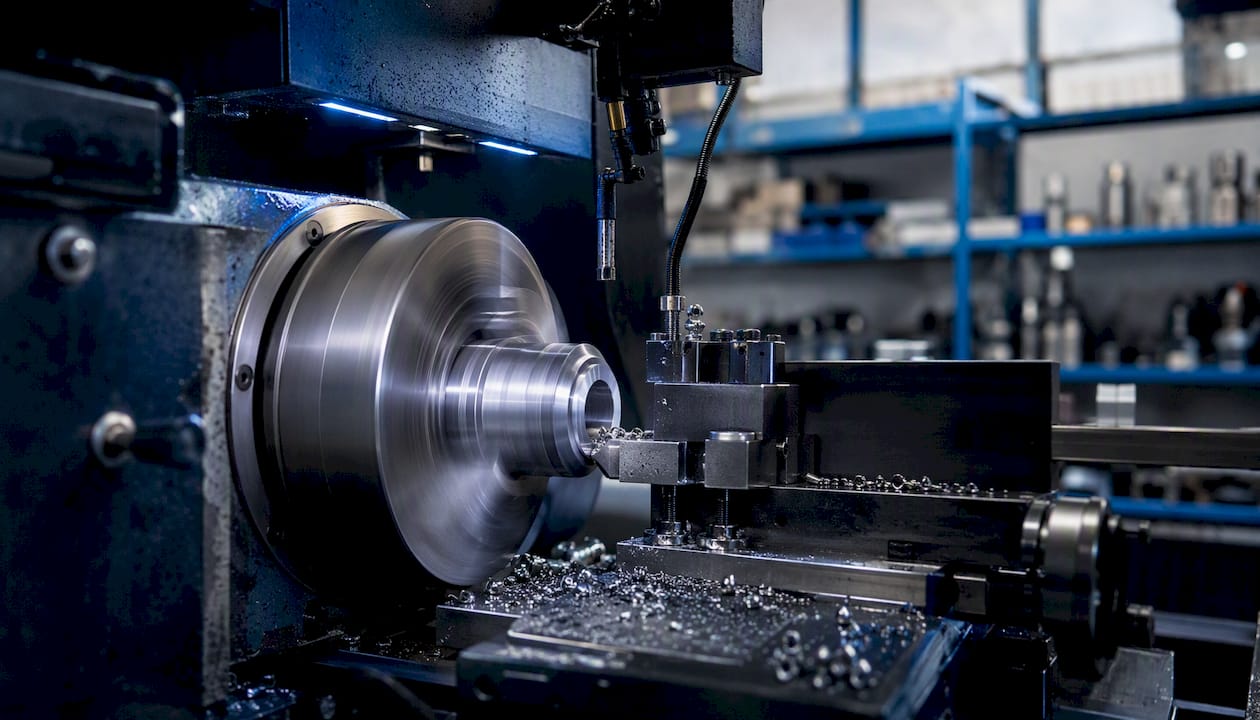
- Machine hours: The right choice for CNC and automated shops. When a machine runs, it consumes electricity, depreciation, and maintenance — not labor. Tracking machine utilization gives you the denominator you need.
For CNC shops specifically, labor hours almost always understate overhead on machine-heavy jobs. A 5-axis machining center running lights-out consumes facility space, power, and depreciation with minimal direct labor. Allocating overhead by labor hours in that scenario assigns insufficient overhead to the machine's output.
Pro Tip: Before switching allocation bases, run the new rate against the last 12 months of jobs and compare results to what you actually charged. If the new base would have changed your quotes by more than 10% on average, the switch is worth the administrative effort.
How to apply the overhead rate to pricing and reconcile variances
Once you have a rate, applying it is straightforward: multiply the rate by the job's actual or estimated driver units. Here is a sample job costing table:
| Cost Component | Calculation | Amount |
|---|---|---|
| Direct materials | Given | $1,200 |
| Direct labor (8 hrs × —/hr) | 8 × — | — |
| Applied overhead (8 machine hrs × $16.67) | 8 × $16.67 | — |
| Total job cost | $1,613 |
Price the job above $1,613 to generate margin. How far above depends on your target gross margin, but you cannot set that target without knowing the fully loaded cost first.
At year-end, compare total applied overhead to actual overhead. Say you applied $68,000 but actual overhead came in at $72,000. That $4,000 gap is under-applied overhead. The standard treatment under GAAP is to charge the variance to cost of goods sold if it is immaterial, or prorate it across work-in-process, finished goods, and COGS if it is significant. Deltek's guidance on actual overhead rate calculations walks through the mechanics of post-period reconciliation in detail.
Government contractors face an additional layer: FAR-compliant overhead pools require traceable cost categories and consistent allocation bases, with auditors checking both.
Pro Tip: Do a mini-reconciliation monthly, not just at year-end. A $4,000 annual variance discovered in December is a problem. The same variance caught in February is a data point you can act on.
The overhead rate mistake most shops make
The most common shop floor error isn't a math mistake. It's choosing the wrong driver and never questioning it again.
A shop sets up with direct labor hours as the allocation base in year one, when the floor is mostly manual. Five years later, the shop has added three CNC machining centers that run largely unattended. The overhead rate is still calculated on labor hours. The result: every automated job is systematically underpriced, every labor-intensive job is overpriced, and the shop wonders why it keeps losing bids on complex parts while winning plenty of simple ones.
The fix isn't complicated. Switching to machine hours, or splitting the overhead pool between a labor-driven pool and a machine-driven pool, realigns the rate with actual cost behavior. The math takes an afternoon. The pricing improvement lasts for years.
Monthly mini-reconciliations are the other habit most shops skip. Waiting until December to discover that applied overhead missed actual by $15,000 means twelve months of mispriced jobs. Catching a $1,200 monthly gap in February means you can adjust the predetermined rate before it compounds.
Consistent overhead accounting isn't about accounting precision for its own sake. It's the difference between knowing your margin and guessing at it.
Availzyemachinistpro's Cost Estimator puts this math to work
Manual overhead rate spreadsheets break when job mix changes, when a new machine goes on the floor, or when a new accountant inherits the file and doesn't know which cells to update. The result is mispriced quotes and margin erosion that doesn't show up until the books close.

Availzyemachinistpro's Cost Estimator is built for exactly this workflow. You configure your own overhead cost pools, select the allocation driver that fits your operation (machine hours, labor hours, or revenue), and the platform applies the rate automatically to every job estimate. Machine-utilization data from the Job Tracker feeds directly into the denominator, so your rate reflects what the shop actually ran, not what you planned. Reconciliation reports compare applied to actual at period end, and every calculation exports with a full audit trail. The Tool Crib and Maintenance Tracker feed indirect cost data into the same system, keeping your overhead pool current without manual data entry.
Plans start at $9.99/month with a 7-day free trial. Start your trial at availzye-machinist-pro.com and run your first overhead rate calculation inside the platform today.
Useful sources and further reading
- Overhead allocation — AccountingTools
- Overhead Rate | Formula + Calculator — Wall Street Prep
- Overhead rate — Investopedia
- How to calculate overhead cost — Workday
- Overhead Rate Calculator — Coefficient
- Pre-determined overhead rate — Wikipedia
- Calculating the Actual Overhead Rate — Deltek Help