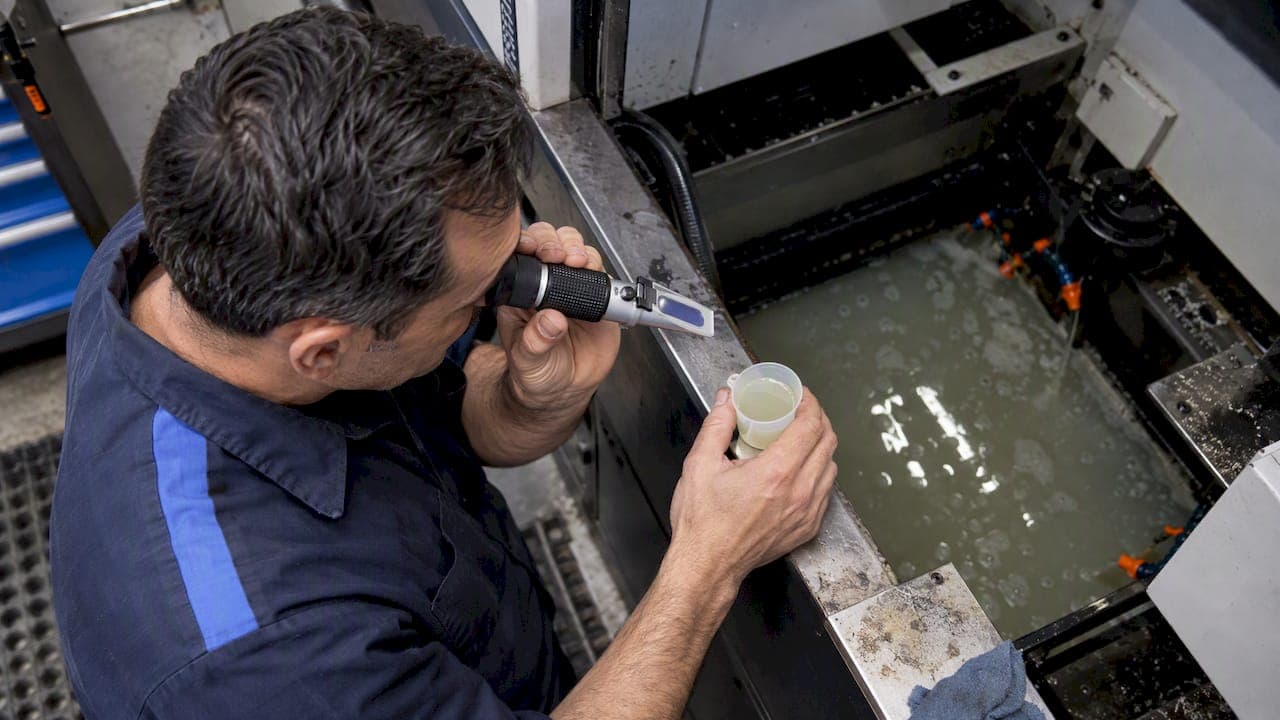
Effective cutting fluid management means keeping concentration, cleanliness, and contamination control within target ranges through routine tests and simple maintenance. A refractometer reading, a pH strip check, and a quick skim of floating tramp oil catch most problems before they start. Shops that track these basics consistently see fewer rejects, longer tool life, and lower disposal costs.
TL;DR:
- Test concentration and floating oil daily, pH weekly, and bacteria plus conductivity every two weeks to monthly; typical pH targets are 8.5 to 9.0.
- Hardness above 450 parts per million raises foaming and emulsion instability; use reverse osmosis or deionized makeup water when local water is hard.
- Field projects found skimmers extended coolant life from weeks to months; smaller shops may favor a $200 skimmer over a $10,000 centrifuge contract.
- Recycling can cut purchases by 50% to 75% and disposal costs by up to 90%, with payback in 6 to 18 months depending on volume.
- Assign one fluid manager to approve additions and dump decisions, and log readings, treatments, and changes so recurring failures can be traced to specific machines.
Table of Contents
- Types of cutting fluids and how maintenance needs vary
- Routine monitoring and testing: what to test and how often
- Contamination control and sump housekeeping
- Cleaning and reclamation: filtration, centrifuges, and coalescers
- How to set up a cutting fluid management program
- Health and engineering controls for cutting fluid exposure
- Disposal, recycling, and the cost case for reclamation
- Monitoring tech: inline sensors, dosing loops, and automation
- Troubleshooting: odor, foam, corrosion, and mist
- Operationalizing the program with shop tools
- Why small, repeatable habits beat big overhauls
- How Availzye Machinist Pro fits into your fluid program
- FAQ
- Sources
Types of cutting fluids and how maintenance needs vary
Before you can manage a fluid, you need to know what class it belongs to. The maintenance routine for a neat cutting oil looks nothing like the routine for a synthetic coolant, and mixing up the two wastes time and money.
Neat or straight oils are used undiluted, straight from the drum to the cutting zone. They do not mix with water, so they skip the biological and concentration headaches that plague water-based fluids, but they still pick up metal fines, chips, and tramp oil from leaking hydraulic or way lube systems. Their main enemies are solids buildup and oxidation from heat exposure.
Water-miscible fluids (soluble oils, semi-synthetics, and full synthetics) are diluted with water before use, which introduces an entirely different set of variables. Water hardness, bacterial growth, pH drift, and evaporation all affect how these fluids perform over time, and all require regular testing to manage.
The properties worth tracking differ by class:
- Neat oils: viscosity, color or clarity, particulate load, and signs of oxidation or burnt smell.
- Soluble oils: concentration (refractometer), pH, tramp oil percentage, and bacterial activity.
- Semi-synthetics: concentration, pH, foam tendency, and biological stability.
- Full synthetics: pH, conductivity, and biological control, since they carry less oil to feed bacteria but still support fungal growth in some formulations.
Water-miscible fluids need the most attention because water itself is an unstable ingredient. Tap water hardness and chloride content vary by location and can throw off emulsion stability even when the concentrate is mixed correctly, which is why coolant maintenance guidance from the University of Minnesota recommends reverse osmosis or deionized water for makeup whenever hardness runs high. Fluids generally perform best at total hardness at or below 450 parts per million; above that threshold, foaming and emulsion instability become more likely.
Knowing your fluid class also tells you what to expect on a shift-by-shift basis. Straight oils are forgiving and mostly need physical cleanup. Water-based coolants demand a testing habit, which is where the next section comes in.
Routine monitoring and testing: what to test and how often
A fluid management program lives or dies on testing consistency. The good news is that the core tests take under five minutes and most can be done by any operator with a few minutes of training.
Daily or per-shift checks should include a refractometer reading and a visual scan for tramp oil. A handheld refractometer measures the refractive index of the coolant sample and converts it to a concentration percentage on a built-in scale; a drop or two on the prism, a look through the eyepiece, and you have a reading. Compare it against the manufacturer's recommended range and top up with concentrate or water as needed.
Weekly checks add pH testing (strips or a handheld meter) and a tramp oil percentage check. Monthly or biweekly checks should include a bacteria count, often done with a dip-slide culture that incubates over 24 to 48 hours, and a check of total dissolved solids or conductivity if you have a meter on hand.
A practical testing cadence looks like this:
- Daily: refractometer concentration check and visual tramp oil scan.
- Weekly: pH test and tramp oil percentage measurement.
- Biweekly to monthly: bacteria dip-slide culture and conductivity check.
- Monthly: full sump inspection and sediment check.
Guidance circulated by coolant management programs puts typical pH operating ranges around 8.5 to 9.0, with elevated bacteria counts and tramp oil percentages flagged as common alert thresholds that call for immediate corrective action.
Trends matter more than single readings. A concentration that drifts downward over several days usually means evaporation or dragout losses outpacing top-up, while a steady pH decline often signals bacterial activity consuming additives faster than they can buffer the fluid. Logging results, even in a simple spreadsheet or a shop maintenance tracker, turns scattered numbers into a pattern you can act on before a sump goes bad.
Contamination control and sump housekeeping
Most coolant failures trace back to contamination rather than the fluid chemistry itself. Tramp oil, metal fines, and general shop debris feed bacteria, clog filters, and interfere with the fluid's ability to lubricate and cool.
Operator habits set the tone here. Chips and fines should be cleared from the machine regularly rather than left to settle into the sump, and sumps should never double as a trash can for rags, cigarette butts, or lunch wrappers. It sounds obvious until you see what actually floats in a neglected tank. Keeping hydraulic and way lube systems leak-free also limits tramp oil, since most of it enters coolant through drips rather than the cutting process itself.
Skimming removes floating tramp oil before it emulsifies into the coolant and starves it of oxygen, which is the first step toward rancid odor. Belt skimmers, disc skimmers, and tube skimmers each work by pulling oil off the surface where it collects, and the right choice depends on tank geometry and oil volume. A belt skimmer suits a narrow, deep sump; a disc skimmer works well in a wide, shallow tank.
- Daily: check skimmer operation and clear chips from the work zone.
- Weekly: skim tramp oil if a skimmer is not already running continuously, and check solids buildup in filters.
- Monthly: inspect sump walls and baffles for sludge accumulation.
- Semiannually or as needed: full sump drain, clean, and refill, depending on fluid condition trends.
A full sump cleaning means draining the fluid, scrubbing biofilm off tank walls and baffles, and flushing lines before refilling with fresh, properly diluted fluid. Skipping this step and simply topping up a dirty sump is one of the most common ways shops end up fighting the same odor and foam problems month after month.
Pro Tip: Run the skimmer on a timer during off-shifts so tramp oil never has a chance to sit and emulsify overnight.

Cleaning and reclamation: filtration, centrifuges, and coalescers
Skimming handles the oil that floats. Solids removal and deeper reclamation handle everything else, and the right equipment depends heavily on shop volume.
- Bag and cartridge filters: remove fine particulates from recirculating coolant; low cost, but filters need regular replacement as they load up.
- Centrifuges: spin out fine solids and some tramp oil using centrifugal force, useful for high-volume grinding operations with heavy fines loading.
- Hydrocyclones: separate denser particles from fluid using a cyclonic flow pattern, often used as a pre-filter stage ahead of finer filtration.
- Coalescers: merge small oil droplets into larger ones that rise and can be skimmed off, useful where tramp oil is persistent and fine.
Field projects documented by the EPA found that simple skimmers extended coolant life from weeks to months in many shops, while some mobile centrifuge services tested in the same projects were not cost-effective at smaller volumes. That distinction matters for deciding where to spend money: a $200 skimmer often outperforms a $10,000 centrifuge contract if your shop runs a handful of machines rather than a full grinding department.
Disposal costs for contaminated coolant range from roughly $20 to $200 per 55-gallon drum, depending on contamination level and local disposal rules, which is a major reason reclamation pays off at scale.
A central reclamation system, where fluid is piped from multiple machines to a shared filtration and skimming station, tends to make financial sense once a shop runs enough machines that individual sump maintenance becomes a full-time job. Below that threshold, per-machine skimmers and a disciplined testing schedule usually deliver most of the benefit at a fraction of the cost. Whatever method you choose, pre-filtration ahead of any fine separation stage extends equipment life and reduces how often filters or cartridges need replacing.
How to set up a cutting fluid management program
A program only works when someone owns it. Without a named person responsible for testing, approving additions, and signing off on sump changes, fluid maintenance drifts to whoever happens to notice a problem, usually after it has already gotten expensive.
The Iowa Waste Reduction Center's guidance on small machining operations frames effective programs around four pillars: administrative control through a designated fluid manager, routine monitoring of concentration and biological levels, physical maintenance like skimming and fines removal, and recycling to restore spent fluid quality. Building a program around those four areas gives you a template rather than a list of disconnected tasks.
A practical setup sequence looks like this:
- Designate a fluid manager who controls concentrate additions, approves top-ups, and signs off on dump decisions, rather than leaving it to whoever grabs the jug.
- Write a short SOP covering sampling procedure (where and how to pull a sample), test methods and frequency, acceptable ranges, and who to notify when a reading falls outside them.
- Set top-up rules so operators know exactly how much concentrate or water to add for a given refractometer deviation, removing guesswork from daily adjustments.
- Define dump triggers such as bacteria counts exceeding a set threshold, persistent odor despite skimming, or pH that will not hold after repeated additions, distinguishing a partial dump and dilution from a full sump change.
- Log every test, addition, and change in a shared record, whether a logbook or a digital maintenance tracker, so patterns show up over weeks rather than getting lost in memory.
The recordkeeping piece deserves attention because it is what turns a reactive shop into a predictable one. Tracking days-in-service per sump fill, disposal cost per drum, and concentration trend over time lets you spot a sump that is underperforming before it fails outright. A shop that logs this data for even a few months usually finds one or two machines that chew through coolant faster than the rest, often tracing back to a leak, poor chip evacuation, or a ventilation gap that lets evaporation run high.
None of this requires sophisticated software to start. A clipboard and a spreadsheet work fine for a single-machine shop. What matters is consistency: the same person checking the same things on the same schedule, with results written down where the next shift can see them.
Health and engineering controls for cutting fluid exposure
Cutting fluids are not just a machining problem, they are an occupational health issue, and the controls that keep fluids clean also tend to keep operators safer.
Mist and direct skin contact from poorly managed fluids are linked to dermatitis, respiratory irritation, and in rare cases a more serious hypersensitivity reaction, according to CDC/NIOSH's archived health hazard update on metalworking fluids. Watching for persistent skin irritation among operators or recurring respiratory complaints is a practical early-warning sign that fluid management, mist control, or both need attention.
OSHA's Metalworking Fluids manual recommends a systems management approach built around engineering controls first, rather than relying on personal protective equipment alone. That means:
- Enclosures around the cutting zone to contain mist and splash at the source.
- Local exhaust ventilation positioned to capture mist before it disperses into the shop air.
- Mist suppression nozzles or coolant delivery redesign to reduce the fine aerosol generated at high spindle speeds.
- Machine delivery design that directs fluid where it is needed without excessive atomization.
OSHA's exposure evaluation guidance similarly emphasizes engineering and work-practice controls over PPE as the primary line of defense. PPE such as gloves and splash goggles still has a place, particularly during manual sampling, sump cleaning, or additive handling, and training records documenting who has been instructed in proper fluid handling and PPE use are worth keeping alongside your test logs.
Disposal, recycling, and the cost case for reclamation
Disposal is where poor fluid management shows up on the balance sheet. Contaminated coolant costs more to haul away, and the contamination that drives up disposal fees is almost always preventable with the maintenance steps covered earlier.
Disposal costs for spent cutting fluid typically run $20 to $200 per 55-gallon drum, with the high end driven by heavy metal contamination, excessive tramp oil, or local hazardous waste classification. Shops that keep fluids clean through skimming and filtration consistently land toward the lower end of that range, since cleaner spent fluid is cheaper to process or dispose of properly.
Coolant recycling systems can reduce new fluid purchases by 50 to 75% and cut disposal costs by as much as 90%, with many systems paying for themselves within 6 to 18 months. That range depends heavily on shop volume and how contaminated the fluid was running before recycling was introduced, so the real payback for any given shop depends on getting a baseline cost picture first.

Before sending spent fluid out for disposal or recycling, document the volume, the hauler or recycler, the waste manifest number if applicable, and the test results that justified the dump. That record protects you in an audit and gives you the cost history needed to evaluate whether an in-house reclamation system would pay for itself at your volume.
Monitoring tech: inline sensors, dosing loops, and automation
Spot checks with a handheld refractometer work well for most shops, but they only capture a snapshot. Inline monitoring closes the gap by measuring concentration continuously and feeding that data into a dosing loop that adjusts additions automatically.
A handheld refractometer is cheap, portable, and accurate enough for daily use, but it depends on someone remembering to pull a sample and read it correctly. An inline refractometer sits in the coolant line and reports concentration continuously, often outputting a signal that a programmable logic controller can use to trigger automatic top-up. The tradeoff is maintenance: the prism needs regular cleaning since deposited film or grit on its surface is the most common failure mode for inline units, and upstream filtration helps keep debris away from the sensor.
Inline monitors are excellent at tracking concentration drift in real time, which lets a dosing loop correct it before performance suffers. What they generally cannot detect is bacterial load or tramp oil percentage, both of which still need periodic manual testing, dip-slide cultures, or a lab sample. Treat inline monitoring as a concentration-control tool, not a full replacement for the weekly and monthly checks covered earlier.
For a shop considering the jump, start with one high-volume machine or a central reclamation loop rather than instrumenting every sump at once. Mount the sensor in a bypass line so it can be pulled for cleaning without shutting down the machine, and set a cleaning schedule, whether a timed high-pressure flush or an occasional ultrasonic bath, before deposits build up enough to skew readings.
Troubleshooting: odor, foam, corrosion, and mist
Most fluid complaints trace back to one of four root causes, and a quick diagnostic flow usually points to the fix.
- Odor: usually anaerobic bacteria thriving in stagnant, tramp-oil-covered fluid. Skim oil, run a bacteria dip-slide, and keep the sump circulating during idle periods rather than letting it sit still overnight.
- Foam: often linked to water hardness, concentration run too high, or detergent contamination from cleaning chemicals. Check concentration first, then test water hardness if foam persists after correcting the mix.
- Corrosion: typically a pH drop, low concentration, or high chloride content in makeup water. Test pH and concentration immediately, and switch to softer makeup water if chlorides are the culprit.
- Mist and respiratory complaints: check machine delivery pressure and ventilation effectiveness rather than the fluid chemistry alone.
A single out-of-range reading usually calls for a top-up or a partial dilution. Repeated failures across multiple tests, or a bacteria count that will not come down after skimming and biocide treatment, mean it is time for a full sump drain and clean rather than another round of patches.
Operationalizing the program with shop tools
A fluid program only sticks when it is easy to follow on a busy shift. Writing the SOP down matters less than making it visible and trackable where operators already look.
A maintenance tracker that logs scheduled checks, flags overdue tests, and stores the SOP alongside the equipment it applies to turns a paper plan into something the whole shift can see and follow, the same way a CNC maintenance checklist keeps machine service intervals from slipping. Logging refractometer and pH results next to scrap rates and tool life data makes it easier to spot when a degraded coolant is quietly driving up tool wear or hurting surface finish.
A simple maintenance log template adapted for fluid checks works as a starting point for shops not ready to commit to dedicated software: columns for date, reading, action taken, and who performed the check are enough to start spotting trends within a month.
Why small, repeatable habits beat big overhauls
Shops love the idea of a major fix: a new recycling system, a complete SOP overhaul, a fresh fluid formulation. What actually moves the needle is smaller and less exciting. A daily refractometer check, a skimmer that runs without being asked, and a one-page SOP that someone actually follows will outperform an expensive reclamation system installed in a shop with no testing discipline behind it.
The habit matters more than the hardware. Appoint a fluid manager, pick three or four numbers worth tracking, and check them on a schedule you can actually keep. Everything else, including whether a centrifuge or a coalescer makes sense, becomes an easier decision once that baseline exists.
— Availzye
How Availzye Machinist Pro fits into your fluid program
Running a fluid management program means juggling test schedules, SOPs, and the connection between fluid condition and shop performance, and that is exactly the kind of juggling this platform was built to simplify. Instead of a logbook in one place and SOPs in another, we keep everything in one cloud-synced workspace your whole team can see.

With these tools, users can:
- Schedule recurring fluid checks through a Maintenance Tracker to keep tests on schedule.
- Store SOPs and test procedures in document management alongside the machine records they apply to.
- Correlate fluid condition with tool life and surface finish using available calculators, turning scattered readings into a clearer picture of what drives scrap or rework.
A 7-day free trial gets you started with no commitment, and our Individual, Small Shop, and Team plans scale from a solo machinist to a full shop floor. Set up your first fluid tracker today and see what consistent monitoring looks like when it lives in one place.
FAQ
Can WD-40 be used as cutting fluid?
WD-40 is a light lubricant and penetrant, not an engineered cutting fluid, so it lacks the cooling capacity and additive package that real cutting fluids provide for machining tasks. It may work in a pinch for a single light cut, but it will not hold up under repeated heavy machining and is not a substitute for a proper water-miscible or neat cutting oil.
What can I use as cutting fluid?
The right choice depends on the operation: neat cutting oils suit heavy-duty or low-speed work where cooling matters less than lubrication, while water-miscible fluids (soluble oils, semi-synthetics, and synthetics) suit higher-speed work where cooling and chip flushing matter more. Matching the fluid class to your material and operation, then following a monitoring routine, matters more than any single product choice.
What are the two major types of cutting fluids?
The two broad categories are neat or straight oils, used undiluted, and water-miscible fluids, which are diluted with water before use and include soluble oils, semi-synthetics, and full synthetics. Water-miscible fluids need concentration, pH, and biological monitoring that neat oils generally do not.
Can I use motor oil as cutting fluid?
Motor oil is formulated for engine lubrication and contains additives not designed for metal cutting, so it lacks the extreme-pressure and cooling properties that dedicated cutting oils provide. Using it regularly can lead to poor surface finish, faster tool wear, and disposal complications, since it is not formulated or tested as a metalworking fluid.
Sources
- Cutting Fluid Management: Small Machining Operations — Iowa Waste Reduction Center (IWRC)
- Metalworking Fluids: Safety and Health Best Practices Manual — OSHA
- Machine coolant waste reduction and maintenance project — EPA technical report