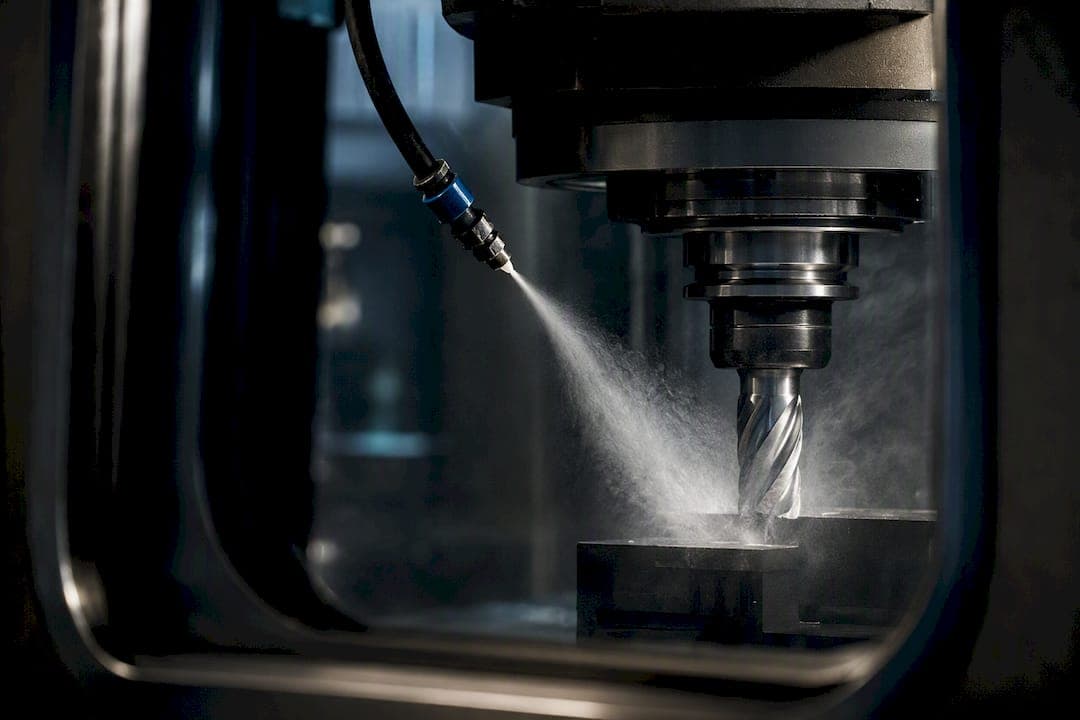
Minimum quantity lubrication delivers a fine oil mist, typically 5 to 50 milliliters per hour, straight to the cutting edge instead of flooding the part in coolant. MQL machining wins when lubrication at the tool-chip interface matters more than bulk cooling or chip flushing, which covers most turning, milling, and drilling work. It loses ground on grinding and heavy interrupted cuts where you need volume to carry heat and debris away, not just a mist to reduce friction.
TL;DR:
- MQL typically delivers 5 to 50 milliliters of oil per hour directly to the cutting edge, mainly benefiting turning, milling, and drilling operations where lubrication at the tool-chip interface is critical.
- Its effectiveness diminishes in operations requiring bulk heat removal or debris flushing, such as grinding and heavy interrupted cuts, where volume is essential.
- Proper nozzle pressure, precise positioning, and high-quality extraction are crucial for consistent mist delivery, especially at high spindle speeds, to avoid misting the chip guard instead of the tool.
- MQL can reduce fluid use by up to 99.8% and extend tool life when correctly tuned; however, material type and operation complexity influence its success.
- Choosing the right system—external or internal-feed—and fluid, along with precise setup and initial testing on known parts, accelerates reliable adoption and helps avoid common troubleshooting pitfalls.
Table of Contents
- What Is MQL Machining? Dosage Ranges and Units
- How MQL Delivers Lubrication and Cooling at the Cutting Zone
- Quantified Benefits and the Limits Nobody Advertises
- Which Operations Actually Benefit From MQL?
- Choosing the Right MQL System and Extraction Setup
- Selecting Fluids and Dialing In Starting Settings
- Setup Checklist and Troubleshooting MQL Machining
- What Shops Should Actually Expect From an MQL Pilot
- Tune MQL Setups Faster With Availzye Machinist Pro
- Sources
- FAQ
What Is MQL Machining? Dosage Ranges and Units
MQL machining, often called near-dry machining, replaces gallons of flood coolant per hour with milliliters of oil delivered as an aerosol directly at the cutting zone. It's a total-loss system: the lubricant is consumed or evaporated during the cut rather than collected, filtered, and recirculated like flood coolant.
Dosage is where most shops get confused, so here's the actual range:
- Typical rates run 5 to 50 milliliters per hour for common jobs, per DGUV guidance on minimum quantity lubrication.
- The Unist MQL Handbook cites a working range of 5 to 80 mL/h for tools under 40 mm.
- Exceptional cases, usually deep-hole drilling or tough alloys, push to 150 mL/h.
- Converted, that's roughly 0.17 to 1.7 fluid ounces per hour for most operations.
Because there's no reservoir to filter or dispose of, fluid selection and nozzle accuracy carry more weight than they do in flood systems.
How MQL Delivers Lubrication and Cooling at the Cutting Zone
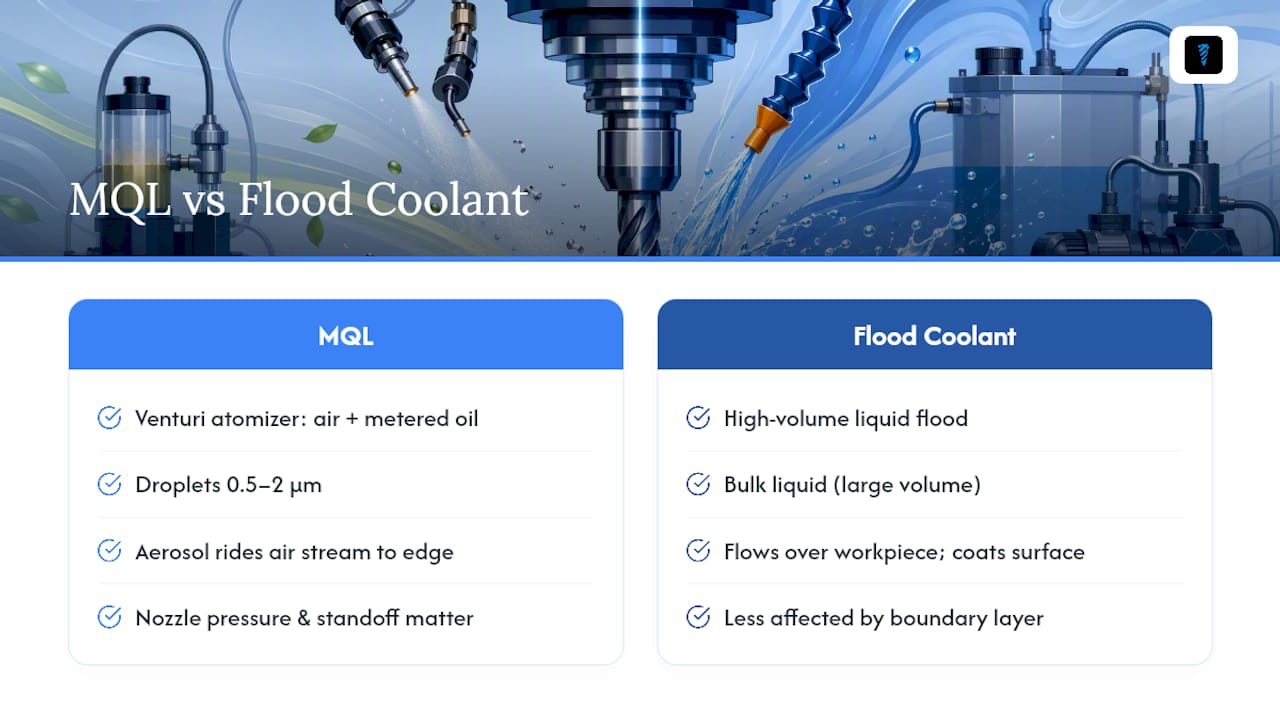
MQL works through atomization, not volume. A venturi-based atomizer mixes compressed air with a metered oil flow, producing droplets in the 0.5 to 2 micron range, according to the Unist Handbook. Droplets that fine ride the air stream instead of falling out of it, which is what lets the mist actually reach the cutting edge rather than coating the workpiece around it.
That delivery has to fight the air barrier a spinning tool generates. At high RPM, a tool's rotation throws off a boundary layer of air that repels anything trying to approach the surface, so nozzle pressure and standoff distance matter more as speed climbs. Get the geometry wrong and you're misting the chip guard, not the tool.
Once the aerosol lands, it works differently than flood coolant does. Flood coolant pulls heat out in bulk through sheer volume and convection. MQL leans on lubrication first, reducing friction and adhesion at the tool-chip interface, with a smaller assist from evaporative cooling as the oil droplets flash off. That's the trade-off in one sentence: less raw heat removal, more friction control.
Quantified Benefits and the Limits Nobody Advertises
The efficiency numbers are the real draw. MQL machining can cut fluid consumption by up to 99.8% compared to flood coolant, according to a 2025 review on sustainable manufacturing pathways, while still improving tool life and surface finish when the process is tuned correctly.
By the numbers:** Reviewers across multiple experimental studies report meaningful reductions in cutting forces and energy draw under optimized MQL, alongside longer tool life. The catch: results swing hard depending on material, feed rate, and how well the aerosol actually reaches the cutting edge.
The limitations are just as real as the benefits. MQL struggles wherever chip flushing is the job, not lubrication. Grinding needs volume to carry away abrasive debris; MQL's mist can't do that work. Heavy interrupted cuts and some deep-drilling operations also fight the process, since a stalled air barrier or clogged flute defeats the mist before it ever lubricates anything.
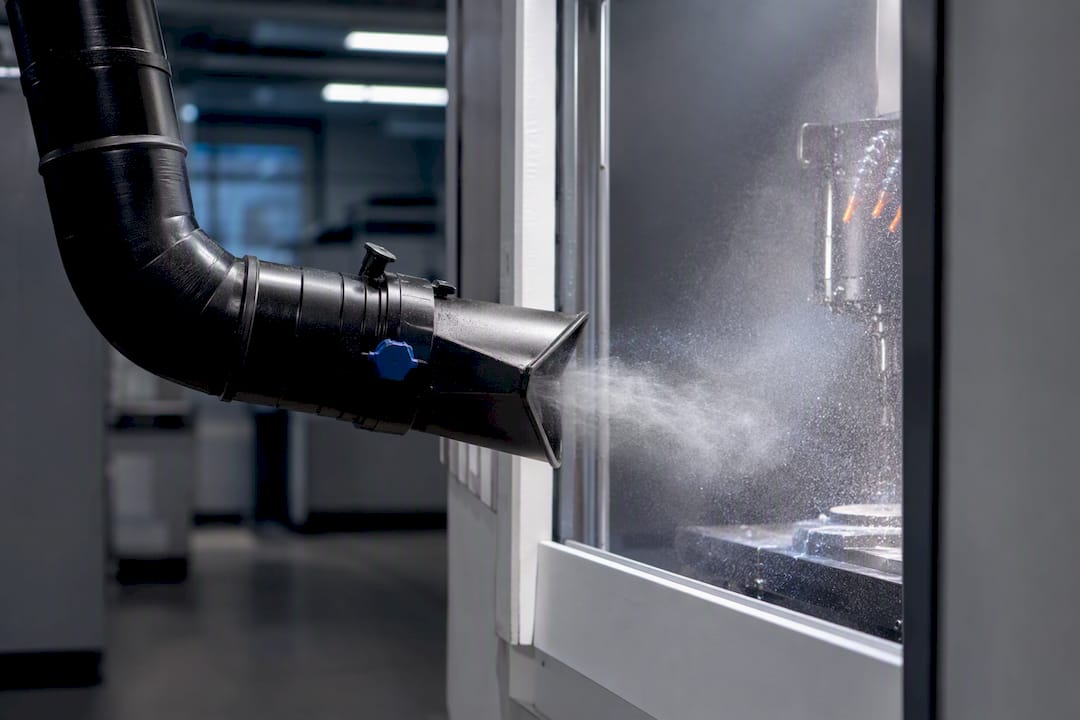
There's a health upside that gets less attention than it deserves. Airborne oil mist still needs management. The DGUV guidance recommends extraction near the cutting point specifically to control aerosol exposure, not as an afterthought.
Which Operations Actually Benefit From MQL?
MQL suitability depends heavily on the operation and the material sitting in the chuck.
- Turning tends to be MQL's easiest win, especially on continuous cuts where the mist has a stable path to the tool tip.
- High-speed milling benefits when nozzle geometry accounts for the air barrier at higher spindle speeds, per high feed milling technique guidance.
- Drilling works well through-tool for shallow to moderate depths, where internal-feed MQL can push mist past the flutes before chip evacuation becomes the bottleneck.
- Grinding and heavy interrupted milling are the operations to treat with caution, since chip flushing needs there routinely outrun what an aerosol can deliver.
Material matters as much as operation. Aluminum machines cleanly under plain MQL with minimal tuning. Steels, nickel alloys, and titanium are a different story: they generate more heat at the interface, and plain MQL often falls short. That's where hybrid approaches, nanoparticle-enhanced fluids or cryogenic-assisted MQL, start showing real gains in tool life and heat dissipation on difficult alloys, per PMC research on MQL performance advancements.
Choosing the Right MQL System and Extraction Setup
Hardware choice shapes reliability more than most shops expect going in.
- External nozzle systems mount near the tool and retrofit onto almost any machine with minimal downtime. They're the fastest path to test MQL machining without touching the spindle.
- Internal-feed systems route the mist through the spindle and tool itself, which is the better long-term choice for high-speed cutting, deep holes, and any production run where consistency can't depend on a nozzle staying aimed correctly shift after shift.
- One-channel systems pre-mix air and oil before the hose, which is simpler but gives you less control over atomization quality.
- Two-channel systems keep air and oil separate until the nozzle, generally producing a finer, more consistent aerosol, per the Unist Handbook.
Extraction isn't optional infrastructure, it's part of the system. Near-point extraction at the cutting zone, spindle-head extraction on enclosed machines, and downward extraction through the chip conveyor all reduce airborne aerosol buildup, a recommendation that comes straight from DGUV occupational guidance on MQL operations.
Selecting Fluids and Dialing In Starting Settings
Fluid choice drives more of MQL's success than most spec sheets suggest. Prioritize lubricity first, since that's the property doing the actual work at the tool-chip interface. Viscosity at 40°C needs to sit in a range that atomizes cleanly rather than clumping in the nozzle. Thermal stability keeps the fluid from breaking down under cutting heat, and biodegradable formulations reduce disposal and exposure concerns where they're available.
Starting settings worth testing on a new setup:
- Nozzle-to-cut distance around 6 to 9 millimeters for most tool sizes.
- Spray angle aimed to intercept the tool-chip interface directly, not the flank.
- Pressure set high enough to punch through the air barrier at your target RPM, then adjusted down if you see excess mist scatter.
Chips tell you almost everything you need to know. Wet, oily chips mean you're overdosing, back off the flow. Discoloration or built-up edge on the tool usually points to insufficient flow or a speed mismatch, not a fluid problem.
Pro Tip: Run your first MQL trial on a part you already know cold. If chip color or tool wear looks different from your flood-coolant baseline, you're diagnosing the MQL setup, not the job itself.
Setup Checklist and Troubleshooting MQL Machining
Get the sequence right before you chase symptoms:
- Verify the applicator, hoses, and seals are intact and leak-free.
- Set the flow rate in mL/h based on the operation, starting conservative.
- Position the nozzle at the correct distance and angle for the tool diameter.
- Enable extraction before the first cut, not after.
- Run a trial cut and inspect chips and finish before committing to a production run.
Most MQL problems trace back to delivery, not the process itself. A practitioner analysis of MQL troubleshooting points to nozzle misalignment, insufficient pressure, or a mist that never overcomes the air barrier as the usual root causes behind inconsistent finish or built-up edge, not some fundamental flaw in MQL as a method.
This is where calculation tools earn their keep. Picking a starting RPM and feed with a proper feeds and speeds calculator gets you into the right cutting regime before you start chasing MQL variables, and checking tool deflection at those parameters rules out a mechanical issue masquerading as a lubrication problem.
Pro Tip: If surface finish is inconsistent but chip color looks fine, check deflection before you touch the nozzle. A tool flexing under load produces the same symptoms as bad mist delivery.
What Shops Should Actually Expect From an MQL Pilot
Run your first MQL machining pilot on a stable family of parts you already understand, not your hardest job. Payback tends to come from two places: eliminated fluid disposal costs and longer tool life, both of which show up faster than most shops expect once the nozzle is dialed in.
Budget for extraction and, if you're serious about high-speed or deep-hole work, an internal-feed retrofit. Track chip quality and tool life from day one; that log is what tells you whether MQL is actually working or just running.
Tune MQL Setups Faster With Availzye Machinist Pro
Dialing in an MQL setup by trial and error costs tool life and shop time you don't get back. Specialized machining software tools can shorten that iteration loop by giving you the starting numbers before the first chip flies.

Run your target material and tool through the feeds and speeds calculator to get an RPM and feed range suited to MQL's lighter cooling profile, then check tool deflection at those settings before you commit spindle time to a trial cut. Once the process is dialed in, the Tool Crib tracks tool life against your new MQL parameters automatically, and the Job Tracker keeps that data attached to the actual work order instead of a shop notebook. If you're piloting MQL machining on a new job family, start a 7-day free trial and run the calculators against your first test part.
Sources
- Minimum quantity lubrication for machining operations (DGUV information 209-025)
- MQL Handbook (Unist)
- Advancements in MQL performance (PMC article)
- Opportunities and challenges of minimum quantity lubrication as pathways to sustainable manufacturing
FAQ
What Is MQL in Machining?
MQL, or minimum quantity lubrication, delivers a fine oil mist, typically 5 to 50 milliliters per hour, directly to the cutting zone instead of flooding the workpiece with coolant.
What Are the Two Types of Machining Lubrication Delivery?
MQL systems come in external nozzle setups, which spray the mist from outside the tool, and internal-feed systems, which route the aerosol through the spindle and tool itself for more consistent delivery.
What Are the Four Main Types of Cutting Fluid Application?
The common categories are flood coolant, mist/MQL application, dry machining with no fluid, and cryogenic cooling, each suited to different combinations of material, tool, and operation.
What Is the Best Lubricant for MQL Machining?
The best MQL fluid balances high lubricity, stable viscosity around 40°C, and thermal stability, with biodegradable formulations preferred where disposal and exposure are concerns. The right choice still depends on the material and operation, so testing against your own chip and finish results matters more than any single spec sheet.