
Every shift handover note needs four things: a production snapshot, current equipment status, any active safety permits or lockout/tagout isolations, and a ranked list of top priorities for the incoming crew. Safety items are the exception to everything else; they require a named recipient and a timestamped acknowledgement, not just a line on a clipboard. The rest of this comes down to a one-page template and a few minutes of overlap between shifts.
TL;DR:
- Having a standardized, one-page handover template ensures quick readability and consistent transfer of critical information across shifts.
- Clear, concise entries for production, equipment status, ongoing tasks, and safety permits prevent miscommunication and support accountability.
- A 15-minute face-to-face overlap combined with a read-back process reduces errors and confirms understanding before the shift begins.
- Digital logs with automatic timestamps and system integrations improve accuracy, retrieval, and tracking compared to paper-based records.
- Enforcing signature or acknowledgment requirements and scheduling audits help sustain a high-quality, error-resistant handover process.
Table of Contents
- What Goes on a Shift Handover Template?
- What Should Each Field Actually Say?
- How Should You Run the Actual Handover?
- How Do You Handle LOTO and Permit Transfers Safely?
- Should You Use a Digital Handover Log or Paper?
- What Does a Filled-Out Handover Actually Look Like?
- What Are the Most Common Handover Mistakes?
- Why Rollout Matters More Than the Template Itself
- How Availzye Machinist Pro Keeps Handovers on Record
- Sources
- FAQ
What Goes on a Shift Handover Template?
A single-page shift handover template beats a notebook full of scattered comments because it forces the same information into the same place every time. That consistency is what makes a one-page handoff form readable in under two minutes, which matters more than it sounds like it should. A supervisor skimming a page in 90 seconds actually reads it. A supervisor facing three pages of narrative skips to the end.
Your template needs these sections, in this order:
- Header fields: date, shift (day/swing/night), prepared by, department or line number.
- Production summary: units produced against target, downtime minutes, main cause.
- Equipment status: machine ID, current state, faults, parts on order.
- Safety permits and LOTO: asset, isolation point, lock number, recipient, timestamp.
- Top priorities: three items max, ranked by urgency.
- Open notes: anything that doesn't fit above but the next shift needs to know.
- Signature and acknowledgement: incoming supervisor signs and timestamps.
Attach photos of anything visual (a cracked fixture, a leak, a damaged part), and link work orders by number instead of describing them from memory. If your shop already tracks jobs digitally, a work order workflow with enforced states makes it easy to reference an open ticket instead of re-explaining it in prose.
What Should Each Field Actually Say?
Vague entries are the most common failure point in shift handover notes, and they're avoidable with a little discipline about phrasing. Here's what each field needs, field by field:
- Production: state units produced versus target, downtime in minutes with the main reason ("Line 3, 22 min, coolant pump replacement"), and quality issues in short phrases ("Batch 447, 3 parts out of tolerance, held for QC").
- Equipment: record machine ID, the symptom in plain language, and current status. Write "running," "idle," or "faulted," not "having some issues." If a part is on order, name it and the ETA ("spindle bearing, ETA Thursday").
- Ongoing tasks: give the job number, percent complete, who owns it, and the next action with a rough time estimate ("Job 8842, 60% done, owner Dave, next step is fixture change, ~30 min").
- Safety items: permit ID, the asset affected, the isolation point, the lock number, and the name of the person on the incoming shift accepting responsibility.
Skip adjectives. "Machine seems fine" tells the next supervisor nothing.
How Should You Run the Actual Handover?

A written note is only half the job. The other half is a short, structured conversation, and skipping it is where most information gets lost. A NASA-funded study on shift handovers found that face-to-face handovers reduced errors more than written notes alone, with audio and video support also outperforming paper-only handoffs.
Here's how to structure the overlap:
- Aim for 15 minutes of paid overlap between outgoing and incoming supervisors; treat 5 minutes as the absolute floor.
- The outgoing supervisor walks the incoming supervisor through the top priorities and any safety items first, not last.
- The incoming supervisor reads back the key points out loud, then signs the acknowledgement line. This read-back step catches misunderstandings before they turn into mistakes on the floor.
- If overlap genuinely isn't possible that day, the incoming supervisor completes a short digital acknowledgement checklist before touching any flagged equipment.
Pro Tip: If your shifts never overlap because of staffing, record a 60-second voice memo attached to the digital log. It's not face-to-face, but it beats a cold read of text every time.
How Do You Handle LOTO and Permit Transfers Safely?
Active lockout/tagout isolations and safety permits carry a higher documentation bar than everything else on the page, and that's by design, not preference. OSHA's 29 CFR 1910.147 requires documented energy control procedures, and that documentation has to survive the handoff between shifts intact.

Every active LOTO or permit needs its asset ID, isolation point, lock number, a named incoming recipient, and a timestamp. That's five fields, no exceptions.
You have two paths for permit transfer: close and reissue the permit at shift change, or formally transfer it with a co-signature from both supervisors. Use close-and-reissue for routine, low-risk work. Use co-signed transfer when the job spans the shift boundary and stopping work mid-task creates its own hazard.
Why this matters: A named recipient with a digital timestamp turns a handover note into an audit trail, not just a memory aid.
Should You Use a Digital Handover Log or Paper?
Digital logs win on almost every axis that matters for accountability. They timestamp automatically, they're searchable months later, and they pull production counts and open work orders straight from your systems instead of requiring someone to retype them. Integrating handover boards with CMMS cuts re-diagnosis time because the incoming crew sees the same data the outgoing crew was already working from.
The best integration points are:
- CMMS work orders, so open maintenance tickets show up without manual entry.
- Tool crib and inventory systems, so parts-on-order status is current.
- MES production counts, pulled automatically instead of hand-copied.
- Photo attachments, for anything a written line can't fully capture.
If full integration isn't there yet, a hybrid approach works: keep the paper form on the floor for speed, then photograph and upload it to a shared digital log before the shift ends. It's not elegant, but it beats losing the only copy in someone's back pocket.
What Does a Filled-Out Handover Actually Look Like?
Here's a realistic entry for a single production line, written the way it should read in under 90 seconds:
That's the whole entry. No filler, no narrative, just what the next person needs.
What Are the Most Common Handover Mistakes?
Good shift handover notes come down to enforcement more than template design. Here's the short list that separates shops with clean handoffs from shops that lose information every night:
- Standardize one format as the single source of truth. If half the crew uses the template and half scribbles on a whiteboard, you have two conflicting records.
- Require a signature or digital acknowledgement on every handover, no exceptions, especially for safety items.
- Schedule the overlap and protect it. If supervisors are pulled onto the floor mid-handover, the conversation never happens.
- Never rely on memory for anything safety-critical. If it's not written with a name and timestamp, it didn't happen.
- Keep entries in short phrases, not paragraphs. If a field takes more than one sentence to write, it usually needs to be two entries.
- Run a one-week audit of what's getting missed, then fix the top five recurring gaps before touching anything else.
Why Rollout Matters More Than the Template Itself
Most resistance to structured handovers fades within two weeks once supervisors see fewer repeated questions and less re-diagnosis time. The template matters less than whether leadership enforces the signature step from day one.
— Availzye
How Availzye Machinist Pro Keeps Handovers on Record
Availzye Machinist Pro replaces the notebook-and-whiteboard routine with shift notes that live next to your actual shop data instead of beside it. Your team enters production numbers, equipment faults, and priorities directly against the job and machine records already in the system, so nothing gets retyped or lost between the floor and the office.
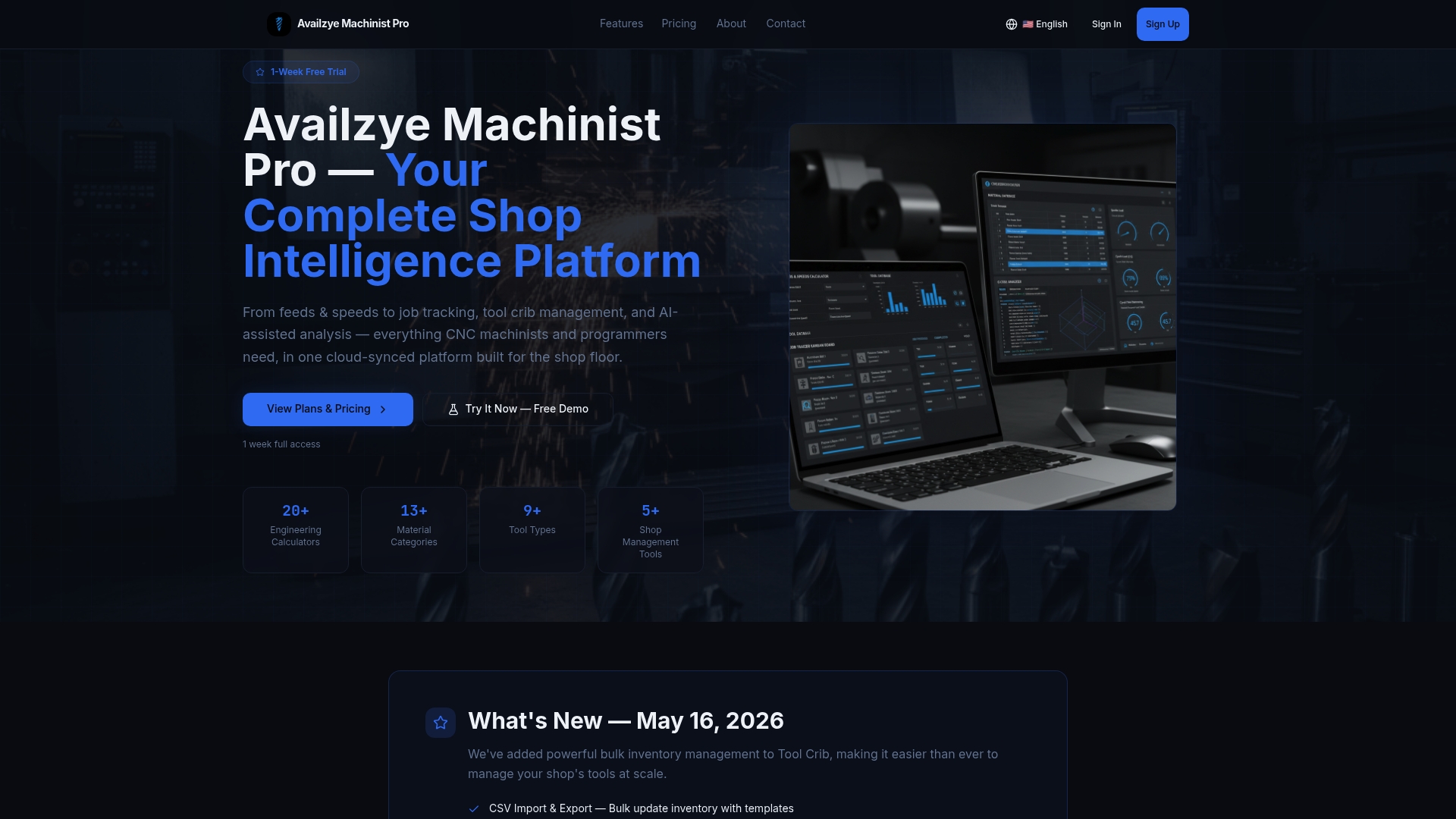
The Job Tracker keeps open work orders visible to the incoming shift automatically, the Maintenance Tracker logs downtime and service history against the exact machine flagged in a handover, and the Tool Crib shows parts-on-order status without a phone call to the crib attendant. Digital acknowledgement means every safety-critical entry gets a name and a timestamp attached, not a hope that someone read it. Small Shop and Team plans include role-based access, so who can close out a handover item stays controlled. Start a 7-day free trial and run your next shift change through it before deciding whether it earns a permanent spot on the floor.
Sources
- OSHA — 29 CFR 1910.147
- Passing the Baton: An Experimental Study of Shift Handover (NASA-funded)
- The Shift Handoff Form Every Manufacturing Plant Needs — Sharpen
FAQ
What Should You Write in Shift Handover Notes?
Write the production numbers against target, current equipment status with any faults, active safety permits or LOTO items with a named recipient, and your top three priorities for the incoming shift. Keep each entry to a short phrase rather than a paragraph so the whole page reads in under two minutes, per practitioner guidance on one-page handoff forms.
What Should Be Included in a Shift Handover?
A complete shift handover includes header fields (date, shift, department), a production summary, equipment status, ongoing task status, and any safety-critical items requiring transfer. Safety permits and lockout/tagout isolations need an asset ID, isolation point, lock number, and a named recipient under OSHA's energy control standard.
What Is a Handover Note?
A handover note is a written record that transfers operational awareness from one shift to the next, covering what happened, what's unresolved, and what needs attention first. It works best paired with a brief face-to-face conversation, since research on handover modalities found face-to-face exchanges reduce errors more than written notes alone.
Can You Give an Example of a Work Handover Report?
A filled example might read: "Line 2, 1,140 units against a 1,200 target, Mill 4 faulted on spindle overtemp with a bearing on order for Thursday, active LOTO on Press 7 with named recipient M. Chen, top priority is monitoring Mill 4 temperature." The incoming supervisor then signs and timestamps the acknowledgement line.
Does Availzye Machinist Pro Support Shift Handover Notes?
Yes. Availzye Machinist Pro includes built-in shift notes tied to your Job Tracker and Maintenance Tracker data, plus digital acknowledgement for safety-critical entries. Plans start with Individual at $9.99 CAD per month, with Small Shop and Team tiers available for larger crews, all through a 7-day free trial.