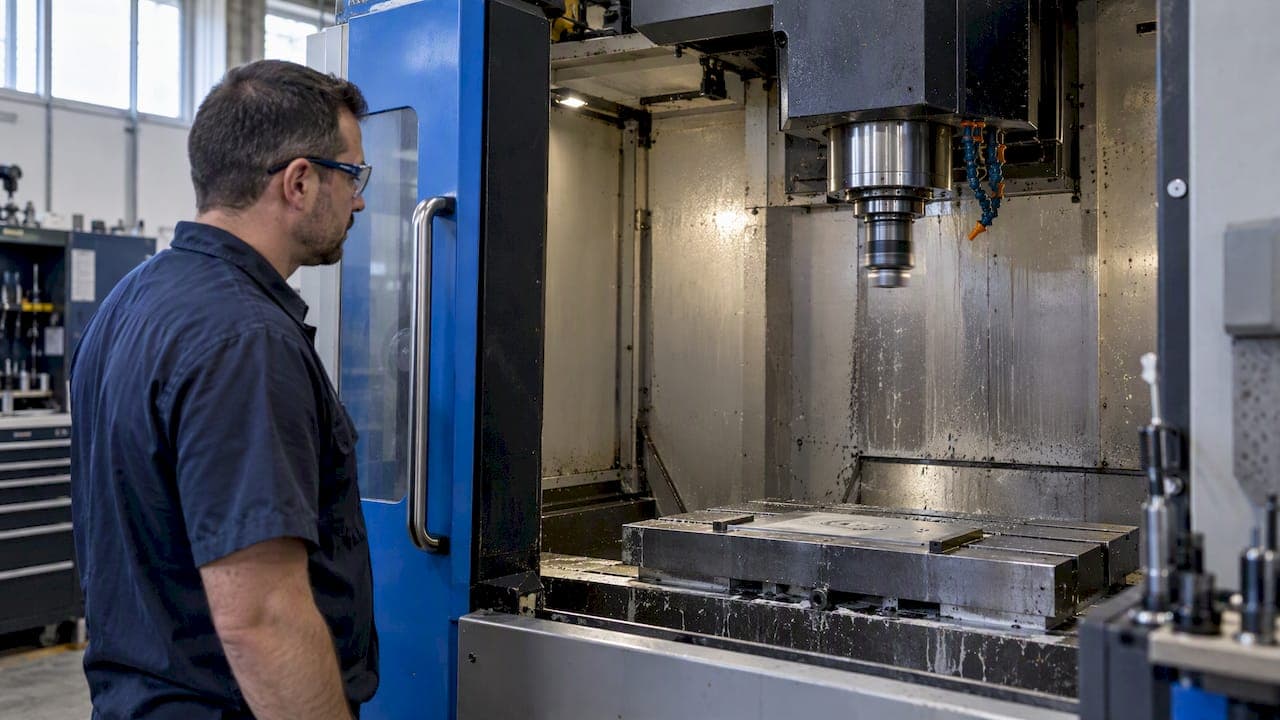
Run a short staged RPM ramp with dwell commands and a balanced holder before any high-RPM cutting. A typical sequence moves through 500, 1,000, 2,500, 5,000, 7,500, and 10,000 RPM with pauses between each step, following the staged warm-up G-code sequence many shops already run. Use this before the first high-speed job of the day or after a spindle has sat idle, and adapt the copyable G-code template in the next section to your own machine.
TL;DR:
- Running a staged warm-up sequence by gradually increasing spindle RPM with dwell pauses reduces wear, hot spots, and improves accuracy.
- Repeating the warm-up after long idle periods or before high-speed jobs is essential to stabilize temperature and lubricant distribution.
- Use a balanced tool holder and verify spindle stability through vibration, noise, load, and temperature checks during each warm-up step.
- Saving a reusable G-code template and logging each warm-up in maintenance records helps optimize routines and detect early spindle issues.
- A typical daily warm-up takes 10 to 20 minutes, while longer run-in procedures after repairs or installation can last several hours.
Table of Contents
- Why warming the spindle matters
- When and how often to run a warm-up
- Concrete warm-up programs and a copyable G-code example
- Tooling, balancing, and safety checks during warm-up
- How to verify the spindle is ready and what to look for
- Warm-up versus run-in: when to use each and how long they take
- Shop-tested practices and where automation helps
- How Availzye Machinist Pro automates warm-up and tracks spindle health
- FAQ
- Sources
Why warming the spindle matters
A cold spindle runs with lubricant still pooled from the last shutdown instead of spread across the bearings. Slow rotation during warm-up moves that lubricant into place and lets bearings seat gradually, which cuts wear and avoids the localized hot spots that show up when a spindle jumps straight to full speed.
Temperature change also shifts the physical size of spindle components. As the housing and shaft expand, runout and tolerances drift until the system reaches a stable temperature, and that drift is exactly what a warm-up routine is designed to get out of the way before you start cutting to spec.
- Lubricant redistribution during slow rotation reduces localized wear and hot spots.
- Thermal expansion during warm-up changes runout until the spindle stabilizes.
- A stable temperature preserves the accuracy your tolerances depend on.
A warm-up program that runs through several RPM steps with dwell pauses is recommended by published shop procedures for spindles idle more than four days, and the same staged approach is commonly used daily before high-speed work.
When and how often to run a warm-up
Warm-up timing depends on how long the spindle has sat and what you are about to ask it to do, not the clock on the wall.
- Run a warm-up at the start of every shift, even on a machine used daily.
- Repeat it after more than two hours idle, especially in a cold shop, following the vendor preheat routine that ramps RPM over a few minutes.
- After a multi-day idle period, lean toward a longer thermal cycle before running above roughly 6,000 RPM, per the staged warm-up guidance for spindles down more than four days.
- Always warm up before any job scheduled above the spindle's normal cruising RPM.
A single-shift shop can get by with one warm-up per day plus a check after long breaks. Multi-shift operations need a warm-up at the start of each shift, since the spindle cools between crews. Hobby shops running sporadically should treat every session like a cold start, since idle time between sessions is often measured in days, not hours.
Concrete warm-up programs and a copyable G-code example
A safe staged sequence looks like this, adjusted for your spindle's rated RPM and your shop's ambient temperature:
- S500 for about 5 minutes
- S1000 for about 3 minutes
- S2500 for about 2 minutes
- S5000 for about 2 minutes
- S7500 for about 1 minute
- S10000 as a final verification step
This mirrors the sample staged warm-up program that shops publish and adapt, which steps through roughly the same RPM points with dwell pauses between each. The S word sets spindle speed and G04 inserts a timed dwell, holding that speed steady long enough for lubricant to redistribute and temperature to settle before the next jump. Ramping through mid-range RPMs instead of jumping straight to top speed keeps bearing load and thermal change gradual rather than sudden.
A simple adapted program might read:
O02020
M03 S500
G04 P300
M03 S1000
G04 P180
M03 S2500
G04 P120
M03 S5000
G04 P120
M03 S7500
G04 P60
M03 S10000
G04 P30
M05

Dwell values are in seconds, so adjust P values and top speed to match your spindle's manual and your shop's conditions before running this on a production machine. Test any adapted program at a reduced top RPM first, since published shop examples note that operators should verify a new sequence safely before trusting it at full speed. Our internal Safe Startup G-code templates walk through building and saving a version like this for repeat use, and our guide to G-code basics covers the S and G04 commands in more detail if you are writing one from scratch.
Pro Tip: Save your warm-up program as a named subroutine on the control so operators can call it with one line instead of retyping steps each shift.
Tooling, balancing, and safety checks during warm-up
For spindles running at or above roughly 10,000 RPM, use a balanced tool holder (G2.5 or better) during warm-up, since balancing guidance for high-speed spindles ties unbalanced holders directly to vibration damage in bearings. An out-of-balance holder spinning at speed stresses bearings in ways a slow warm-up cannot fix.
Shop practice and manufacturer guidance generally favor warming up with the holder you intend to use installed, empty or loaded, rather than swapping tools mid-routine. Before ramping up, confirm the basics:
- Guards and enclosures are closed and latched.
- Coolant is set per your shop's policy for that job.
- Operator PPE is on and the emergency stop is within reach and tested.
A vibration-damping mat under the machine base can help on floors prone to transmitting vibration, an approach covered in guidance on rubber isolation mats for CNC installations.
How to verify the spindle is ready and what to look for
- After each RPM step, listen and look for unusual vibration or noise before moving to the next step.
- Stop immediately if you hear grinding, knocking, or feel vibration through the machine frame.
- Watch spindle load and temperature readings where your control displays them. Load should stay stable at each step, and the temperature curve should flatten rather than keep climbing.
- If load or temperature does not stabilize after a full warm-up cycle, stop the sequence, inspect the toolholder and spindle taper, and consider scheduling a run-in or service visit instead of pushing into production speeds.
A sudden load spike at a step that was stable yesterday is one of the clearest early signs of a loose holder or a developing spindle problem, and it is worth stopping for even when the noise sounds minor.
Pro Tip: Log load readings from each warm-up alongside maintenance records so a slow drift over weeks shows up before it becomes a breakdown.
Warm-up versus run-in: when to use each and how long they take
Warm-up and run-in solve different problems, and using one in place of the other carries real risk.
- Warm-up is a short daily program, typically minutes long, meant to stabilize temperature and redistribute lubricant before normal cutting.
- Run-in is a longer program, sometimes hours, used after a new spindle install or a repair to seat bearings and cure any packing or coatings.
- Manufacturer documentation often requires run-in rather than a simple warm-up after extended idle periods of several days, and after low ambient temperature startups or spindle replacement, per run-in checklist guidance.
Controls that distinguish the two programs do so for a reason: a daily warm-up run as if it were a run-in, or vice versa, risks thermal shock or premature wear. If a run-in does not bring vibration and temperature back to normal, stop and consult the machine manual or a service technician rather than guessing at another cycle.
Shop-tested practices and where automation helps
Saving a warm-up program as a reusable G-code template beats rewriting it by memory every shift, and logging each run in a maintenance tracker turns scattered habits into a pattern you can actually review. Spindle load monitoring is the piece that cuts unnecessary warm-up time while still protecting bearings, since you are reacting to real data instead of a fixed clock.
— Availzye
How Availzye Machinist Pro automates warm-up and tracks spindle health
The G-code generator allows a staged warm-up sequence like the one above to be saved as a reusable template instead of retyped every shift, and the maintenance tracker can log each run alongside service history so drift shows up early. Spindle load data can feed a system to help spot load spikes that signal a loose holder or a bearing issue before they turn into downtime.
| Feature | What it does for warm-up |
|---|---|
| G-code generator | Saves and reuses staged RPM warm-up templates |
| Maintenance tracker | Logs warm-up runs and service history together |
| Spindle load monitoring | Flags load spikes during warm-up steps |
- Generate and store your own staged warm-up program in the G-code generator.
- Log every warm-up run against machine history in the maintenance tracker.
- Review load trends across shifts to fine-tune your routine over time.
Subscription plans are available at different tiers, each with a 7-day free trial. Start a free trial on our main platform to try the G-code generator and maintenance tracker on your own warm-up routine.
FAQ
What is the CNC spindle orientation code?
Spindle orientation on most controls is commanded with an M code that stops the spindle at a fixed angular position, often used for tool changes or rigid tapping. The exact code and behavior can vary by control brand, so check your machine's programming manual for the confirmed command.
What is the RPM of a 500W spindle motor?
A 500W spindle's top RPM depends on its design rather than its wattage alone, so there is no single fixed figure that applies across brands. Check the nameplate or manufacturer specification sheet for your specific spindle rather than assuming a standard value.
What is a spindle speed?
Spindle speed is the rotational rate of the spindle, measured in revolutions per minute (RPM), and it is set in a CNC program using the S word. During a staged warm-up program, spindle speed is increased step by step rather than jumped straight to the target cutting speed.
How to check spindle?
Checking a spindle before and during warm-up means listening for unusual noise, watching for vibration, and monitoring load or temperature readings where your control provides them. A balanced tool holder is also worth confirming at higher RPMs, since an unbalanced holder is a common source of vibration that shows up during these checks.
How long should a spindle warm-up take?
A daily warm-up typically runs in the range of 10 to 20 minutes using a staged RPM sequence, based on the staged warm-up program widely used in shops. A full run-in after installation or repair takes considerably longer, sometimes several hours, since it seats bearings rather than just stabilizing temperature.
Sources
- Spindle Warm Up Program
- How to power the machine on and warm up the spindle
- Warm a CNC machine for maximum performance and reliability
- Haas VF2 spindle warm-up program configuration guide