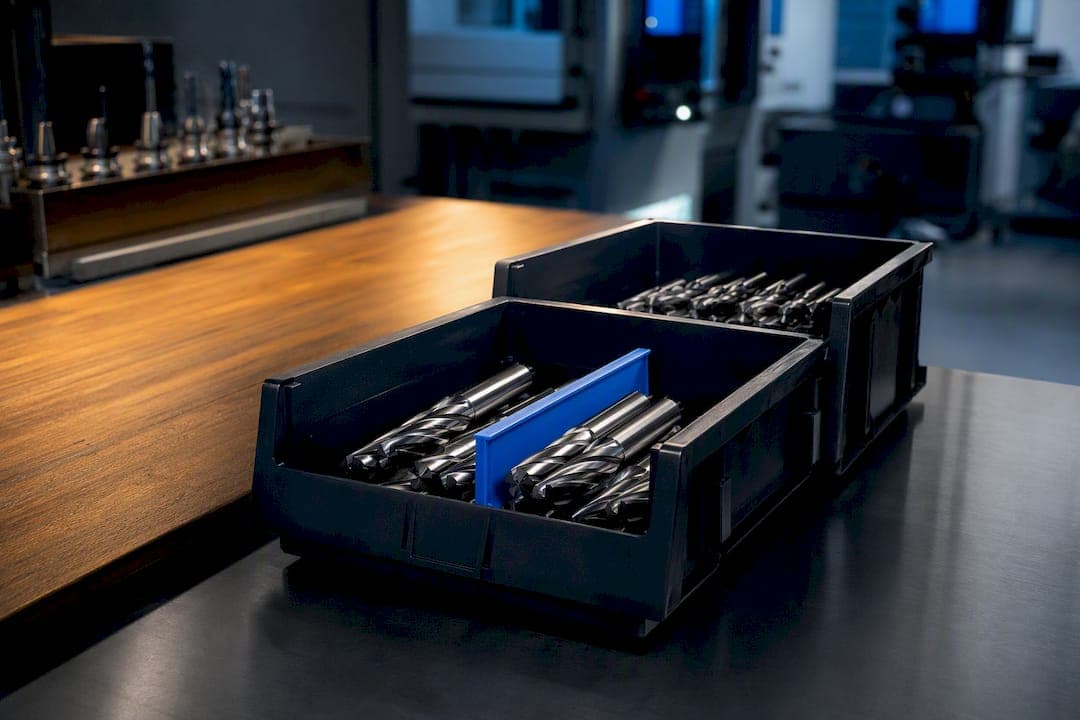
A two-bin system splits inventory for one part number into a working bin and a reserve bin. When the working bin runs empty, that's the reorder signal, full stop. It works best for cheap, high-turn shop supplies with steady demand and dependable lead times, and it fails fast on parts where demand swings or suppliers slip.
TL;DR:
- The reserve bin size should be based on a formula multiplying average daily usage by lead time, plus safety stock, to accurately match demand and lead time variability.
- The system works best for low-cost, high-turnover parts with predictable demand and reliable suppliers, while it struggles with volatile demand or unreliable deliveries.
- Reordering must be triggered immediately when the front bin is empty; delays increase the risk of stockouts despite reserve stock sitting nearby.
- A hybrid approach, combining two-bin for simple consumables and digital systems for high-value parts, prevents stockouts and optimizes capital.
- Proper setup, clear labeling, and consistent enforcement of the rule that an empty front bin means reorder are essential for reliable operation.
- ✓Tool Crib inventory with low-stock alerts
- ✓Tool life logging
- ✓Job Tracker for work orders
- ✓Maintenance Tracker for service logs
Table of Contents
- What Makes a Two-Bin System a Pull-Based Kanban Method
- How to Run a Two-Bin System Day to Day
- Sizing the Reserve Bin: The Formula Behind the Bin
- When a Two-Bin System Works, and When It Doesn't
- Rolling Out a Two-Bin System Without Breaking It
- Two-Bin vs. Perpetual, Reorder-Point, and Min-Max Systems
- Where Availzye Machinist Pro Fits Into a Two-Bin Workflow
- Why Discipline Beats Forecasting Every Time
- Sources
What Makes a Two-Bin System a Pull-Based Kanban Method
A two-bin system, sometimes called twin-bin or two-bin kanban, is one of the oldest forms of visual inventory management techniques in lean manufacturing. Each SKU gets two containers instead of one. Bin 1 sits in front, at the point of use, and gets picked from every day. Bin 2 sits behind or above it as backup stock, untouched until Bin 1 runs dry.
The mechanics are almost embarrassingly simple, and that's the point:
- Bin 1 empties during normal picking, which is the trigger, not a calendar date or a forecast.
- Bin 2 gets pulled forward and starts feeding production immediately.
- The empty Bin 1 goes to the storeroom or supplier with a reorder request attached.
- Once refilled, Bin 1 returns to its spot, and the cycle resets.
This is what separates the two-bin inventory method from reorder-point software or demand forecasting tools. Nobody is guessing what next month looks like. The system reacts to what's actually happening on the floor, which is exactly why lean practitioners favor it over spreadsheet-driven reorder point formulas for low-complexity parts. It's a behavior-driven control, not a predictive one, and behavior is a lot easier to enforce than a forecast is to get right.
How to Run a Two-Bin System Day to Day
Getting a bin storage system running correctly comes down to five repeatable steps, and skipping any one of them is usually where shops get into trouble — tools available in the Engineering Simulation Software & Tools | Jewlz Technologies can help shops integrate these steps efficiently.
- Place the bins correctly. Bin 1 goes at the point of use, front and accessible. Bin 2 goes directly behind or above it, clearly labeled as reserve stock, never mixed in with Bin 1's contents.
- Pick only from Bin 1. Operators pull parts from the front bin during normal work. Bin 2 stays sealed until Bin 1 is confirmed empty.
- Trigger the reorder the moment Bin 1 hits zero. This is non-negotiable. A delayed trigger eats into the lead-time cushion built into Bin 2, and that's how stockouts happen even with reserve stock sitting nearby.
- Send the reorder signal. This can be a physical Kanban card dropped in a collection box, a barcode or RFID scan that auto-generates a purchase request, or a simple line entry in an ERP or WMS system, according to Longbridge.
- Receive and reset. New stock refills Bin 1 first. The bin returns to its position, and Bin 2 becomes the new working bin until the cycle repeats.
Pro Tip: Color-code the empty-bin card or tote lid. A bright orange tag traveling through the shop is far harder to ignore than a line item buried in a spreadsheet.
Sizing the Reserve Bin: The Formula Behind the Bin
The reserve bin isn't a guess. It's calculated with a formula practitioner guides have used for decades: reserve quantity = (average daily usage × lead time in days) + safety stock, as AccountingTools lays out.
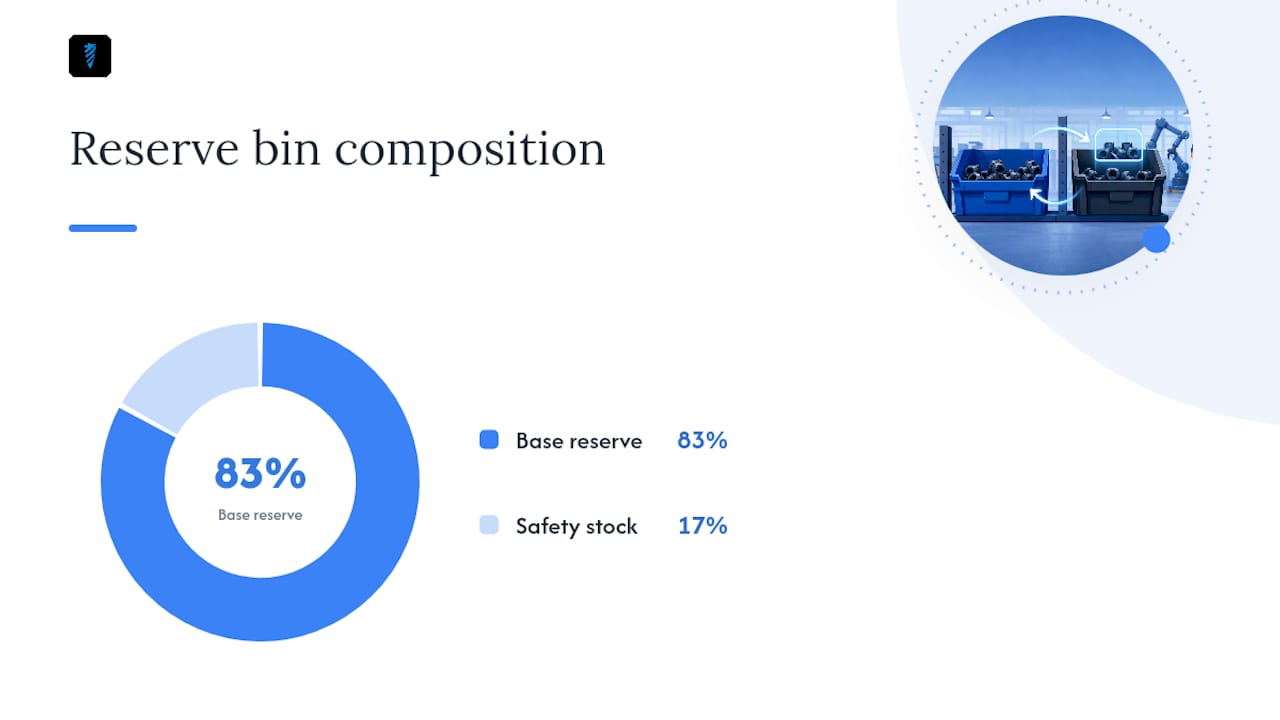
Safety stock covers the gap between what you expect and what actually happens. A common approach is to add 10 to 25 percent of the calculated reserve for parts with mild lead-time variability, and scale up from there if a supplier has a history of late shipments.
Here's a worked example, following the same logic Investopedia uses to illustrate the math:
- Daily usage: 40 units of a fastener
- Lead time: 7 days
- Base reserve: 40 × 7 = 280 units
- Safety stock amount based on a safety margin, typically a portion of the calculated reserve
- Total reserve bin size: 336 units
Run that formula for every SKU and you'll size bins that actually match how the part behaves, not a round number someone picked because it looked reasonable.
When a Two-Bin System Works, and When It Doesn't
Two-bin control shines on the shop floor for one clear reason: it removes almost all the daily counting burden. Fasteners, gloves, cutting fluid, shop rags. Anything cheap, high-turn, and steady in demand is a natural fit.
Where it earns its keep:
- Low administrative overhead, since nobody's running cycle counts on hardware bins.
- Fewer stockouts on frequently used parts when demand and lead time stay predictable.
- Visual, self-enforcing discipline that doesn't depend on software uptime.
Where it breaks down:
- Volatile demand blows through the reserve bin faster than the formula assumed.
- Unreliable suppliers stretch lead time past what the safety stock was built to cover.
- High-value items tie up too much capital sitting idle in a second bin, which is why Freshbooks frames this as a class C inventory tool, not a strategy for expensive tooling or capital parts.
The fix for most shops is a hybrid model: two-bin for the cheap, steady-moving class C items, and a digital min/max system or perpetual tracking for anything in class A or B where a stockout actually hurts.
Rolling Out a Two-Bin System Without Breaking It
A clean rollout starts before a single bin hits the floor.
- Run an ABC classification first. Two-bin belongs on class C parts. Trying to force it onto expensive or slow-moving SKUs is the single most common setup mistake.
- Verify lead times with actual suppliers, not the number from three years ago in a purchasing file nobody's updated.
- Pilot on 10 to 20 SKUs before rolling the method shopwide. Fix the formula and the physical layout on a small set first.
- Label everything clearly. Bin 1, Bin 2, part number, reorder quantity, all visible from a few feet away.
- Train on one rule only: empty Bin 1 means reorder now. Complicating the trigger with judgment calls defeats the entire purpose, since the method is designed to be behavior-driven, not decision-driven.
- Set an audit cadence and an escalation rule for what happens when a supplier misses a delivery window.
Pro Tip: Watch for partial refills. If someone tops off Bin 1 without touching Bin 2, the trigger logic breaks silently, and you won't notice until a real stockout hits.
The most common pitfalls: bins get physically mixed together, refills happen "whenever," and nobody revisits lead times after the initial setup even when a supplier's performance changes.
Two-Bin vs. Perpetual, Reorder-Point, and Min-Max Systems
Two-bin trades visibility for simplicity. A perpetual tracking system gives you real-time counts on every SKU, but it demands consistent data entry and software discipline that most shops don't maintain for a $2 box of fasteners.
Reorder-point and min-max approaches sit somewhere in between; useful for mid-value parts with more demand variation than a class C item, but still routine enough not to justify full perpetual tracking:
- Two-bin fits high-frequency, low-value, stable-demand parts where a physical trigger beats a data entry step.
- Reorder-point/min-max fits parts with more variability, where a calculated threshold outperforms a fixed bin size.
- Perpetual/digital tracking fits tooling, fixtures, and anything with real dollar value where a missed count is expensive.
Most shops that run this well don't pick one system. They run two-bin for the bulk of their consumables and layer digital tracking on top for anything that actually moves the needle on cost.
Where Availzye Machinist Pro Fits Into a Two-Bin Workflow
Two-bin handles your fasteners and consumables fine on its own. Where it gets shaky is tooling. Inserts, drills, and holders carry real cost, and a physical bin alone won't tell you which job burned through your inventory or flag a reorder before you're standing at the machine with nothing to load.
That's the gap Availzyemachinistpro's Tool Crib module is built for. Low-stock alerts fire before a tool bin actually hits zero, tool life logging tracks wear against actual usage, and CSV imports keep the data current without hours of manual entry.
| Two-bin does well | Digital tracking adds |
|---|---|
| Simple visual trigger for consumables | Automatic low-stock alerts before empty |
| Zero software dependency | Tool life and wear history per insert |
| Fast to teach new staff | Audit trail tied to specific jobs |
| Minimal admin for class C parts | CSV import for bulk tool crib updates |
- Barcode scans replace manual card handling and cut transcription errors.
- Tool Crib check-in/check-out ties consumption to the Job Tracker, so you can see exactly which work order drained your carbide.
- A free trial lets a shop test the combination before committing to a subscription.
Why Discipline Beats Forecasting Every Time
The conventional pitch for two-bin systems focuses on cost savings and reduced counting, and that's true but incomplete. What actually makes the method work is that it removes judgment from the equation entirely. Nobody has to decide whether now is the right time to reorder. The bin decides.
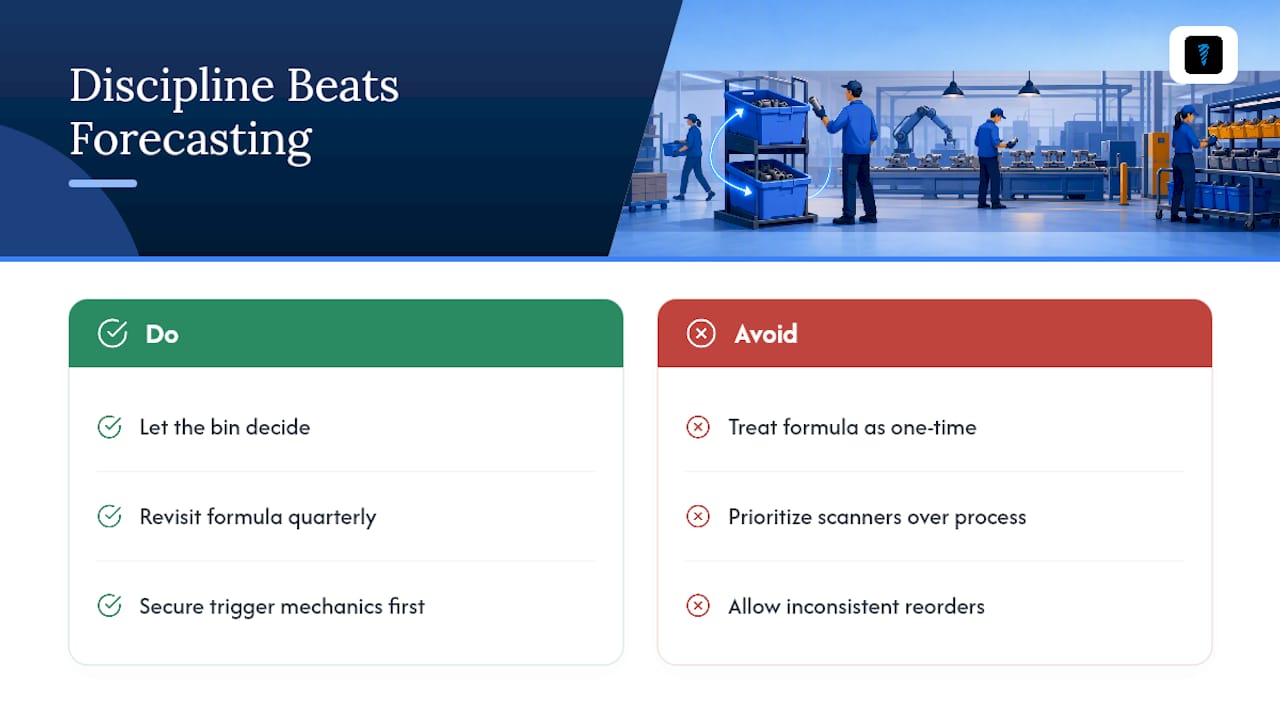
Where most rollouts fail isn't the math. It's assuming the formula is a one-time setup instead of a living number. Lead times change, suppliers slip, and a reserve bin sized for a 7-day lead time quietly becomes inadequate when that supplier starts running 12 days. Revisit the formula quarterly for anything supplier-dependent, not just at initial rollout.
Prioritize this: get the trigger mechanics airtight before you worry about barcode scanners or software integration. A shop that enforces "empty Bin 1 means reorder now" with total consistency will outperform one running fancy tracking on top of a sloppy physical process. Simplicity only works if nobody cheats it.
— Availzye
Sources
- Two-bin inventory control — AccountingTools
- Two-Bin Inventory Control: Definition & How it Works
- Two-Bin Inventory Control Simple Reorder System
- Two-Bin Inventory Control: Definition, How It Works, and ...