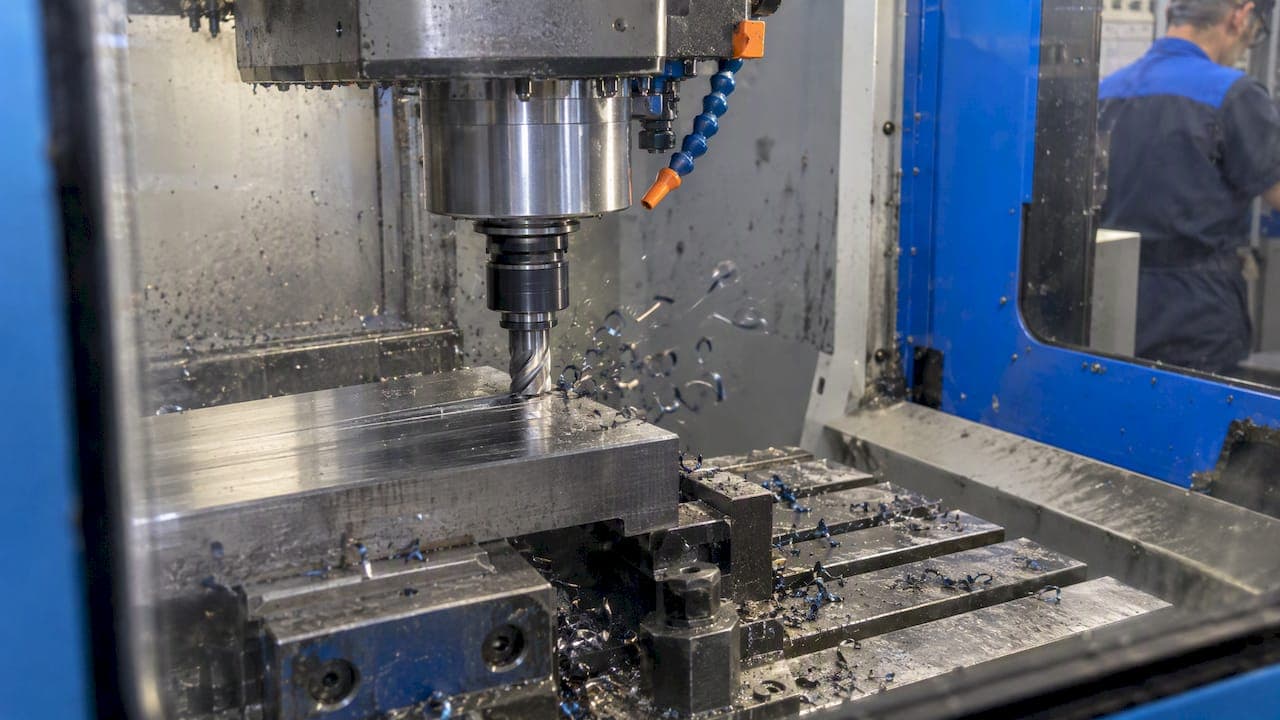
Climb milling usually wins on surface finish when your machine has near-zero backlash and the setup is rigid, because the cutter pulls into the material instead of rubbing before it bites. Conventional milling is the safer default when backlash is measurable or the toolpath climbs an ascending slope. The right call still depends on radial depth of cut, cutting speed, feed per tooth, and the surface's inclination.
TL;DR:
- A dial indicator check that reveals dead travel after reversing an axis identifies backlash; use conventional milling until it is controlled.
- In a 2019 ball end milling study of hardened steel, climb performed better in 17 of 28 tested conditions, while conventional won in eight.
- Radial depth of cut had the strongest effect on modeled surface roughness, while ascending slopes favored conventional milling and descending slopes generally favored climb.
- At high speed and radial engagement, conventional milling showed lower variability in some conditions; compare Rt, Ra, wear, and cycle time on test cuts.
Table of Contents
- Climb (down) milling vs conventional (up) milling: the basic definitions
- Forces, chip formation, and what they mean for finish and tool life
- Machine and setup checks before you commit to climb milling
- When to use climb vs conventional: a decision guide tied to your cutting parameters
- Setting up a test pass: checklist and tuning tips
- What I'd actually test before trusting either method
- Testing climb vs conventional without the guesswork
- FAQ
- Sources
Climb (down) milling vs conventional (up) milling: the basic definitions
Climb milling, also called down milling, feeds the workpiece in the same direction the cutter edge is moving at the point of contact. The tooth bites in at full chip thickness and the chip thins to nothing as the edge exits, which is why the cutter gets pulled toward the uncut material. Conventional milling, also called up milling, runs the feed against the direction of cutter rotation. The tooth starts with a chip thickness of zero, rubs for an instant, then the chip grows as the edge rotates through the cut.
That rubbing at entry is the root of most conventional-milling complaints: localized heat, work hardening on tougher alloys, and a rougher-looking cut start. Climb avoids the rub but trades it for a cutter that wants to grab the part and pull along the feed axis, which is where backlash becomes a problem.
In CAM software, the direction you choose for a pocket or contour pass determines which mode you get:
- A toolpath set to climb (often labeled "down milling" in your post processor) keeps the cutter on the side where rotation and feed align.
- A conventional pass reverses that relationship, which some CAM strategies default to for roughing on older machines.
- Mixed strategies exist, where roughing runs conventional for safety and finishing passes switch to climb for surface quality.
Forces, chip formation, and what they mean for finish and tool life
The force direction is the clearest mechanical difference between the two methods. Climb milling generates forces that push down and into the workpiece, which helps hold thin or flexible parts against the table. Conventional milling generates forces that lift the workpiece up and away from the fixture, meaning clamping has to work harder to keep the part seated.
Chip thickness behaves in opposite patterns too. A climb cut starts thick and thins to zero, so the cutting edge is doing its heaviest work when it is sharpest for that pass and least likely to deflect. A conventional cut starts at zero and grows, which concentrates rubbing and heat generation right at entry, a known contributor to premature edge wear on abrasive or work-hardening materials.
- Climb milling shears chips cleanly and tends to produce a better as-cut surface when backlash is controlled, according to university machine shop guidance.
- Conventional milling's initial rub can increase tool wear over time on materials prone to work hardening, since the edge spends more cycles sliding before it cuts.
- Climb milling drops chips behind the cutter path, reducing the chance of re-cutting chips that have already been removed, while conventional milling tends to push chips ahead of the tool where they can get run over again, per industry shop notes.
Radial depth of cut (ae) was identified as the most significant factor in surface roughness models in a 2019 ball-end milling study, outranking cutting speed and feed per tooth in its effect on measured roughness. That single variable is worth tracking closely before you commit to a strategy on a new job.
Heat partitioning follows the same logic as chip formation. Climb milling sends more heat into the chip and away from the finished surface, while the entry rub in conventional milling transfers more heat directly into the part and the cutting edge. On heat-sensitive alloys, that difference alone can justify switching strategies for the finish pass even if roughing stays conventional.
Machine and setup checks before you commit to climb milling
Climb milling only works as well as your machine's drive train lets it. Backlash lets the table lurch forward as the cutter pulls it into the feed direction, and on a bad day that lurch shows up as chatter marks, a broken tool, or a gouged part.
- Jog the axis you plan to climb-mill along, then reverse direction and watch a dial indicator on the table for any dead travel before it moves. Anything measurable is backlash you need to account for.
- Ball screw drives typically show far less backlash than aging leadscrew setups, which is why shop guidance consistently points to verifying screw type and condition before trusting climb passes on an unfamiliar machine.
- Check spindle runout and table rigidity under load. A stiff spindle and a well-tensioned table resist the pull of climb milling; a loose or worn one amplifies it into vibration.
- Review your clamping against force direction. Climb's downward push helps hold flat stock, but conventional's upward lift means marginal clamping that was fine for climb can let a part walk during a conventional pass.
- Match cutter geometry to the mode. Down-cut end mills push chips downward and pair naturally with climb strategies on parts where you cannot tolerate burrs on top edges; up-cut geometry clears chips upward and tends to suit conventional roughing where evacuation matters more than top-edge finish.
Pro Tip: Run a short test cut at reduced feed first; if you hear a chirp or see a visible lurch on the climb pass, treat that machine as backlash-limited and default to conventional until you can verify or adjust the drive.
When to use climb vs conventional: a decision guide tied to your cutting parameters
Trajectory shape matters more than most machinists assume. A 2019 experimental study on ball-end milling of hardened steel molds found climb milling was the better choice in 17 of 28 tested cutting conditions, generally on descendant trajectories, while conventional won in 8, generally on ascendant trajectories, with the rest showing no meaningful difference. Radial depth of cut, not cutting speed, drove most of that outcome.
The same study prioritized Rt (total profile height) over average roughness (Ra) when picking a strategy for mold surfaces, since Rt catches local defects that an averaged Ra value can hide.
- On a descending slope, climb milling generally gave the better surface in the tested conditions.
- On an ascending slope, conventional milling generally gave the better surface in the tested conditions.
- At high radial depth of cut combined with high cutting speed, conventional showed lower roughness variability in some tested conditions, which argues for conventional on heavy, fast radial passes unless your machine and fixturing are unusually rigid.
Two quick examples translate this into shop language. For a flat pocket finish pass with light radial engagement (ae well under the cutter diameter) on a rigid, backlash-free vertical machining center, climb is the stronger default. For a ball-end finishing pass climbing up a sloped mold cavity wall, conventional is worth testing first, then compare Rt readings against a climb pass before standardizing.
| Condition | Favored method | Why |
|---|---|---|
| Descendant trajectory, low to medium ae | Climb | Lower roughness in tested conditions |
| Ascendant trajectory | Conventional | Lower roughness in tested conditions |
| High ae with high vc | Conventional | Lower variability in tested conditions |
| Verified backlash-free, rigid setup | Climb | Cleaner shear, less rub |
Capture Ra, Rt, cycle time, and visible tool wear on every test pass so your own shop data replaces guesswork over time.
Setting up a test pass: checklist and tuning tips
Before switching strategies on a production job, run the comparison on scrap stock or a non-critical feature first.
- Confirm backlash is at or near zero, check clamp force against the expected force direction, and verify spindle runout is within spec for the tool you are running.
- When moving from conventional to climb, reduce feed per tooth slightly on the first pass to limit chip load while you confirm the machine handles the pull without chatter, then use a chip load calculation to dial feed back up.
- Order your CAM toolpaths so climb passes run where chip evacuation benefits most, keep coolant aimed at the exit side of the cut to flush chips away from the finished surface, and set lead-in and lead-out moves that avoid dwelling at the cut start.
- Log Ra, Rt, tool wear, and cycle time for each test, then turn repeated results into a written standard for that machine and material combination rather than relying on memory next time.
Pro Tip: Keep a running log by machine, not just by job: a drive train's backlash behavior changes as ball screws wear, so a climb-safe machine today is worth re-checking every few months.
What I'd actually test before trusting either method

Shop lore about climb versus conventional is full of confident claims that do not hold up across every machine and material. The only way to know which method wins on your equipment is to measure it: track Ra, Rt, tool wear, and cycle time on real test passes instead of defaulting to whatever the last job used.
Start small, log everything, and let a handful of controlled tests on your own machines build a standard you can trust. Run your feed and chip-load numbers through a calculator before the first cut and check for chatter risk before committing to a wider rollout.
— Availzye
Testing climb vs conventional without the guesswork
We built Availzye Machinist Pro around exactly this kind of decision: our Feeds & Speeds and Chip Thinning calculators help you set safe starting parameters before a climb test, Chatter Prediction flags risk before you commit a program to the spindle, and Tool Deflection modeling catches issues a static chip-load number misses. Results can then be logged against the job so your shop standard builds itself over time instead of living in someone's notebook.

Start a 7-day free trial on our Individual, Small Shop, or Team plan and run your next climb-versus-conventional comparison with the numbers in front of you instead of a guess.
FAQ
What is another name for climb milling?
Climb milling is also called down milling, a term that describes the cutter feeding in the same direction as its rotation at the point of contact. Both names refer to the same cutting mode and appear interchangeably in CAM software and shop documentation.
What's the difference between CNC and VMC?
CNC refers broadly to computer numerical control, the automated control system used across many machine types including lathes, routers, and mills. A VMC, or vertical machining center, is one specific kind of CNC machine, built with a vertically oriented spindle for milling operations like the climb and conventional passes discussed here.
What are the two types of milling?
The two primary cutting modes are climb (down) milling and conventional (up) milling, distinguished by whether the feed direction matches or opposes the cutter's rotation at the point of contact. Beyond that distinction, milling also splits into operation types like face milling, peripheral milling, and slot milling, but climb and conventional describe the direction of engagement within any of those.
What does "climb cutting" mean?
Climb cutting is another term for climb milling, where the workpiece feeds in the same direction the cutting edge rotates, so the tooth bites in thick and thins toward exit. This produces a pulling force on the workpiece and generally cleaner shear compared to conventional cutting, provided the machine has minimal backlash.
Sources
- Optimal Machining Strategy Selection in Ball-End Milling of Hardened Steels for Injection Molds
- Climb Milling vs Conventional Milling | McKelvey School of Engineering Student Machine Shops
- Climb milling vs conventional milling — JLCCNC blog