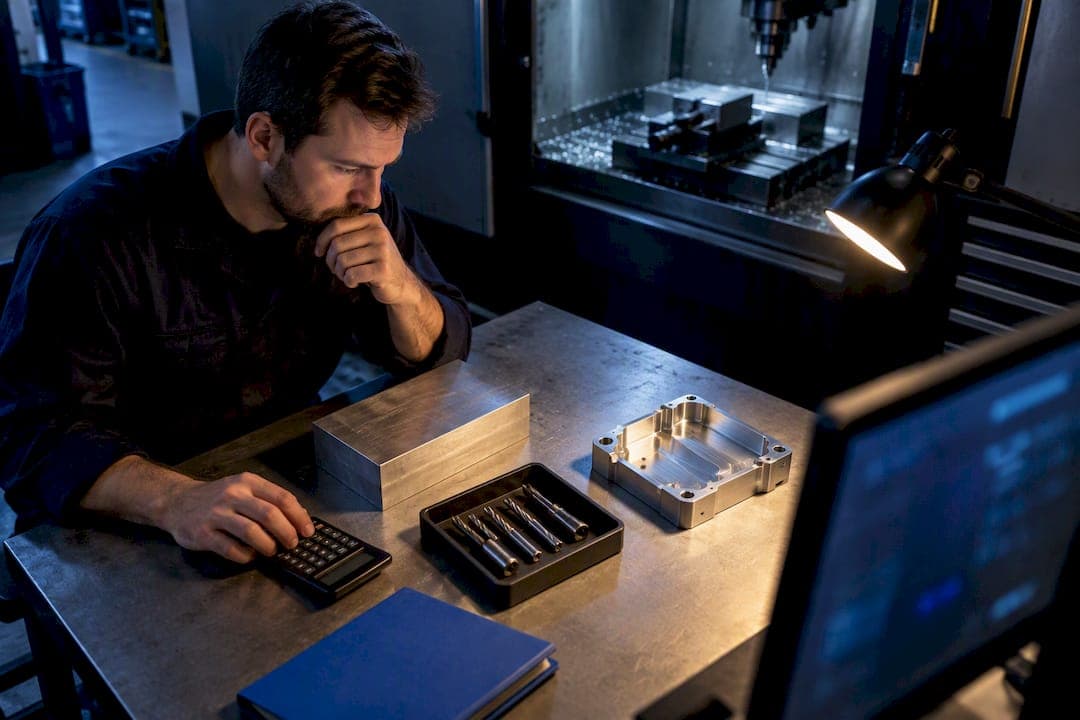
Machining cost estimation follows one formula: part cost equals material plus setup divided by batch, plus machine rate multiplied by cycle time, plus tooling plus secondary operations. A defensible number needs auditable line items, sensitivity to tolerance and finish changes, and setup costs amortized correctly across batch size. Automated, process-based estimators speed this up and cut the manual errors that plague spreadsheet quotes.
TL;DR:
- Batch size significantly impacts setup costs, lowering the per-part expense from over $8 at 50 parts to less than $1 at 500 parts.
- Tighter tolerances can double or triple machining costs due to increased machine time and inspection, especially when moving from ±0.005 inch to ±0.001 inch.
- Material costs can vary considerably based on stock size and buy-to-fly ratio, with solid billet costs being much higher than finished parts.
- Using process-based estimators that incorporate real geometry and shop data can reduce costs by up to 30% compared to manual spreadsheet estimates.
- Accurate, defendable quotes rely on logging actual setup times, tool wear, and non-cutting activities to prevent underestimating costs in quick-turn scenarios.
Table of Contents
- The standard machining cost formula and when to use each term
- Breaking down each cost component: material, setup, rate, cycle time, tooling, and overhead
- How tolerances and surface finish change what you can charge
- Worked example: pricing a bracket at batch quantity 50
- Spreadsheets versus process-based estimators: what fits your shop
- Where a calculator-driven toolchain closes the estimation gap
- What matters most when the clock is running
- Turning this workflow into a repeatable habit with Availzye Machinist Pro
- Sources
- FAQ
The standard machining cost formula and when to use each term
The formula manufacturing engineers use looks like this: Part Cost = Material + (Setup ÷ Batch) + (Machine Rate × Cycle Time) + Tooling + Secondary Operations. Each term draws from a different data source, and incorrect mixing or omission of these components commonly lead to inaccurate estimates.
Material cost comes from stock weight or volume multiplied by price per pound, pulled from supplier quotes or your CAD model's mass properties. Setup cost is a fixed dollar figure divided by batch quantity, sourced from time studies or shop floor logs. Machine rate times cycle time comes from your CAM software's simulated cycle time (adjusted for real-world non-cutting time) multiplied by your shop's hourly rate. Tooling is the amortized cost of consumables per part, and secondary operations covers anything outside the primary machine, like deburring, heat treat, or plating, according to DFMA's cost estimator guidance.
Common pitfalls when assembling these numbers include:
- Using only CAM-reported cycle time without accounting for load, unload, and inspection time.
- Not dividing setup cost by the precise batch quantity.
- Estimating material cost based on nominal part volume rather than actual stock size.
- Omitting tooling wear costs, which can be significant.
Breaking down each cost component: material, setup, rate, cycle time, tooling, and overhead
Each line item has its own formula and its own failure points.
- Material: Calculate stock weight (length × width × height × material density) multiplied by cost per pound, then add a scrap allowance for buy-to-fly ratio. A part machined from a solid billet with a 5:1 buy-to-fly ratio costs far more in raw stock than the finished part suggests.
- Setup: Setup includes fixture building, work offset probing, first-article inspection, and program proving. Divide total setup cost by batch quantity: a $500 setup spread over a quantity of 10 parts adds $50 per part, while the same setup over 1,000 parts adds $0.50 per part, a difference that determines whether small-batch work is profitable at all, according to DFMA.
- Machine rate: Add depreciation, maintenance, energy, and floor space cost, then divide by billable hours per year. Rate benchmarks vary sharply by machine class: 3-axis milling typically runs $35 to $60 per hour, 4-axis sits around $60 to $90, and 5-axis machines can range from $75 to $300 per hour depending on complexity, according to Fabcon's 2026 hourly rate data.
- Cycle time and material removal rate: Base cycle time on feed rate, depth of cut, and tool path length, then add non-cutting time for tool changes and part handling.
- Tooling: Divide tool cost by expected tool life in parts or minutes, and add changeover labor when tools need frequent swaps.
- Overhead: Apply a surcharge percentage for shop administration, quality systems, and profit margin on top of the direct cost total.
A structured, process-based approach to combining these components can reduce total production costs by roughly 15 to 30% in typical manufacturing environments, according to a cost modeling and economic analysis of machining processes, largely by exposing which line item actually drives the price.
How tolerances and surface finish change what you can charge
Tighter tolerances force slower feeds, more careful fixturing, and heavier inspection, and each of those adds direct cost. Stepping from a ±0.005 inch tolerance to ±0.001 inch can multiply cost by two to three times because the machine runs slower and the part needs more frequent in-process checks, according to DFMA.
- Standard tolerances (±0.005 inch or looser) rarely need extra process steps beyond normal machining.
- Precision tolerances (±0.001 inch) usually add secondary inspection and slower finishing passes.
- Mirror or near-mirror surface finishes usually necessitate multiple finishing passes, increasing finishing costs by approximately four to five times over a standard mill finish, according to the same source.
A single tolerance callout on a drawing can double or triple the price of an otherwise simple part, which is why engineers should question any tolerance tighter than the function actually requires (DFMA).
Worked example: pricing a bracket at batch quantity 50
Take a representative part: a 6061 aluminum bracket, 4 inches by 3 inches by 1 inch, machined on a 3-axis mill from bar stock, batch size 50, standard ±0.005 inch tolerance.
- Material: Stock weighs 0.8 pounds at $3.50 per pound, giving $2.80 per part.
- Setup: Fixturing and program proving cost $400 total, divided by 50 parts equals $8.00 per part.
- Machine time: Cycle time of 12 minutes (0.2 hours) at a $45 per hour 3-axis rate equals $9.00 per part.
- Tooling: Tool cost amortized across expected tool life adds $1.20 per part.
- Overhead: A 15% surcharge on the direct total adds roughly $3.15 per part.
| Line item | Cost per part |
|---|---|
| Material | $2.80 |
| Setup (÷50) | $8.00 |
| Machine rate × cycle time | $9.00 |
| Tooling | $1.20 |
| Overhead (15%) | $3.15 |
| Total | $24.15 |
Running the same part at a batch of 500 drops setup to $0.80 per part, pulling the total closer to $16.95. Tightening the tolerance to ±0.001 inch instead, while holding batch at 50, roughly doubles the machine-time line, pushing the total well past $30. Batch size and tolerance are consistently the two levers that move the price the most.
Spreadsheets versus process-based estimators: what fits your shop
Spreadsheets are transparent and flexible, and every engineer can build one in an afternoon. Their weakness is manual entry error and a blind spot for real cycle time, since a spreadsheet only knows what a person types into it.
- Spreadsheets work well for simple, repeat parts where historical actuals already exist.
- Process-based tools calculate cycle time directly from geometry and cutting parameters, cutting out guesswork.
- A material removal rate calculator can validate a spreadsheet's cycle time assumption before you commit to a quote.
- Practical shop calculators, when fed correct inputs, tend to land within about 15% of the real invoice for standard prismatic parts, according to TWC Industrial's cost calculator.
Pro Tip: Build one spreadsheet template you trust for simple parts, then reserve a process-based tool for anything with multi-axis work or tight tolerances, where manual cycle-time guessing gets expensive fast.
Where a calculator-driven toolchain closes the estimation gap
Estimation accuracy depends on catching the details spreadsheets miss: real cutting loads, tool wear, and non-productive time. Availzye Machinist Pro bundles calculation tools that feed directly into those line items, alongside shop management features that track what actually happened on the floor.
- Feeds & Speeds and Tool Deflection calculators refine the cycle-time assumptions that drive the machine-rate line.
- A CAD viewer with STEP-to-STL conversion lets you check part geometry before committing to a cycle-time estimate.
- The Job Tracker and Tool Crib inventory log actual setup times and tool life, turning next quarter's estimates into measured data instead of guesses.
- An AI Assistant and built-in cost estimator module tie these calculators together for machinists building a quote from scratch.
Each of these maps back to a specific line item: deflection and feeds data sharpen cycle time, and tool crib logs sharpen the tooling line, closing the gap between estimate and invoice.
What matters most when the clock is running

When a quote is due in an hour, precision matters less than defensibility. Favor a sensitivity table over a single confident number. A quote you can walk through line by line, with two or three scenarios attached, holds up better under a customer's questions than a number nobody can explain.
Instrument your shop wherever you can. Every logged tool-life figure and every recorded setup time shrinks the error bar on your next quoting process. Reserve supplier quotes for anything nonstandard and trust your own numbers for repeat work.
— Availzye
Turning this workflow into a repeatable habit with Availzye Machinist Pro
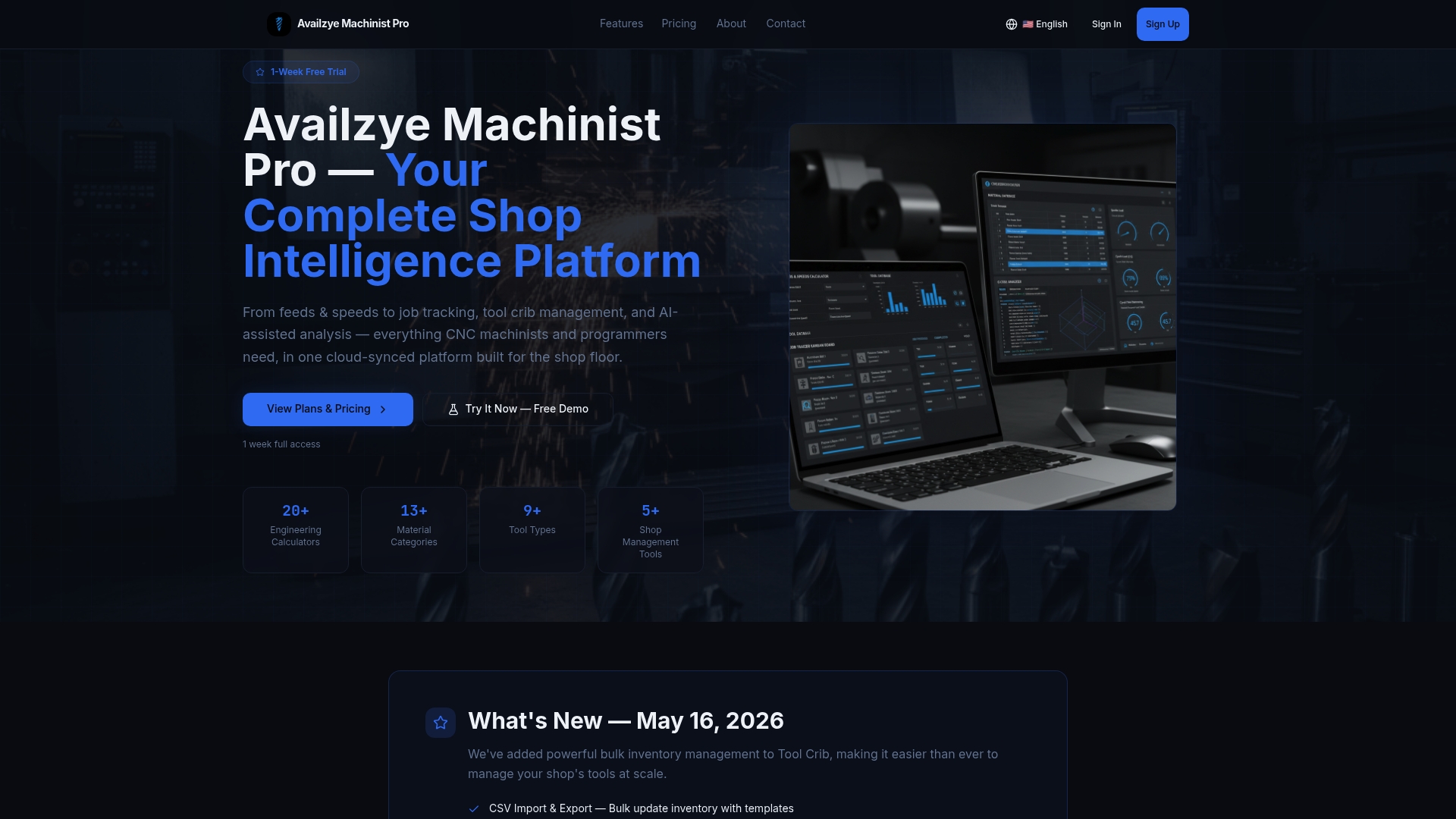
Building a defensible quote by hand works, but rebuilding the same spreadsheet logic for every part wastes hours you do not have. Availzye Machinist Pro combines the calculators behind this article's formula (feeds and speeds, tool deflection, cycle time inputs) with a built-in cost estimator and shop management tools that log setup time and tool life automatically, so future estimates get sharper on their own.
- Start a free trial to run your own parts through the cost estimator.
- Choose a plan suitable for solo calculation work or a full shop floor rollout.
- Explore options for multiple estimators needing shared access and role-based permissions.
Visit the Availzye Machinist Pro landing page to compare plans and start your trial.
Sources
- Machinists (BLS May 2023)
- Machining cost estimator: How to calculate CNC part costs (DFMA)
- Cost modeling and economic analysis of machining processes (IJCOPE, 2026)
- CNC machining hourly rate (Fabcon, 2026)
FAQ
What is the formula for estimating machining cost?
The standard formula is Part Cost = Material + (Setup ÷ Batch) + (Machine Rate × Cycle Time) + Tooling + Secondary Operations, according to DFMA's cost estimator guidance. Each term draws from a different source: material from stock weight and price, setup from time studies, and machine rate from your shop's actual overhead.
What are the 5 levels of cost estimation?
Cost estimation maturity typically runs from a rough order-of-magnitude guess, to a budget estimate based on similar past parts, to a detailed estimate built line by line, up to a definitive estimate validated against supplier quotes and shop actuals. Definitions vary across industries, so treat this as a general progression rather than a fixed standard.
What is the SFM formula?
Surface feet per minute (SFM) is calculated as SFM = (Pi × Diameter in inches × RPM) ÷ 12, and it sets the cutting speed used to derive spindle RPM for a given tool and material. It feeds directly into the cycle-time calculation behind machining cost estimates, as detailed in a shop-ready feeds and speeds guide.
Can a CNC machinist make $100,000 a year?
The national mean annual wage for machinists was $54,600 as of May 2023, while CNC programmers earned a mean of $64,580, with top earners near $90,090, according to the Bureau of Labor Statistics. Earning more than these figures depends on specific roles, locations, and experience levels.