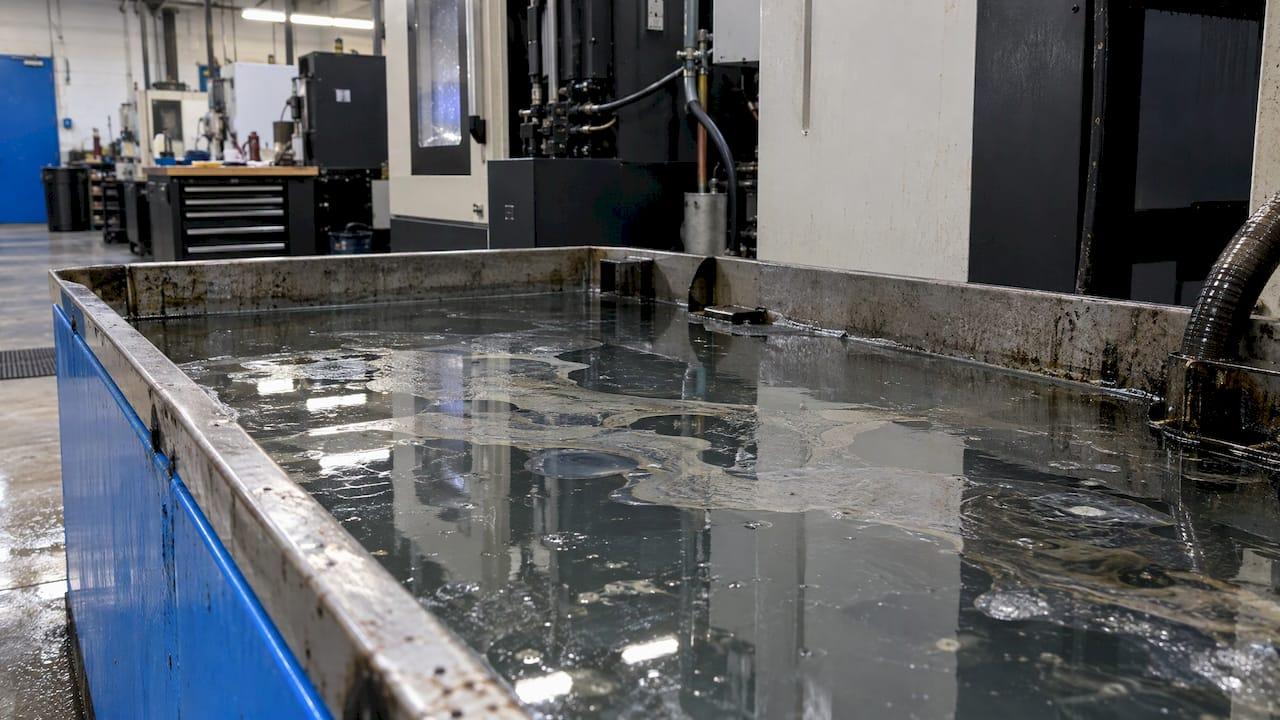
To remove tramp oil, match the tool to the form the oil takes. A skimmer pulls free oil off a quiet sump surface. A coalescer or portable separator handles oil that is mixed into the coolant as droplets. A centrifuge is the only practical answer for fully emulsified oil. Whichever you choose, the removal gear only works if you also check concentration, keep the sump from sitting idle with oil on top, and write down what happens, so the same problem does not cost you another shift.
TL;DR
- Tramp oil is stray hydraulic, way and gear oil in water-based coolant. It shows up as a surface film, as droplets, or as emulsified oil.
- Skimmers remove free surface oil only. Dispersed oil needs a coalescer or separator, and emulsified oil needs a centrifuge.
- Keep the skimmer running while the machine idles, and read concentration from a sample taken from a clean area of the sump.
- Log coolant stops with a consistent downtime reason so you can see whether the oil, the concentration or the equipment is the repeat offender.
- A simple daily, weekly and monthly routine does more than any single piece of equipment.
Table of Contents
- What tramp oil is and why it hurts your coolant
- Three forms of tramp oil, three different fixes
- Skimmers: the first line of defense
- Portable separators and coalescers: when oil is mixed in
- Centrifuges for emulsified oil
- Which method fits which situation
- Do not leave oil on a standing sump
- Coolant concentration control: where tramp oil bites
- A routine that keeps the sump clean
- Using downtime codes to catch coolant problems
- Our perspective
- Put coolant checks and downtime in one place
- FAQ
- Sources
What tramp oil is and why it hurts your coolant
Tramp oil is unwanted oil that gets into water-based coolant. In machining shops it is typically stray hydraulic oil, way oil and gear oil that leaks or washes into the system and floats on the surface. It can gather as a surface film or circulate as droplets.
The damage is mostly biological. A surface film can reduce oxygen transfer into the coolant, and low-oxygen conditions can support the bacterial activity behind odor and coolant breakdown. A University of Minnesota coolant maintenance fact sheet makes the same point from the other side: free oils are removed to eliminate a food source for bacteria and to stop films that keep oxygen from dissolving into the fluid.
What that looks like on the floor: a sump that smells after a weekend, coolant that turns dark, a refractometer that will not give a clean reading, and tools or parts that start showing finish problems you cannot trace to the program. Blaser's maintenance guidance notes that tramp oil on the surface may lead to anaerobic conditions, which is exactly why standstill periods matter.
Three forms of tramp oil, three different fixes
Before you buy anything, look at what is in the sump. Oil comes in three forms, and each needs a different removal method, according to a comparison of skimmers, coalescers and centrifuges:
- Free oil: a layer or sheen on the surface. Easiest to remove.
- Mechanically dispersed droplets: oil beaten into the coolant by pumps and agitation. Moderate difficulty.
- Chemically emulsified oil: stays suspended indefinitely. Hardest, and essentially only a high-speed centrifuge pulls it out.
That ordering is the whole buying logic. If your sump shows a visible film, a skimmer is the cheapest first step. If the coolant looks milky or cloudy and a skimmer collects little, the oil is not sitting on top, and you need a separation stage that works on the fluid itself.
Skimmers: the first line of defense
A skimmer collects free-floating oil that reaches the sump surface. Belt, disk and tube styles all do the same job. Industry guidance treats them as the default starting point: one simple measure many shops can take is to install a tramp-oil skimmer on each machine tool, since tramp oil floats to the top of the cutting fluid where it can be captured.
Where skimmers do well
- They are inexpensive and easy to add to a single sump.
- They fit on top of settling tanks or accessible machine sumps, as the MNTAP fact sheet describes.
- They work best on a machine that sits idle for a few hours every day, because oil rises when the fluid is still.
Where they stop
The same comparison is clear that skimmers remove free oil only, need a quiet surface and mounting room, and do nothing for dispersed oil. A surface pickup alone does not separate dispersed droplets.
Fitting a skimmer in a vertical machining center
Mounting room is the practical constraint. One 2026 selection guide for VMC reservoirs describes a bracket arrangement in Haas VF-series coolant tanks with 2 to 3 inches of clearance, running on 110V single-phase power with a timer for about an hour each evening shift. Treat that as one example, not a rule: measure your own reservoir opening, the fluid level range and the space around the pump before you order.
A timer is a sensible habit on any machine. Running the skimmer when the sump is calm, rather than during heavy flood cooling, gives the oil a chance to collect on the surface.
Portable separators and coalescers: when oil is mixed in
When oil is circulating as droplets, a portable unit that works directly from the sump is the common next step. The design is straightforward, and manufacturers describe it consistently.
One portable unit runs on compressed air with no electricity, draws the oil and coolant mixture from the surface through a floating inlet, pumps it through a bag filter to catch chips, then through an all-plastic coalescing element. Clean coolant returns to the sump continuously, and the collected oil drains periodically into a waste oil container. The manufacturer states it can clean a sump in 3 to 4 hours, recommends cleaning each sump once a week, and says the machine can keep running during the process.

Another manufacturer describes portable coalescer units the same way: a floating skimming device and a feed pump push collected coolant through plate packs of coalescing media, the oil-free fluid goes back to the sump, and separated oil exits through a port to a separate waste container.
Because one portable unit can be rolled from sump to sump, this style suits shops with several machines on separate reservoirs and a weekly cleaning rhythm.
Centrifuges for emulsified oil
When the oil is emulsified, surface and media-based methods will not get it. A manual-clean disc bowl centrifuge is the equipment one manufacturer lists for removing both free and emulsified tramp oil to 0.5% or less, with particulate to 5 microns nominal in one pass, at flow rates of 1 to 4 gpm depending on fluid type and condition. Those are the manufacturer's stated specifications, so confirm figures for your own fluid and volume when you size a unit.

A centrifuge is a bigger purchase and makes most sense for a larger or central system. If you are weighing equipment for individual sumps against a central coolant system, this overview of coolant choices for mixed-metal shops is worth reading alongside your fluid supplier's recommendations.
Which method fits which situation
| Situation | Oil form | Typical fix | Notes |
|---|---|---|---|
| Visible film on a sump that sits idle overnight | Free oil | Belt, disk or tube skimmer | Needs a quiet surface and mounting room |
| Coolant looks cloudy, skimmer collects little | Dispersed droplets | Portable coalescer or separator | Works on circulating fluid, often weekly per sump |
| Milky coolant, repeated odor after skimming | Emulsified oil | Centrifuge | Larger investment, suits bigger systems |
| Machine with no skimmer, shutting down for a weekend | Free oil | Manual removal | Do it before the standstill |
The EPA's study of coolant life optimization evaluated exactly this mix of practices: disk and belt skimmers and a centrifuge alongside coolant changes and sump cleaning. Its coolant change procedure starts with skimming all tramp oil from the surface before pumping the sump out, which is a good habit before any coolant change.
Do not leave oil on a standing sump
Idle time is when a sump turns. Blaser's guidance for production stops says to keep the skimmer running during standstill, or to remove tramp oil manually if there is no skimmer. Before a holiday shutdown or a long weekend, make skimming part of the shutdown checklist, not an afterthought.
The broader routine is covered in our guide to cutting fluid management and daily checks, and the machine-level tasks that belong beside it are in the CNC maintenance checklist.
Coolant concentration control: where tramp oil bites
Tramp oil does not only feed bacteria. It also corrupts the measurement you use to control the coolant. If a handheld refractometer shows a diffused scale line, the emulsion is either unstable or heavily loaded with tramp oil. Mixing more concentrate in response can push you well past the right range.
TotalEnergies' metalworking guidance gives a practical fix: a blurred line may mean the sample contains tramp oil, so take a clean sample from a tramp-oil-free area of the sump and re-read it, using that value. The same guidance recommends calibrating the refractometer with your mixing water, checking concentration daily and checking pH weekly (every 2 to 3 days for soluble oils).
A trade-press piece citing an Eriez specialist also recommends daily concentration checks with a hand-held refractometer, regular pH monitoring with a test strip or electronic meter, and staying within the fluid manufacturer's suggested range, which that article puts at 8 to 12 percent. Your fluid's data sheet sets the number for your shop.
Record every reading
Blaser strongly recommends recording concentration and pH in a monitoring sheet and notes the right frequency depends on sump size. A reading that is not written down cannot show a trend. A slow drift in concentration or pH across three weeks tells you something a single good reading never will.
A routine that keeps the sump clean
Here is a schedule you can adapt. The daily, weekly, monthly and quarterly pattern follows the maintenance example in the VMC skimmer guide, combined with the concentration and pH checks above.
- Daily: look at the coolant surface. That guide's target is a tan or beige color, not black. Check concentration with a refractometer, sampling from a clean area.
- Weekly: confirm the skimmer is actually turning and collecting. Check pH. Run the portable separator on each sump if that is your method.
- Monthly: clean the skimmer's scraper assembly. Empty the collected-oil container.
- Quarterly: audit pH, bacteria count and tramp oil percentage.
- Before any shutdown: skim or remove surface oil by hand.
Then fix the source. If oil keeps coming back faster than a skimmer can take it away, look for leaking way lube lines, hydraulic fittings and gearbox seals. This is where a preventive approach pays: our piece on operator-ready predictive maintenance covers how to turn recurring signs into scheduled work instead of surprises.
Using downtime codes to catch coolant problems
Coolant trouble rarely announces itself as "coolant." It shows up as a stopped machine, a bad finish or a rejected part, and the reason written on the shift sheet is often "other." A short, consistent downtime code list fixes that.
One machine monitoring vendor explains that downtime categorization relies on operators recording a reason code, usually on a tablet, which is different from native machine alarms such as a coolant pump alarm. The alarm tells you what the control saw. The reason code tells you what the shop did about it and why.
A practical set of coolant-related codes might look like this:
| Code | Meaning | What it helps you see |
|---|---|---|
| COOL-LVL | Low coolant level or sump top-off | Leaks, evaporation, carryout |
| COOL-CONC | Concentration out of range, remix | Measurement or dosing issues |
| COOL-OIL | Tramp oil cleanup, skimmer or separator service | Oil source and removal equipment performance |
| COOL-ODOR | Odor, discoloration or bacteria treatment | Sumps that sit idle or run low on oxygen |
| COOL-CHG | Full coolant change and sump clean | Coolant life and cost per sump |
| COOL-PUMP | Pump or filter blockage | Chips, oil fouling, pump wear |
These are example labels, not a standard. What matters is that every operator uses them the same way. After a month, sort by code and machine. If one machine collects most of the COOL-OIL entries, you have a leak to find, not a coolant problem to keep treating.
Our perspective
Most shops treat tramp oil as a purchasing decision: which skimmer, which separator. We see it as a records problem. The equipment is only as good as the routine around it, and the routine only holds if the readings, the oil cleanups and the stops are written down where the whole shop can see them.
That is why we built Availzye Machinist Pro to put the shop floor in one cloud-based place. The Maintenance Tracker is designed for machine downtime and service logs, so a COOL-OIL stop and a skimmer service sit next to each other. Shift notes carry what second shift saw on the sump surface to first shift. The Tool Crib tracks inventory with low-stock alerts, so the concentrate and consumables you rely on do not run out mid-week. Team roles keep the people who log and the people who review working from the same record.
Our aim is simple: fewer apps, spreadsheets and paper logs between you and an answer. When a coolant problem repeats, you should be able to see it in a few clicks instead of remembering it.
Availzye
Put coolant checks and downtime in one place
If your coolant readings live on a clipboard and your downtime lives in someone's head, a log you can search is the upgrade that costs the least. Availzye Machinist Pro combines the Maintenance Tracker, shift notes and Tool Crib inventory with the feeds and speeds, tool deflection and power calculators machinists use daily. Plans are Individual at $9.99 CAD per month, Small Shop at $24.99 CAD per month and Team at $49.99 CAD per month, each with a 7-day free trial. See the plans and start your trial.

If you want a template to start from, our CNC maintenance log template shows how to structure service entries so they stay useful months later.
FAQ
What is the cheapest way to remove tramp oil?
A skimmer on each sump is the usual low-cost starting point. Skimmers are inexpensive and easy to add to a single sump, but they only take free oil off a quiet surface. If oil is dispersed or emulsified, you will need a coalescer, separator or centrifuge.
How often should I check coolant concentration?
Daily, with a refractometer calibrated on your mixing water, and check pH weekly. Soluble oils can need pH checks every 2 to 3 days. Sample from a clean area of the sump, because tramp oil can blur the refractometer line and skew the reading.
Should a skimmer run when the machine is not cutting?
Yes. Oil rises when the fluid is still, and a standing sump with a surface film can turn anaerobic. Keep the skimmer running during standstill, or remove surface oil by hand before a shutdown if the machine has no skimmer.
What downtime codes should I use for coolant problems?
Keep the list short and specific: low level, concentration, tramp oil cleanup, odor or bacteria, full change, and pump or filter blockage. Use the same labels on every shift. After a month, sort by code and machine to find the recurring cause.
Sources
- Tramp Oil: Sources, Effects & Removal Methods, EdjeTech
- Coolant Maintenance for Machining Operations, MNTAP
- A Guide To Tramp Oil And Best Ways To Remove It, Pennine Lubricants
- Tramp Oil Removal: Skimmer, Coalescer, Centrifuge, Universal Filters
- Proper fluid management, filtration keep sumps cleaner, CTEMag
- Choosing VMC Coolant Tank Skimmers, Industrial Monitor Direct
- Portable Tramp Oil Separators, Keller Products
- Tramp Oil Removal Equipment, Eriez
- Machine Coolant Waste Reduction by Optimizing Coolant Life, EPA
- Maintenance during production stops, Blaser Swisslube
- Measuring the coolant concentration, Blaser Swisslube
- Metalworking, TotalEnergies
- How to Respond to Downtimes Faster, MachineMetrics
- Coolant choices for mixed-metal shops