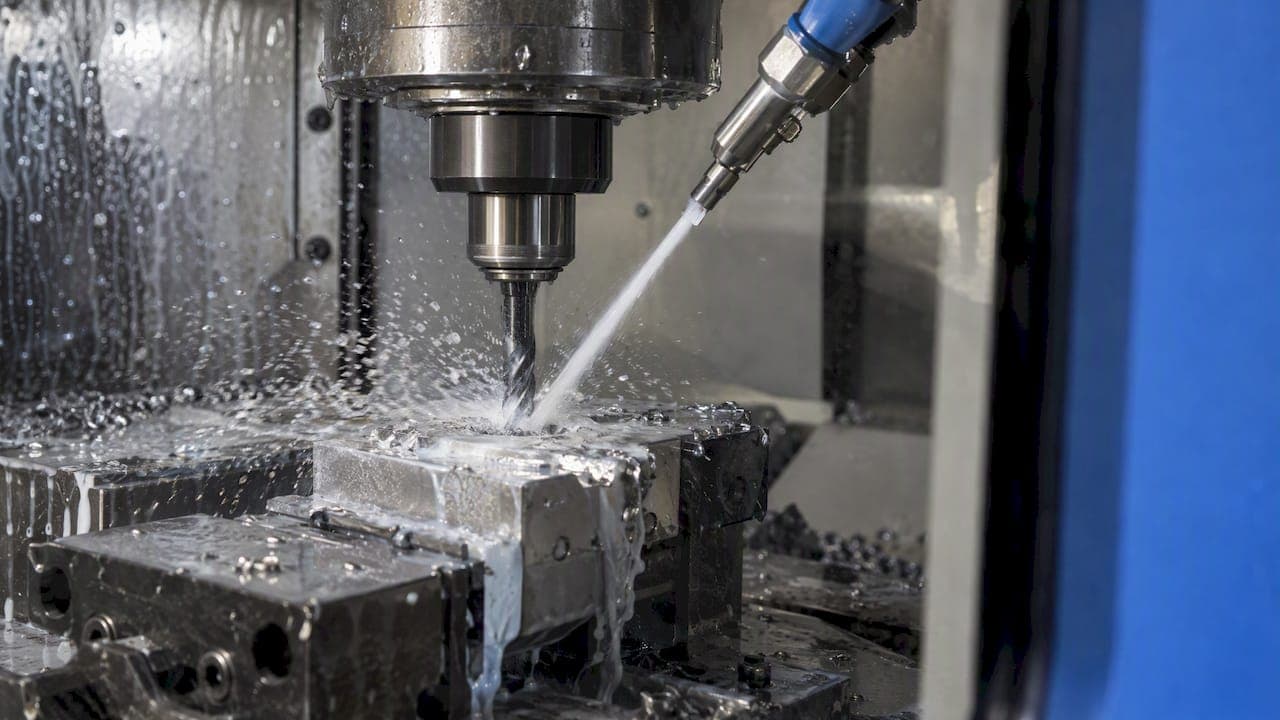
High-pressure coolant (HPC) delivers a focused jet of fluid at the cutting edge, and the payoff is better chip control, cooler cutting tools, and room to run faster or last longer in the same cut. The gains are biggest in drilling, turning, and tough materials like stainless and Inconel, and they depend on the jet being aimed at the right spot with tooling built for it. This guide covers what HPC does, where it earns its keep, what the setup requires, and how to fold it into your cutting parameters.
TL;DR
- HPC improves chip evacuation and chip control, which cuts stoppages and protects surface finish, especially in drilling and turning.
- A high-velocity jet shortens the tool-chip contact length, which helps reduce cutting forces and temperature.
- With HPC properly applied, 300-series stainless has been milled at 800 sfpm against a median of 325 to 350 sfpm.
- The benefits are only fully realized with tooling designed for precision coolant delivery, plus enough pump flow and clean, filtered fluid.
- Treat HPC as a change to your cutting data: re-run feeds, speeds, power, and tool life targets, then log what you see.
Table of Contents
- What high-pressure coolant does at the cutting edge
- The main benefits
- Where HPC pays off most
- What you need to run HPC well
- Safety with high-pressure coolant
- How to fold HPC into your cutting parameters
- Perspective
- Plan and track your HPC upgrade
- FAQ
- Sources
What high-pressure coolant does at the cutting edge
Flood coolant washes over the part. High-pressure coolant is aimed. The nozzle or through-tool channel puts a fast, narrow stream exactly where chip, insert, and workpiece meet.

Machines commonly offer standard HPC capability of 70 to 80 bar (1,015 to 1,160 psi), and some deliver up to 150 bar (2,176 psi). Many shops also run lower-pressure through-spindle systems: Haas, for example, offers 300 psi and 1,000 psi through-spindle coolant options. Which tier fits depends on your tools, your holes, and your material.
Three mechanisms explain most of what you will see on the floor:
- Cooling and lubrication where it counts. The jet reaches the interface instead of the surrounding steel.
- Shorter contact length. A high-velocity jet shortens the contact length between insert and material, which helps reduce cutting forces and lower temperature.
- Chip handling. The fluid carries chips out of the cut so they are not recut or packed into a flute.
The main benefits
Better chip control and evacuation
This is the benefit most shops notice first. Sandvik Coromant lists improved chip control and evacuation among the main advantages of HPC, alongside higher cutting speed and better machine utilization.
There is a nuance worth knowing. One trade-press analysis argues that HPC works less by physically breaking chips with force and more by cooling the tool so chips curl and break. In practice that means the jet position and the chip breaker geometry work together. If you fight long stringy chips in gummy material, read our guide to chip evacuation problems, causes, and chip breaker choices alongside any coolant change.
Longer tool life and less thermal shock
Heat kills edges. HPC helps by holding a more consistent temperature in the cutting zone, which matters most in interrupted cuts such as milling. Reporting in CTE Magazine describes HPC as minimizing damaging thermal shock to cutting tools by keeping that temperature steady.
For a sense of scale in turning, a trade-press report on directed high-pressure toolholders describes productivity gains or tool life increases of as much as 50 percent with 1,000 psi supply and nozzles placed close to the cut. Treat that as a ceiling reported for a specific toolholder system, not a promise for every job. Your own tool life log is the real answer.

Higher cutting speeds and productivity
Cooler edges and cleaner chip flow let you push the speed. In one published example, 300-series stainless was milled at 800 sfpm with properly applied HPC, against a median of 325 to 350 sfpm. That is a large jump, and it came with correct application, so do not copy the number into a program without testing on your machine and tooling.
Better machine utilization
Fewer chip jams means fewer feed holds, fewer broken drills, and fewer trips to clear the work area. Sandvik Coromant also notes that quick-change tool holders with through-coolant connections remove the need for manual coolant nozzle adjustments, which raises utilization and cuts setup time.
Surface finish and deep-hole capability
Haas describes through-spindle coolant as essential for deep-hole drilling and deep pocketing, keeping tools lubricated and free of chips, and links it to heavier cuts, higher feedrates, and better surface finish. If a deep hole is your bottleneck, HPC is usually the first lever to look at.
Where HPC pays off most
Not every operation benefits equally. This summary pulls together the sources above.
| Operation or material | Why HPC helps | What to watch |
|---|---|---|
| Drilling, especially deep holes | Flushes chips out of the flutes and cools the cutting lips | Needs through-coolant drills and enough flow |
| Turning | Targeted nozzles direct the jet under the chip, aiding chip breaking | Nozzle aim and chip breaker geometry |
| Hard-to-break chips (Inconel, Super Duplex) | Per Sandvik, turning and drilling in these materials benefit most | Tooling must be developed for precision coolant |
| Milling stainless | Higher sfpm possible with proper application | Interrupted cuts mean heat cycling; keep temperature steady |
| Deep pockets | Clears chips that would otherwise be recut | Through-tool coolant, plus clean fluid |
What you need to run HPC well
Buying a pump is the smaller part of the job. The benefits are only fully realized with tooling designed for precision coolant delivery, such as drills with through-coolant channels or turning tools with targeted nozzles.
Flow, pressure, and horsepower
Pressure alone is not enough. A published rule of thumb calls for 0.5 gallons per minute per machine-tool horsepower for milling and turning, and 10 gallons per minute per inch of drill diameter for drilling. Check that against your pump and your spindle.
For retrofit planning, one industrial supplier's engineering write-up estimates that a 1,000 psi, roughly 9 GPM system typically needs a 7.5 hp motor. Packaged units exist for smaller machines too: the Chipblaster F-30, for example, is a fixed-rate high-pressure unit for machine tools up to 20 hp. Confirm your own machine builder's requirements before buying anything.
Concentration and filtration
Clean, properly mixed fluid is not optional at high pressure. The same trade-press source recommends coolant concentration of at least 8% and no more than 12%, with HSK manufacturers recommending filtration down to 5 µm. Dirty fluid clogs small coolant channels and wears pumps. Our guide to cutting fluid management and daily checks covers the routine that keeps fluid ready for HPC.
Typical retrofit components
A retrofit through-spindle skid typically includes a high-pressure pump, dual-stage filtration, a relief or bypass valve, and a reasonably sealed enclosure. Spec the filtration before you spec the pump.
Safety with high-pressure coolant
Atomized fluid behaves differently from a flood stream. High-pressure atomized water-soluble coolant carries an elevated fire and explosion risk. Run it in a reasonably sealed enclosure with a mist collector or demister, and read the coolant supplier's safety data sheet and the machine builder's safety bulletin before commissioning. Add a relief or bypass valve to the system so a blocked tool cannot overpressure the line.
Wear eye protection when working near any pressurized line, and never inspect a nozzle with the pump running.
How to fold HPC into your cutting parameters
HPC does not simply bolt on. It changes what is possible, so your numbers should change too. A sensible sequence:
- Baseline first. Record current speed, feed, tool life, and cycle time on one repeat job with flood coolant.
- Raise speed in steps. Increase surface speed gradually rather than jumping to a headline figure.
- Recalculate chip load. Faster cutting changes the chip you form. Our chip load calculation guide gives the formula.
- Check power and deflection. More aggressive parameters raise spindle load and push long tools. Run a tool deflection check before committing to a deep, fast cut.
- Log tool life. Record wear per part so you can show the shop whether the pump paid for itself.
- Look at the toolpath. Cooler, cleaner cutting makes higher-engagement strategies safer. See our notes on toolpath optimization and high feed milling.
If you are weighing HPC against minimal-lubrication options for certain jobs, our MQL machining guide explains dosage and setup so you can decide per operation.
A simple payback frame
You do not need a spreadsheet full of guesses. Compare three numbers on the same job before and after: parts per edge, cycle time, and scrap or rework. Multiply the cycle time saved by your shop rate and the edges saved by their cost. If the total over a quarter beats the system cost, the case is made. If it does not, the data tells you whether the issue is tooling, flow, or fluid condition.
Perspective
We built Availzye Machinist Pro around one observation: the best shops treat a coolant change as a parameter change, and then they write down what happened.
HPC shifts chip formation, heat, and tool wear all at once. That makes it a good fit for the physics-based calculators we provide, including feeds and speeds, chip thinning, power and torque, and tool deflection, because you can test a new setup on paper before you risk a tool or a spindle.
It is also a shop management question. When you add a pump, through-coolant tooling, or a new filter, you need the tool life log, the maintenance log, and the job record in the same place, so the result is visible to the whole team instead of living in one machinist's head. Our platform is designed to keep those pieces in a single cloud-synced application so you are not switching between spreadsheets, paper logs, and separate apps.
That is how a shop turns a promising coolant upgrade into a repeatable, documented gain.
Availzye
Plan and track your HPC upgrade
Before you change coolant, set a baseline. Availzye Machinist Pro combines the calculators you need to model new cutting data with a Tool Crib for tool life logging and low-stock alerts, a Maintenance Tracker for pump and filter service, and a Job Tracker for results by work order. Plans are 9.99 CAD per month (Individual), 24.99 CAD per month (Small Shop), and 49.99 CAD per month (Team), with a 7-day free trial. Start your free trial and see the plans.

If you want to start with a single calculation, try the Tool Deflection calculator on your longest tool, or ask the AI Assistant for machining guidance on a tough material.
FAQ
Is high-pressure coolant worth it for a small shop?
It can be, if your work includes deep holes, tough alloys, or recurring chip jams. The gain comes from fewer stoppages, longer tool life, and faster cutting. Test it on one repeat job and compare parts per edge and cycle time before you commit to a bigger system.
What pressure counts as high-pressure coolant?
Definitions vary by builder. Standard machine capability is commonly 70 to 80 bar (1,015 to 1,160 psi), and some machines reach 150 bar. Through-spindle options such as 300 psi and 1,000 psi are also common in US shops.
Do I need special tooling?
Yes, for full benefit. Drills with through-coolant channels and turning tools with targeted nozzles are built to use the jet. Without them, much of the extra pressure is wasted. Check the tool maker's recommended coolant pressure and flow for each tool.
Does HPC replace the need for good chip breakers?
No. The jet and the chip breaker work together, and the cooling effect is what helps chips curl and break. If chips still pack, review insert geometry, feed, and nozzle aim as well as pressure.
Sources
- Sandvik Coromant: Machining with coolant
- Production Machining: High-Pressure Coolant Improves Profits and Productivity
- Production Machining: Chip Control With Coolant
- CTE Magazine: The Pressure's on to Improve Drilling
- Haas: Through-Spindle Coolant, 300 psi (21 bar)
- Chipblaster F-Series high pressure coolant datasheet
- Industrial Monitor Direct: High-pressure through-spindle coolant pump system