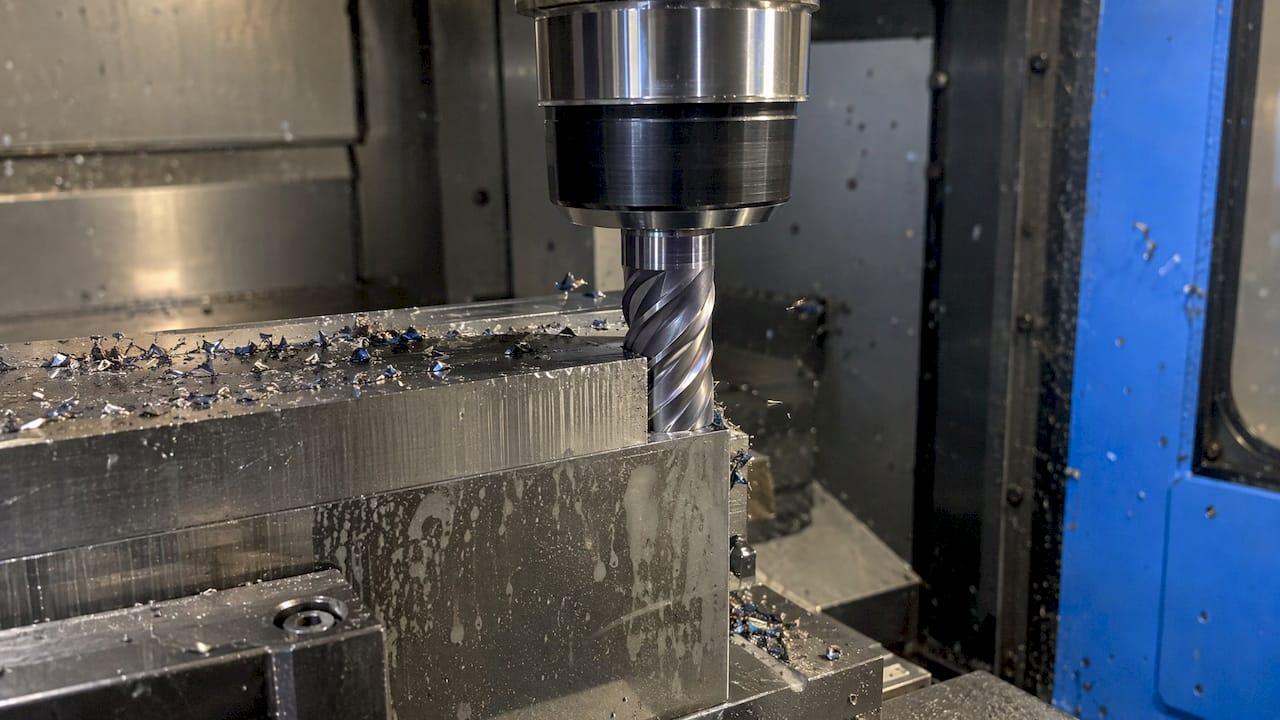
A variable helix end mill gives each flute a slightly different helix angle, so the flutes strike the workpiece at different moments along their length. That keeps the cut from settling into one repeating vibration. The payoff is mostly in roughing, where the tool can take a deeper axial cut with less chatter. Pair the tool with feeds, speeds and a chatter check built for it, and you get the benefit. Run it with numbers from a uniform-helix tool, and you leave most of it unused. Our Feeds & Speeds calculator is built for that second step.
TL;DR
- Variable helix means a different helix angle on each flute. Variable pitch (also called variable index) means uneven spacing between flutes. Many tools combine both.
- Both break up the regular tooth impacts that feed chatter. Helix works along the flute, pitch works around the circumference.
- The clearest gains come in roughing: more depth of cut, higher feed, sometimes one fewer finishing pass. Light skim cuts see little advantage.
- Match the helix range and flute count to the material. Then recalculate feed per tooth and check engagement before you run it.
- Expect to pay roughly 20 to 25 percent more per tool than standard geometry, and run it in a rigid machine.
Table of Contents
- What a variable helix end mill is
- How it reduces chatter
- Roughing versus finishing
- Materials where variable helix helps
- Choosing flute count and helix angle
- Setting feeds and speeds for a variable helix tool
- Where variable helix goes wrong
- Run the numbers in one place
- Our view
- FAQ
- Sources
What a variable helix end mill is
Helix angle is the angle between the tool centerline and a line tangent to the cutting edge, as Harvey Performance defines it. On a standard end mill, every flute has the same angle. On a variable helix tool, ISCAR describes different flutes carrying different helix angles. A 4-flute example from one tooling maker runs 38°, 37°, 39° and 35°. The differences are small, a few degrees, but they are enough that each flute engages the part at a slightly different rate along its axial length.
ISCAR also separates this from a "varying helix," where the angle changes along the length of a single flute. When a catalog says "variable," read the description to see which one you are buying.
Variable helix, variable pitch and variable index
These terms get mixed up on shop floors and in forum threads. The practical split:
| Feature | What changes | Where it acts |
|---|---|---|
| Variable helix | Helix angle differs flute to flute | Along the flute: how each edge engages axially |
| Variable pitch / variable index | Spacing between flutes around the circumference is uneven | At the tool face: when each edge arrives |
| Both together | Angle and spacing both vary | Two independent mechanisms against chatter |
Harvey Performance defines pitch as the radial separation between cutting edges at a given point along the length of cut. Variable pitch makes that separation non-constant, which helps break up harmonics. W.C. Chapman's write-up puts the combination plainly: helix variation acts at the engagement level, pitch variation at the spacing level, and used together they attack chatter two ways. That is why you see "variable helix, variable index" on so many 4, 5 and 6 flute catalog pages.
So if someone asks whether a variable pitch end mill is the same thing, the answer is: related, often combined in one tool, but not identical. Check the spec for both.
How it reduces chatter
Regenerative chatter builds when each tooth cuts the wavy surface left by the previous one, and the tooth passing frequency lines up with a resonance of the tool, holder or machine. A uniform tool delivers impacts at perfectly regular intervals, which is the ideal way to feed that vibration.
A variable geometry tool spoils the rhythm. Harvey Performance describes differently spaced flutes as creating different time intervals between edge contacts instead of simultaneous contact on every rotation. Cutting Tool Engineering quotes an end mill engineer saying variable helix does for harmonics what variable pitch does: it breaks up the pattern that leads to chatter. The axial force on the tool keeps shifting, so it never locks into one frequency.
Two things from the academic side help you set expectations:
- Research from the University of Sheffield and collaborators on stability prediction for variable pitch and helix tools found that the benefit depends on tool geometry and the machine's structural dynamics. They also noted that run-out and differences between the designed and as-ground geometry affect real results. In practice: a good holder, low run-out and a rigid setup are part of the tool's performance.
- A 2006 CIRP paper on helix angle and chatter shows that helix angle shapes stability at specific depths of cut, tied to the helix pitch. Stability is not a simple "more depth, more chatter" line.
The takeaway is that a variable helix tool widens your stable window. It does not remove the need to choose speed and engagement sensibly. If you want to see how stable pockets of RPM work, we cover it in our guide to chatter stability lobes and in three quick stability lobe checks.
Roughing versus finishing
This is where most buying decisions get made.
Roughing: where variable helix earns its price
Roughing is about metal removal rate. A 2004 article in Cutting Tool Engineering reports that variable-geometry end mills can, in some cases, double, triple or even quadruple the depth of cut. Its example is a slot in 4340 steel cut two diameters deep at surface speeds above 600 SFM. The same article says they can raise width of cut and feed rate too.
A more recent, measured case: American Machinist reported that ISCAR's varying-helix end mills raised material removal in rough shoulder milling of austenitic stainless from 9.17 to 20.05 cm³/min. Tool life went from 30 to 45 pieces, with the main gain coming from doubling the depth of cut. Those are one manufacturer's results on one job, so treat them as a direction, not a promise. They do show what the geometry is for: letting you take the deeper cut.
For roughing, fewer flutes give more chip room. PrecisionFab's selection guide ties roughing to rapid removal and fewer flutes for chip clearance. If you are slotting or pocketing deep, chip evacuation is as important as vibration.
Finishing: a smaller, different advantage
The same CTE article notes that a variable-geometry tool can leave a finish equal to or better than a light finishing pass with standard geometry. Sometimes that lets you skip a pass. For light skim cuts, though, it says they usually offer little advantage. Finishing generally favors more flutes: the PrecisionFab guide gives an example where a Ra 3.2 µm drawing tolerates a 3-flute pass, while Ra 0.8 µm calls for 5 to 6 flutes with a reduced chip load.
A workable rule for the floor:
- Heavy roughing, deep slots, long reach: variable helix, 3 to 5 flutes depending on material and chip room.
- Semi-finish and one-pass rough-and-finish: variable helix with a higher flute count, where chatter marks were your reason for an extra pass.
- Light finish passes at shallow depth: standard geometry is usually fine; the variable tool's advantage is small.
If you need to verify what a given finish should be, the Ra calculator inside the platform helps you tie surface finish to feed per tooth and corner radius before you commit to a flute count.
Materials where variable helix helps
Steel, stainless and hardened material. Travers Tool calls variable helix end mills a first choice for production and high-performance machining and for difficult materials such as stainless and heat-resistant superalloys. PrecisionFab says variable helix is standard on modern roughing tools for steel and hardened steel, where uniform-helix tools hit vibration at their depth-of-cut limits. Redline Tools describes its variable helix, variable index lines as made for chatter-free performance in steel, stainless, alloy and hardened applications.
Aluminum. Harvey Performance's aluminum guide says variable helix tools are available and a good choice for reducing chatter and harmonics while raising removal rates. Aluminum tools usually pair this with a high helix angle and few flutes for chip evacuation. A published example from a Harvey Tool material overview uses roughly 42° for aluminum and about 34° for high-temperature alloys. Treat the numbers as a rough illustration and confirm against the tool maker's own spec sheet.
The CTE article makes the underlying point: the geometry has to be matched to the workpiece material, with higher helix angles allowing more aggressive feeds in nonferrous metals.
Titanium and superalloys. Lower helix angles strengthen the flute and handle heat better, which is why the material-specific tool families sit at the lower end of the range. Some variable pitch ball nose tools are made for finishing and are labeled not for traditional slotting or roughing, so read the product description for the operation it was designed for.
Precision work in brittle materials is a different discipline, but the stability principle is the same. If your shop quotes tight-tolerance parts, the CNC glass machining page shows how engineers frame tolerances and RFQ requirements for demanding components.

Choosing flute count and helix angle
The trade-offs are consistent across tool makers:
- Higher helix angle: better chip evacuation, higher speeds and feeds, better finish. Conical End Mills notes the opposite end, lower helix, strengthens flutes for roughing and hard materials. ANCA's grinding guide says high-helix tools tend to chatter more, which is where variable geometry helps.
- Fewer flutes: more chip space, suited to softer materials like aluminum, brass and plastics. More flutes: a stronger core, smoother cuts, suited to harder materials and finishing, per Productivity Inc..
- Spindle and machine: the 2004 CTE article advises at least a 40-taper spindle to use variable-geometry tools effectively, and puts their price at about 20 to 25 percent above standard geometry. That is a 2004 figure, so compare against current catalog prices, but the ratio is a useful budget guide. Vendor listings today range from the mid-teens in dollars for a basic 4-flute to well above that for coated and corner-radius versions.
A quick selection routine
- Name the operation: slot, pocket, shoulder, profile, finish.
- Name the material and hardness.
- Pick the flute count that leaves enough chip room for the depth you plan to take.
- Pick a variable helix tool whose spec lists the material group you are cutting.
- Check your holder and stick-out. Run-out and overhang undo geometry.
- Calculate the numbers (next section) rather than copying the catalog's top-end figures.
Setting feeds and speeds for a variable helix tool
This is the step that decides whether the geometry pays off. Catalog numbers are starting points, and they assume a rigid setup that your machine may not match.
Step 1: Start from the tool maker's surface speed and chip load. Pick the line for your material. Variable helix tools often list higher axial depths than standard tools.

Step 2: Convert to RPM and table feed. The flute count drives feed rate, so a 5-flute tool and a 3-flute tool at the same chip load run very different table feeds. Our guide to feed per tooth versus feed per revolution walks through the conversion. The Feeds & Speeds calculator does it for you, so you are not redoing the arithmetic on paper for each tool.
Step 3: Correct for chip thinning. At light radial engagement the actual chip is thinner than your programmed feed per tooth, so the tool rubs instead of cutting. This matters on variable helix tools used in high-speed roughing with small stepovers. The platform's Chip Thinning calculator adjusts feed for radial engagement, and our article on fixing chip thinning shows how much feed that can recover. For low stepovers specifically, see radial engagement milling at 10% stepover.
Step 4: Check deflection. A deeper cut means more force, and long, small-diameter tools bend. The Tool Deflection calculator estimates how much the tool will move at your stick-out and load, so you can shorten reach or trim the depth before the part is scrap.
Step 5: Check power and chatter risk. Taking double the depth of cut doubles the load on the spindle. The Power & Torque calculator shows whether your machine has it, and the Chatter Prediction tool helps you pick spindle speeds with room to spare. Our write-up on trochoidal milling parameters and high feed milling covers toolpath strategies that suit these tools.
Step 6: Log what happened. Record the tool, material, parameters and parts per tool. With the Tool Crib's tool life logging, you can see whether a variable helix end mill's higher price is returning more parts per edge in your own shop, and low-stock alerts keep you from running out of the one tool a job depends on.
If you are comparing G-code from CAM against what the tool can take, the G-Code analysis feature lets you review programmed feeds and engagement before the program reaches the machine.
Where variable helix goes wrong
- Treating it as a cure for a weak setup. Loose holders, long stick-out and run-out reduce the benefit, as the stability research notes.
- Using standard-tool parameters. Running the same shallow depth as your old tool wastes the geometry. Running a deeper depth without a power check stalls the spindle.
- Buying for the wrong operation. Some finishing-style variable pitch tools are not meant for slotting.
- Ignoring chip evacuation. A high flute count in a deep slot packs chips even when the vibration is gone.
- Mixing up terms when ordering. Confirm whether the catalog means variable helix, variable pitch, or both.
Run the numbers in one place
Variable helix tools reward careful math: the right chip load for the flute count, corrected for chip thinning, checked for deflection and spindle load. Availzye Machinist Pro puts the Feeds & Speeds, Chip Thinning, Tool Deflection, Power & Torque and Chatter Prediction calculators in one cloud-based app, next to the Tool Crib and Job Tracker. There are three plans: Individual at 9.99 CAD per month, Small Shop at 24.99 CAD per month and Team at 49.99 CAD per month, with a 7-day free trial. You can see them on the Availzye Machinist Pro plans page.
The Tool Database keeps your end mill specs together, so helix, flute count and cutting data are on hand when you set up the next job. You can look at the Tool Database to see how it fits your tool list.
Our view
Variable geometry is one of the cases where a better tool only pays when the numbers around it are right. A shop that buys a 5-flute variable helix end mill and runs it at the old feed and depth has paid more for the same result.
We built Availzye Machinist Pro around that gap. Feeds and speeds, chip thinning, deflection, power and chatter prediction sit in one application, so the person at the machine can take a catalog starting point and turn it into parameters for their own spindle, holder and stick-out.
The shop-side tools matter just as much. Logging tool life in the Tool Crib and tracking jobs in the Job Tracker turn "this tool seems to last longer" into a number you can show the owner when you order the next box.
Our aim is simple: fewer scrapped parts, fewer guessed feeds, and tooling money that goes where it pays back.
Availzye
FAQ
What is the difference between variable helix and variable pitch end mills?
Variable helix changes the helix angle from flute to flute. Variable pitch, also called variable index, changes the spacing between flutes around the tool. Both disturb the regular timing of tooth impacts, and many catalog tools use both together.
Are variable helix end mills only for roughing?
No, but roughing is where the gains are clearest, since the tool can take more depth, width and feed. They can also leave a good finish and sometimes save a finishing pass. On light skim cuts the advantage is usually small.
Do variable helix end mills work in aluminum?
Yes. Tool makers offer variable helix tools for aluminum, typically with a higher helix angle and fewer flutes for chip evacuation. They are used to cut chatter and raise removal rates.
Do I need different feeds and speeds for a variable helix tool?
Use the tool maker's data for that exact tool as the start, then adjust for your machine. Calculate feed from chip load and flute count, correct for chip thinning at low radial engagement, and check deflection and spindle power if you increase the depth of cut.
Sources
- ISCAR Milling Applications and Cutter Basics Guide
- Harvey Performance: The Anatomy of an End Mill
- W.C. Chapman: Killing Chatter, How End Mill Geometry Fights Vibration
- Harvey Performance: How to Extend the Life of Your End Mill
- Cutting Tool Engineering: Don't Hack Away at Chatter Problems
- White Rose Research: Analytical prediction of chatter stability for variable pitch and helix tools
- CIRP 2006: Influence of Mill Helix Angle on Chatter
- Cutting Tool Engineering: Variations on a Theme (2004)
- American Machinist: Breakthrough Endmills Varying Helixes Boost Performance
- PrecisionFab: End Mill Selection
- Travers Tool: Choose the Right Helix Angle
- Redline Tools: 4, 5 & 6 Flute Variable End Mills
- Harvey Performance: Attacking Aluminum
- Material-specific end mill overview
- Conical End Mills: End Mill Selection Guide
- ANCA: Guide to Grinding a High Performance Endmill
- Productivity Inc.: Selecting the Right End Mill